
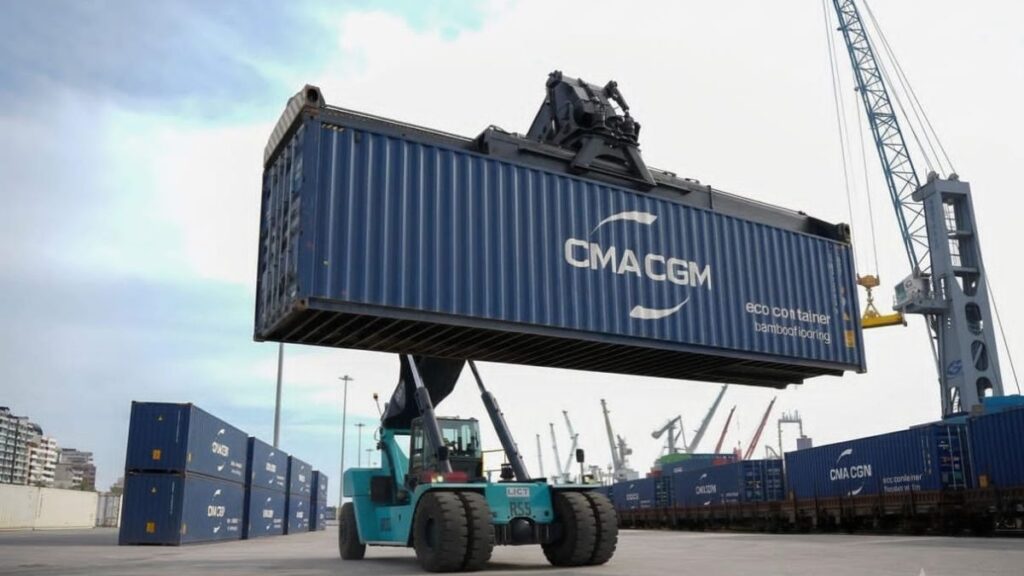

Syria’s transport and logistics sector is entering a new phase as French shipping group CMA CGM expands its investments beyond operating the container terminal at Latakia Port to projects linking seaports with dry ports, border crossings, and transport networks.
The expansion is putting Syria’s logistics infrastructure to the test, particularly its ability to restore the country’s role in regional trade.
CMA CGM strengthened its presence with the July 8, 2026, announcement, made during French President Emmanuel Macron’s visit to Damascus, of a partnership covering dry port projects in Damascus and Aleppo, a logistics zone at the Nasib border crossing (Daraa, southern Syria), and the development of air freight facilities at Damascus International Airport. The partnership also includes a plan to rehabilitate Syria’s railway network.
The move follows an agreement signed in May 2025 between the body overseeing Syria’s ports and the French company to develop and operate the container terminal at Latakia Port for 30 years, with investments totaling €230 million.
The 2025 contract provides for an investment of €30 million during the first year and €200 million over the following four years. The funding will be used to build a new 1.5-kilometer quay with a depth of 17 meters, allowing the port to receive larger ships and increase its operating capacity.
However, during Macron’s visit, Syrian President Ahmed al-Sharaa announced that the company had decided to provide €200 million, 14 months after the contract was signed. Since the 2025 agreement stipulated that the amount would be invested over the following four years, the announcement suggests that this part of the investment will be accelerated.
Beyond the figures and investments, the French company’s expanding role raises questions about Syria’s ability to transform the development of a single port into an integrated transport system capable of reshaping the country’s commercial position in the region.
From Terminal Operations to an Investment Partnership
CMA CGM’s relationship with Latakia Port began in 2009, when it signed its first contract to manage and operate the container terminal through a consortium that included Terminal Link and Syrian partners. Investments at the time totaled about $45.9 million, but the new agreement differs from the previous contract.
Strategic maritime transport expert Dr. Adnan Haj Omar told Enab Baladi that the key difference between the two contracts is the transition from operating a container terminal to developing an integrated transport system.
He added that the new agreement allocates 60% of revenues to the Syrian state and 40% to the company. These shares may be adjusted in line with changes in container traffic. The contract is also subject to Syrian investment law and includes an international arbitration clause.
New Quay Marks the Beginning of the Transition
Most of the project’s investment is focused on building a new maritime quay measuring 1.5 kilometers in length and 17 meters in depth. These specifications would allow the port to receive larger container ships than it currently handles.
Haj Omar said developing the port goes beyond constructing the quay and requires upgrades to the operating system, including:
- Ship-to-shore gantry cranes and yard cranes.
- Digital operating systems.
- Electronic integration with customs services.
Haj Omar estimated that these investments could increase the port’s annual capacity from around 500,000 containers to between 2.5 million and 3 million containers.
However, he explained that these figures are “analytical estimates, not final official figures,” and that reaching them depends on implementing all elements of the project, rather than constructing the quay alone.
“The quay alone is not enough. Operations require modern equipment, operating systems, and personnel capable of managing the port according to international standards.”
Adnan Haj Omar
Strategic maritime transport expert
From the Port to a Logistics Network
The agreement signed in May 2025 is not limited to developing container operations at Latakia Port. It also includes connecting the port with dry ports in Damascus and Aleppo, as well as the logistics zone at the Nasib border crossing.
Haj Omar believes this connection “could transform Latakia from a maritime transit point into the hub of a national transport network.” Moving containers directly to inland customs clearance centers would also help:
- Transport containers directly instead of allowing them to accumulate at the port.
- Reduce pressure on storage yards.
- Accelerate the movement of ships and goods.
- Shorten shipment waiting times.
- Connect Aleppo to a modern commercial network after years of logistical isolation.
However, Haj Omar said the model’s success depends on developing land transport infrastructure, particularly the railway network.
“Rehabilitating the railway network, which once extended for around 2,800 kilometers but now has only a small portion in operation, is a decisive factor because complete reliance on road transport increases the cost of moving goods.”
Adnan Haj Omar
Strategic expert
Although freight train services have resumed between Latakia Port and the dry port in Adra (Rural Damascus) after a 14-year suspension, the challenge is turning the route into a regular service capable of handling substantial commercial traffic. Haj Omar said this is the government’s responsibility, not that of the investing company.
Can Syria Restore Its Role as a Trade Corridor?
Economist Ammar Youssef believes the agreement’s importance is not limited to the port. It also sends a message about the return of international companies to the Syrian market.
Youssef told Enab Baladi that the presence of a company the size of CMA CGM signals that investment and business activity may be possible in Syria, potentially encouraging other companies to examine the market.
He added that the project could open the way for supply corridors and production chains running through Syria, benefiting from the country’s location between the Mediterranean Sea, Iraq, the Gulf, and Europe. However, he stressed that attracting investment and increasing exports require other factors, including:
- Economic and political stability.
- An improved investment environment.
- Access to energy and financing.
- Infrastructure development.
An Opportunity to Restore Syria’s Trade Role, With Conditions
Despite the project’s importance, Haj Omar warned against treating it as a stand-alone solution to the problems facing Syria’s transport sector.
He noted that Latakia Port faces regional competition from ports including Beirut, Haifa, Mersin, and Port Said, in addition to the need for large-scale investment to rehabilitate infrastructure.
He explained that the project’s success depends on several factors, including:
- Coordination among government institutions to connect the port, customs services, and inland centers.
- Providing a stable and secure operating environment.
- Securing the funding required to restore the national transport network, whose cost is extremely high and far exceeds the size of CMA CGM’s investment.
- Revitalizing commercial activity, as the actual return on investment remains linked to commercial demand for using the corridor.
“Syria has the geographical location and the investment opportunity, but becoming a regional transit hub requires the accumulation and actual implementation of multiple projects, not merely one agreement, regardless of its size.”
Adnan Haj Omar
Strategic maritime transport expert
When Will the Investment Produce Results?
Haj Omar said the agreement’s economic effects will not be immediate, as they depend on completing the new infrastructure and bringing it into full operation.
He said overcoming the project’s challenges could benefit the Syrian economy by:
- Reducing import and export costs by shortening cargo handling times and limiting reliance on expensive road transport.
- Attracting additional foreign investment, as the agreement provides an initial indication that international investors are again showing interest in the Syrian market.
- Creating direct and indirect employment opportunities in the port and logistics sectors.
- Supporting imports and exports and strengthening Syria’s chances of gradually restoring its role as a regional trade corridor.
Haj Omar added that these results “will not appear during the first years,” when work will focus on construction and development. The economic impact is expected to become clearer after the infrastructure is completed and enters service.
A Relationship That Began in Latakia
CMA CGM has deep historical ties to the region. Lebanese-French businessman Jacques Saadé, who was originally from Latakia, founded the group in Marseille, France, in 1978.
The company’s first shipping routes linked Beirut, Latakia, Livorno, and Marseille. It later grew into one of the world’s largest shipping and logistics companies.
After Jacques Saadé died in 2018, his son Rodolphe Saadé took over leadership of the group and oversaw its expansion into maritime transport, air freight, and logistics services.
The current investment in Syria extends this historical relationship with Latakia Port, but it is part of a broader project aimed at developing a logistics network that goes beyond operating a container terminal.