

The Central Bank of Syria announced that it had restored its banking relationship with the Banque de France by reactivating the Syrian central bank’s account there, coinciding with France’s announcement that it had begun returning 51 million euros in seized assets to the Syrian state.
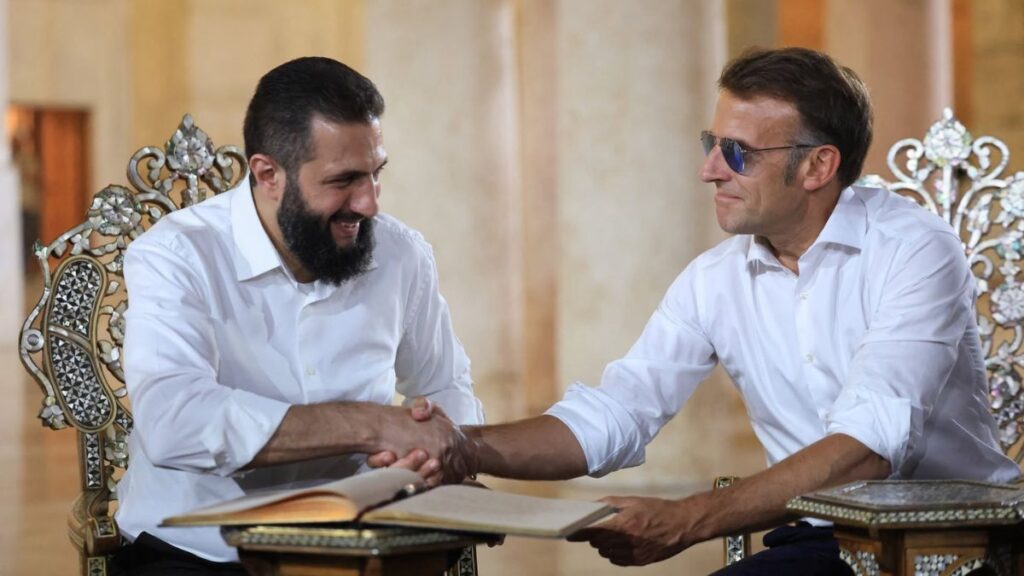
The announcement came as a result of French President Emmanuel Macron’s visit to Syria with an economic and investment delegation.
The Central Bank of Syria said the step would provide an environment for financial and technical cooperation between the two countries’ central banks.
Central Bank of Syria Governor Safwat Raslan and Expertise France CEO Jérémie Pellet signed a memorandum of understanding on Wednesday, July 8, for institutional strengthening, technical support, and capacity building at the Central Bank of Syria.
Recovery of Syrian Assets From France
Speaking to Enab Baladi, Syrian economist and banking expert Dr. Ibrahim Qushji said France’s announcement that it had begun returning 51 million euros, about $58 million, in assets seized from the family of Rifaat al-Assad to the Syrian state is the most prominent direct result of Syrian-French banking coordination.
“These major assets cannot be liquidated or legally transferred without reciprocal accounts and direct communication channels between the two central banks,” he said.
The reopening of accounts makes it possible to direct these recovered funds transparently and in documented form toward projects supporting development and reconstruction, or toward compensation for those affected. This strengthens international confidence in Syria’s new governance mechanisms.
Return to the SWIFT System
Syria spent many years cut off from SWIFT, the global financial transfer system, which paralyzed foreign trade and interbank transactions.
The Syrian academic said the Banque de France represents one of the main pillars of the European Central Bank and serves as a legitimate gateway to facilitate the lifting of technical and legal restrictions on Syrian banking operations.
Reactivating channels with Paris paves the way for remittances from expatriates and foreign companies to flow again through monitored official channels, instead of informal money exchange networks, supporting the supply of foreign currency at the Central Bank of Syria.
Dr. Qushji said France would provide technical assistance aimed at modernizing Syria’s monetary policy tools by activating the partnership between the Syrian Banking Institute and the International Institute of Banking and Finance, affiliated with the Banque de France.
According to the same expert, opening reciprocal accounts allows for:
- Investing Syrian reserves in safe and effective financial instruments.
- Developing foreign exchange systems that prevent harmful speculation, known as hot money.
- Facilitating the movement of serious investment capital.
He explained that reviving the banking partnership between Damascus and Paris goes beyond the narrow technical framework because it represents an international certificate of confidence under which Syria’s financial structure is rebuilt based on modern transparency. It also lays the groundwork for a flexible transition of the Syrian economy from contraction and isolation to openness and attracting capital.
Declaration of Intent to Recover Rifaat al-Assad’s Funds
Syrian President Ahmed al-Sharaa received French President Emmanuel Macron at the People’s Palace in Damascus on Tuesday, July 7, for talks focused on strengthening Syrian and French cooperation.
The meeting saw the two sides sign a number of agreements and memoranda of understanding in several investment fields.
The announced agreements included the signing of a declaration of intent between Foreign Ministers Asaad al-Shaibani and Jean-Noël Barrot regarding funds looted by Rifaat al-Assad, in addition to a comprehensive cooperation framework to strengthen relations between the two countries in several fields.
The Élysée said France had begun the process of returning 51 million euros to Damascus from assets confiscated from the Assad family.
The agreements also included the announcement of a strategic partnership in several fields, focused on maritime and air transport and logistics services. The agreement was signed by Qutayba Ahmed Badawi, head of the General Authority for Crossings and Customs, and Rodolphe Saadé, CEO of the CMA CGM Group.
The two sides signed a declaration of intent in civil aviation, as well as a protocol agreement on managing air cargo handling and marketing air freight services.
Syria signed an agreement with the French Development Agency and Expertise France. The agreements also included a protocol agreement on cooperation in modular water treatment and energy solutions in Homs (central Syria).
A memorandum of understanding was also signed for cooperation in the health sector, in addition to another memorandum of understanding to develop Syrian university hospitals between Syria’s Ministry of Higher Education and the French company Ellipse Projects SAS.
Another memorandum was signed to strengthen economic cooperation and develop trade relations, along with a memorandum of understanding for cooperation in institutional strengthening, technical support, and capacity building for the Central Bank of Syria.