
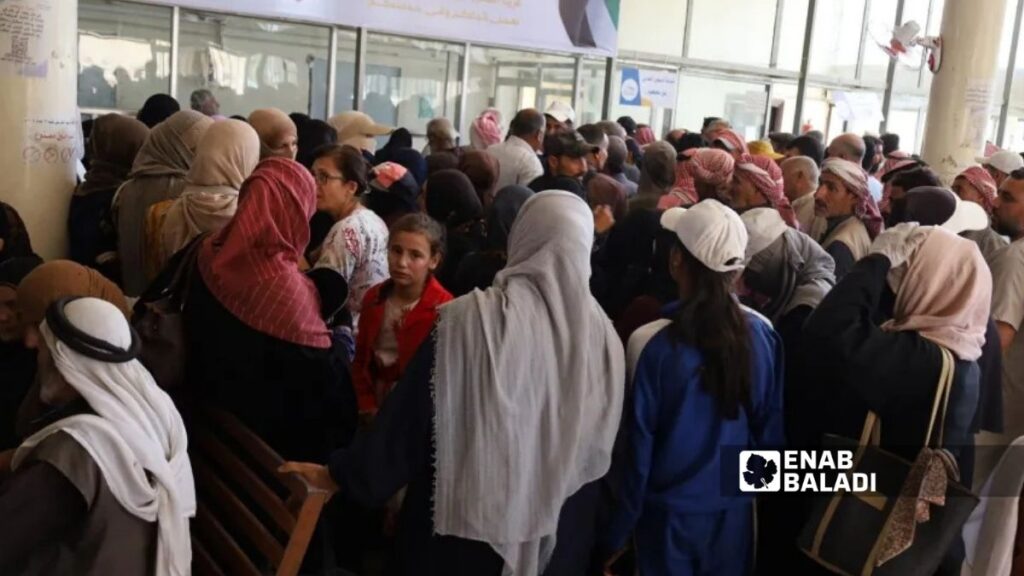

As the Central Bank of Syria’s deadline for replacing old Syrian pound notes with new denominations approaches, al-Hasakah governorate in northeastern Syria is experiencing unprecedented confusion. The replacement process is limited to a single center inside the post office building in al-Hasakah city, forcing hundreds of residents to stand in long lines, while others have converted their savings into US dollars for fear that their money will lose its value after the deadline.
The shortage of replacement centers and scarcity of new currency in the governorate have developed into a multifaceted crisis affecting the foreign exchange market. A parallel market has emerged in which the dollar is sold at different rates depending on whether customers hold old or new Syrian pounds. With no oversight of exchange operations, residents are suffering additional losses while already facing mounting economic pressures.
One Center for an Entire Governorate
Currency replacement in al-Hasakah is restricted to the city’s post office, which began providing the service on June 21, some time after replacement operations had started in most Syrian governorates. This effectively shortened the period available for residents to exchange their money.
As the deadline approaches, the number of applicants has risen sharply, while the center’s capacity has remained limited, causing severe overcrowding and delays in registering appointments and completing transactions.
Mohammad al-Abdullah, an employee from al-Hasakah city, told Enab Baladi that he had visited the post office center several times during the past week but had been unable to replace the full amount of money in his possession.
“Every time I arrive in the morning, I find dozens of people ahead of me. Employees register large numbers of names without providing a clear appointment time. Some of my money is still in the old currency, and I fear I will not be able to replace it before the deadline,” he said.
He added that many residents now spend long hours outside the center without any guarantee that their turn will come because of the heavy pressure on the governorate’s only replacement facility.
A Costly Option
According to Central Bank of Syria instructions, old denominations will cease to be valid for circulation on July 30. After that date, replacements will be restricted to the central bank’s headquarters in Damascus under procedures that will be announced later.
For al-Hasakah residents, this represents an additional burden. Central bank branches in the governorate remain closed, meaning that anyone unable to replace their money before the deadline will have to travel hundreds of kilometers to the capital to complete the process.
Abdul Karim al-Hussein, a trader from southern rural al-Hasakah, said traveling to Damascus to replace the money was “not a realistic option” for many residents.
“The cost of travel and accommodation could consume a large portion of the money we want to replace. Many people therefore preferred to sell their old pounds and convert them into dollars, even at a loss,” he told Enab Baladi.
He said fears surrounding the approaching deadline had prompted many traders to dispose quickly of the old cash they held.
Two Dollar Rates
With time running out, growing numbers of al-Hasakah residents have turned to buying dollars as the fastest way to preserve the value of their savings until the replacement process after the deadline becomes clear.
However, the increased demand has created an unprecedented situation in the foreign exchange market. Some money changers have begun using two different dollar rates depending on which type of Syrian currency is used for the purchase.
On Tuesday, July 28, one dollar was sold for 13,900 new Syrian pounds, while the rate rose to 14,300 old Syrian pounds, a difference of up to 400 pounds per dollar.
Residents who still hold the old currency therefore incur an additional loss when converting it into dollars, on top of the loss caused by having to exchange their money under time pressure.
Khurma Ahmed, a homemaker from al-Hasakah city, said she was forced to buy dollars after losing hope of securing a place in line at the post office center.
“I had saved money over several years for my children’s education. When I saw the long lines and became afraid that the deadline would pass, I bought dollars despite the large difference in the rate because I feared the old pounds would become worthless in the market,” she said.
Ahmed added that many families had made the same decision in recent days despite knowing the losses they would bear.
An Unregulated Parallel Market
Economist Muhannad al-Abdullah said the current crisis was no longer limited to the currency replacement process. It had also produced a parallel currency market in al-Hasakah because of the delayed arrival of new banknotes and the restriction of replacements to one center.
Al-Abdullah told Enab Baladi that the sudden rise in demand for dollars in recent days had significantly increased trading volumes across the governorate. For residents unable to replace their money, the dollar had become a means of protecting their savings.
He said the difference between the dollar’s price in new and old currency “reflects a market imbalance more than a difference in the currency’s actual value,” explaining that money changers had taken advantage of time pressure and residents’ fear of the deadline.
The lack of effective oversight of exchange operations has allowed multiple dollar rates to emerge and created a high profit margin for some market dealers, while residents alone bear the cost of the imbalance, he said.
Al-Abdullah added that a difference of 400 pounds per dollar results in major losses for people holding large amounts of the old currency, as the value of the difference increases with every transaction.
Why Was al-Hasakah Delayed?
Al-Abdullah linked al-Hasakah’s delayed participation in the replacement process to the exceptional administrative conditions the governorate has experienced for months.
Most Syrian governorates benefited from networks of public banks and currency replacement centers during the early stages of the process, while al-Hasakah remained outside the system for an extended period because government banking institutions remained closed, he said.
The post office did not begin providing the service until June 21, later than in other governorates, reducing the time available to residents and causing demand to accumulate during the final weeks, he added.
Al-Abdullah said increasing the number of centers from the beginning could have eased the pressure and prevented the formation of the parallel market that emerged in recent days.
Exceptional Conditions
Al-Hasakah is among the governorates most affected by the currency replacement process because of the continuing administrative division between the Syrian government and the Syrian Democratic Forces, SDF.
Following the fall of Bashar al-Assad’s government in December 2024, government offices, including banks, were closed. Field conditions changed at the beginning of this year, when the Syrian government regained control of large parts of the governorate’s countryside, while al-Hasakah and Qamishli cities and parts of their surrounding areas remained under SDF administration.
Despite the January 29 announcement of an agreement between the Syrian government and the SDF to organize the integration and gradual reactivation of institutions, the agreement has yet to result in the reopening of financial and banking institutions. Central bank branches and public banks therefore remain out of service across the governorate.
These conditions led authorities to designate the post office as the only outlet for the currency replacement process, unlike in other governorates where public banks, foreign exchange companies, and multiple centers participated.
A Race Against Time
On May 31, Central Bank of Syria Governor Safwat Raslan issued a decision extending the deadline for replacing old banknote denominations until July 30. He described it as the “final opportunity” to complete the process, after the nationwide completion rate had surpassed 63% at the time.
In recent days, the central bank also urged residents not to delay replacing their money and to follow information through official channels. It said old denominations would remain replaceable through the central bank for five years after they cease to circulate, under procedures to be announced later.
For al-Hasakah residents, however, time was not the only problem. The limited banking infrastructure, delayed launch of the service, and absence of alternative centers pushed many people to seek individual solutions. These included turning to the dollar and accepting unfavorable exchange rates, or risking waiting until after the deadline and later traveling to Damascus to replace their money.
Amid lines at the post office, fears over the deadline, and rising demand for dollars, al-Hasakah is entering the final days of the currency replacement process under conditions that reflect the governorate’s unique administrative complications. Thousands of residents remain in a race against time to preserve the value of their savings while awaiting solutions that may arrive only after the deadline.