


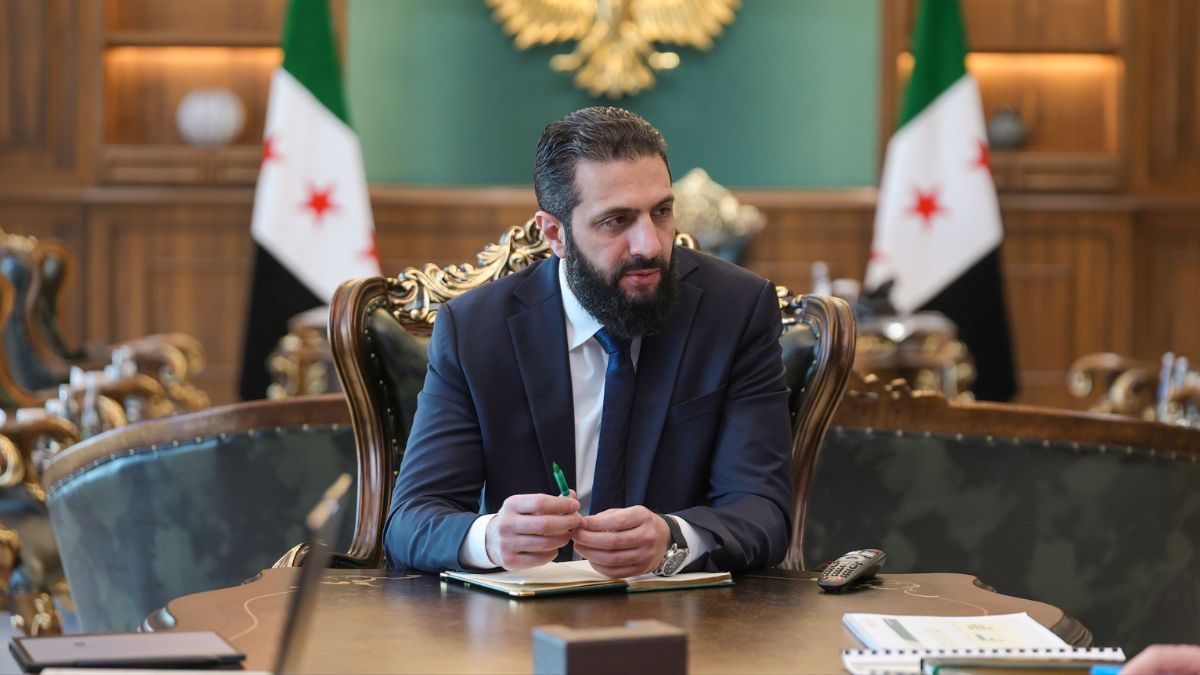
 Syrian President Ahmed al-Sharaa at a small government meeting in the Syrian capital, Damascus, February 19, 2026. (Syrian Presidency)
Syrian President Ahmed al-Sharaa at a small government meeting in the Syrian capital, Damascus, February 19, 2026. (Syrian Presidency)
Syrian President Ahmed al-Sharaa issued Decree No. 149 of 2026, appointing the president and members of Syria’s Supreme Constitutional Court and defining its duties.
According to the text of the presidential decree published by the Syrian Arab News Agency, SANA, on Tuesday, July 7, the Supreme Constitutional Court will be headed by Dr. Issam Khaled al-Khalif and will also include six members alongside al-Khalif.
Al-Khalif serves as deputy head of Syria’s Central Authority for Supervision and Inspection, which is responsible for monitoring and inspecting government institutions to ensure compliance with applicable laws and regulations, improving services provided to citizens, and strengthening trust in government institutions.
The decree named the members of the Constitutional Court as follows:
The presidential decree, according to its text, is based on the provisions of the Constitutional Declaration, particularly Article 47, which states the following:
Article 4 of the decree outlines the main duties the Supreme Constitutional Court will carry out until the law regulating its working mechanism and powers is issued. These duties are:
Before assuming their duties, the president and members of the Supreme Constitutional Court will take the following constitutional oath before the president of the republic:
“I swear by Almighty God to respect the Constitutional Declaration and to perform my duty with honesty and devotion.”
The expenses resulting from implementing the provisions of this decree will be paid from the budget of the Supreme Constitutional Court. The decree will be published and communicated to those required to implement it.
The formation of the Supreme Constitutional Court comes less than a week after the head of the Higher Committee for People’s Assembly Elections, Mohammad Taha al-Ahmad, announced the complementary third of the members of the People’s Assembly. The members were appointed by Syrian President Ahmed al-Sharaa under the constitutional powers granted to him by the Constitutional Declaration.
Under the former regime, the Constitutional and Legislative Affairs Committee in the People’s Assembly had several duties, including reviewing the constitutionality of legislation and draft laws referred by the presidency and the executive authority to the assembly. The committee also gave its opinion and submitted its report on the matter to the assembly for reading under the dome. If the committee decided that a draft law could not be considered because it was unconstitutional, the assembly would refrain from discussing it and return it to the body that had originally submitted it.
The last president of the Supreme Constitutional Court under the former regime was Mohammad Jihad al-Laham, who had previously served as speaker of the Syrian People’s Assembly.
The Supreme Constitutional Court is considered the highest judicial authority in Syria. It previously consisted of five members, one of whom served as court president, and they were named by the president of the republic at the time by decree.
Membership in the Constitutional Court may not be combined with any government post or membership in the People’s Assembly.
if you think the article contain wrong information or you have additional details Send Correction


 A
A
A
A
A
A




 More Politics