


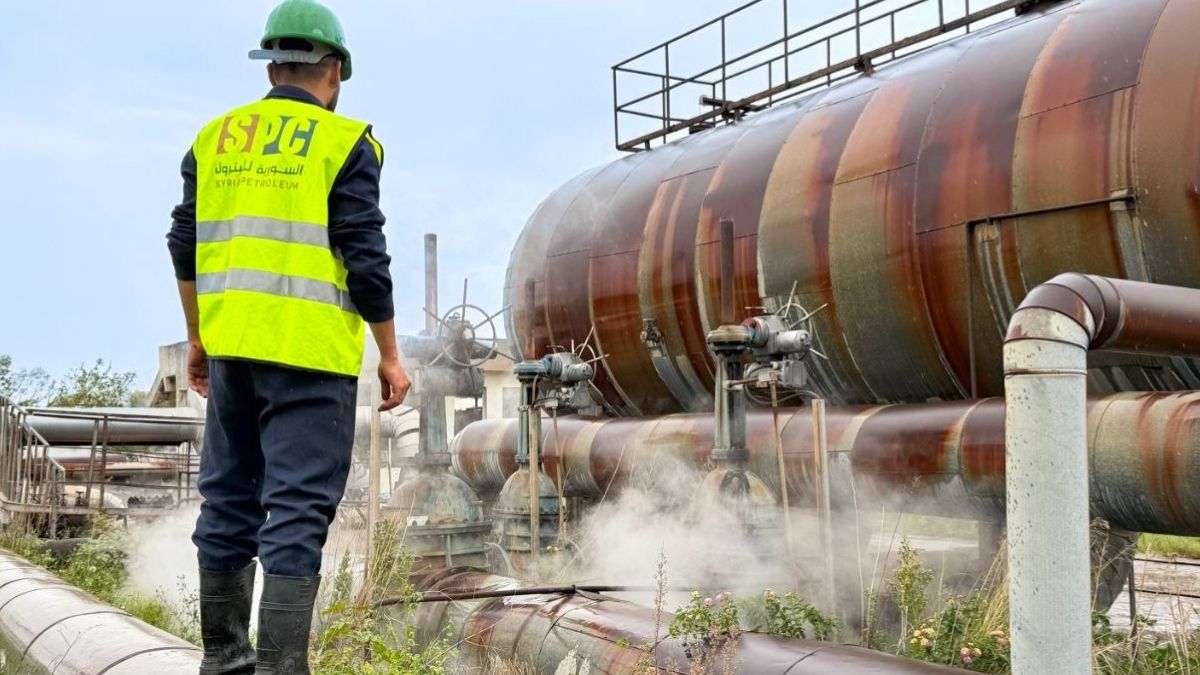
 One of the oil tanks at Baniyas refinery, April 2, 2026. (Syrian Petroleum Company)
One of the oil tanks at Baniyas refinery, April 2, 2026. (Syrian Petroleum Company)
Global oil markets have seen a notable decline in prices in recent days, amid the announcement of a memorandum to halt the war between Washington and Iran, ending a conflict that had caused major disruptions to global energy supplies.
This was quickly reflected in markets, as Brent crude fell by up to 3.1% to below $78 a barrel, its lowest level since the beginning of March. Gasoline prices in some global markets also fell to lower levels than before.
In the United States, gasoline prices fell below $4 per gallon for the first time since March.
The decline came as navigation resumed through the Strait of Hormuz, according to the terms of the agreement. The strait is considered one of the most important strategic routes for transporting oil globally, and its reopening eased fears of supply shortages and higher shipping and insurance costs.
But this global decline was not reflected in fuel prices in Syria, where local prices remained at their levels, even though part of the justification for their earlier rise was linked to changes in global markets.
This reality raises questions about the nature of the relationship between local and global prices, and whether fuel prices in Syria still respond to market factors or have become tied to other economic and financial factors.
The Syrian Petroleum Company raised fuel prices in Syria on May 7 by between 17% and 30%.
At the time, the price of a liter of first-grade diesel rose to $0.88 from $0.75, about 17.3%.
The price of a liter of 90-octane gasoline rose to $1.10 from $0.85, about 29.4%, while a liter of 95-octane gasoline rose to $1.15 from $0.91, about 26.4%.
The price of a household gas cylinder rose to $12.5 from $10.5, about 19%, while the price of an industrial gas cylinder rose to $20 from $16.8, about 19%.
Today, Thursday, June 18, the Syrian pound’s exchange rate against the US dollar stands at 14,230 Syrian pounds for buying and 14,300 pounds for selling.
Economically, falling global prices would be expected to lower import costs in Syria and therefore reduce prices for consumers, but Syrian markets do not fully operate according to this mechanism.
Economist and Hama University professor Dr. Abdul Rahman Mohamed believes that analyzing fuel price behavior in the Syrian market cannot be separated from the distorted economic structure left by more than a decade of war, sanctions, and institutional collapse.
In any healthy economy, price reflects the balance of supply and demand and production costs. In Syria’s current economy, however, price has become a reflection of other balances: the state’s fiscal deficit, the dominance of the war economy, and the complexity of supply chains subject to sanctions.
Therefore, the failure of fuel prices to respond to the global decline, even though part of the previous increase was linked to global pricing, is not a paradox. It is an inevitable result of the multilayered nature of Syria’s crisis.
According to Dr. Abdul Rahman Mohamed, the phenomenon should be read economically from the perspective of a decoupling between the local pricing mechanism and external factors, in favor of the dominance of emergency internal factors. This does not negate economic logic, but confirms that the prevailing logic is now that of a “managed scarcity” economy, not a free market economy.
He explained that this reading is based on the following points:
Rising global oil prices in previous periods led the international market factor to be used as a justification for raising fuel prices locally, but the continuation of high prices despite the global decline in oil indicates the presence of other, more influential factors.
Dr. Abdul Rahman Mohamed explained that linking price increases to global changes was a justification for the policy of lifting subsidies, but the failure to reduce prices clearly reveals the real structural reasons, including:
As a result, import costs are paid in dollars bought from the parallel market, making the exchange rate more influential than the global oil price.
The Syrian Fuel Company said the adjustment of petroleum product prices came in light of continued global increases in oil prices and the costs of supply and shipping, along with repercussions linked to current regional conditions and the additional pressures they have imposed on the energy sector.
As the gap between global and local price movements continues, debate is growing over the need to reform the pricing method, not merely adjust prices.
Economist Abdul Rahman Mohamed suggested that solutions in the Syrian situation cannot be conventional. Rather, they must be gradual and realistic, focusing on managing the crisis before its final resolution, which is tied to a comprehensive political settlement and the lifting of sanctions. These include:
if you think the article contain wrong information or you have additional details Send Correction


 A
A
A
A
A
A






 More Economic Reports