


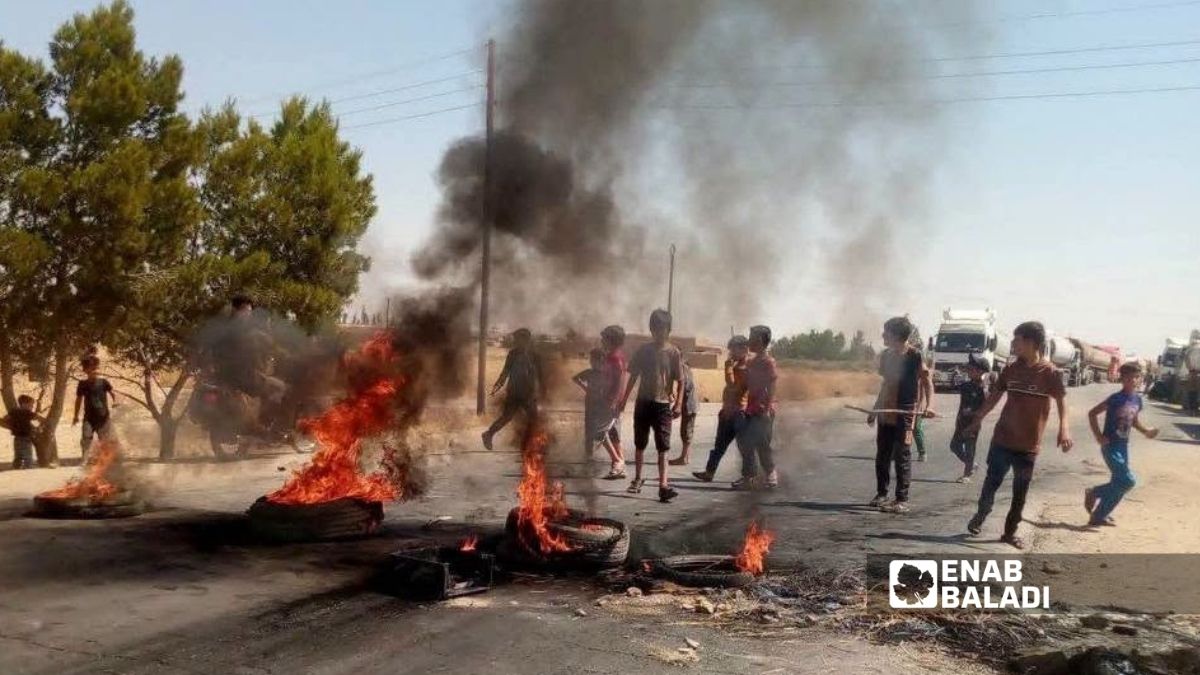
 Protesters in southern Hasakah countryside block a main road in front of oil tankers, 18 June 2025. (Enab Baladi)
Protesters in southern Hasakah countryside block a main road in front of oil tankers, 18 June 2025. (Enab Baladi)
For the second consecutive day, public anger is escalating in the southern countryside of Hasakah (northeastern Syria), as residents continue to block main roads in front of oil tankers heading from al-Jabsa field toward other Syrian areas. The protest movement is becoming sharper and wider in scope, driven by deteriorating living conditions, the absence of fuel, and rising prices for basic services.
According to Enab Baladi’s monitoring, several residents of al-Haddadiya, Daabil, and nearby villages continued today to block the road in front of oil tankers, in a renewed protest demanding fuel supplies for residents, improved services, reconsideration of the case of workers dismissed from al-Jabsa field, and lower prices for basic goods, chiefly diesel.
At the center of the protests, participants say their movement is no longer linked only to high prices, but to what they describe as a near total collapse of services.
Mohammad al-Aboud, one of the protesters from Daabil, told Enab Baladi that what is happening “can no longer be met with silence, as the governorate is living through a comprehensive service collapse,” adding that residents went out today, as they did yesterday, because “all the necessities of life have disappeared.”
Mohammad added, “There is no diesel, no water, no stable supply of bread, and prices are doubling day after day. A water tank that used to be filled for 30,000 liras now costs more than 150,000 liras. We are not asking for luxury, we are only asking to live.”
Blocking the road is “not a goal in itself,” but a means of pressure to make residents’ voices heard after years of deterioration, Mohammad said, noting that “promises no longer convince anyone, because reality is moving in the exact opposite direction.”
This escalation follows the previous day’s actions, when Daabil village witnessed a sit-in and road closure in protest against poor services and rising water and fuel prices, in addition to protests in al-Burayj, north of al-Arishah subdistrict, that demanded better living conditions and an end to what residents described as “the spread of favoritism and corruption.”
In parallel with the protests, the fuel crisis has entered a phase with a deeper impact on daily life, after water tankers in Hasakah stopped operating because their subsidized diesel supplies were cut off. This has led to a near total disruption of water distribution services in several villages and towns.
Suleiman al-Ali, who owns a water tanker operating in the area, told Enab Baladi that stopping work was not a choice, but “an inevitable result of the absence of fuel,” explaining that operating costs have become too high to continue.
Suleiman added, “We buy diesel from the free market at very high prices, reaching 14,000 liras per liter, and there is no support or fair pricing. Sometimes we work at a loss just to cover vehicle maintenance, and this is not possible in the long term.”
He warned that if the current situation continues, all water tankers will go out of service, which, as he described it, would mean “a real thirst crisis in some rural areas that depend mainly on tanker transport.”
The repercussions of the fuel shortage have not stopped in the countryside, but have extended to Hasakah city, where public transport has seen a partial paralysis after dozens of vans, locally known as “fooksat,” stopped operating because they were not supplied with their diesel allocations.
According to a source in the city’s public transport administration who spoke to Enab Baladi, the number of operating vehicles has fallen to about 150 out of 698, while a large number of drivers have not received their allocations for 11 days, causing a severe transport crisis inside the city.
In this context, Ahmed al-Hussein, a driver of one of the vans, told Enab Baladi that continuing to work has become almost impossible under current prices.
The driver added, “We are forced to buy diesel from the black market at multiplied prices, and this increases the cost for both the driver and the passenger. Some of us have reduced the number of trips, and some have stopped completely.”
Transport fares have nearly doubled within a few days, adding to the burden on residents, according to the driver, who noted that “people cannot pay, and we cannot continue operating at a loss.”
He warned that the continuation of the crisis “will lead to a complete halt in public transport within a short period,” unless fuel is provided urgently and regularly.
As the transport crisis overlaps with the halt in water tankers and rising prices of basic goods, the overall picture in Hasakah appears closer to a gradual service paralysis, directly reflected in street protests whose scope is expanding day after day.
Residents’ testimonies reflect the scale of accumulated tension in the area, where many link deteriorating services to the absence of fairness in the distribution of resources.
Ali al-Mohammad, a resident of southern Hasakah countryside, said people “have reached a point where they can no longer endure,” adding, “We are in an area considered among the richest in resources, and yet we are the poorest in services.”
Al-Mohammad added, “Children cannot find clean water, bread is unstable, and unemployment is spreading widely. People went out today because they no longer have anything to lose.”
He believes that ignoring the demands “could lead to a larger explosion,” warning that “the street is no longer under social control as it was before,” referring to the widening circle of anger.
These developments come amid an earlier context documented by Enab Baladi, as Hasakah governorate witnessed similar protests over the past days linked to poor services and the absence of fuel. They coincided with a government announcement that fuel stations in the governorate would begin receiving fuel under a plan it said was intended to support the agricultural sector and ease shortages during the harvest season.
Hasakah Deputy Governor and spokesperson for the presidential team tasked with implementing the 29 January agreement, Ahmed al-Hilali, had confirmed that “the Syrian Petroleum Company began supplying fuel stations with fuel under a joint plan,” noting that the goal was to support the agricultural sector and ensure the continuation of harvest operations.
On the ground, however, according to residents, these measures have not translated into any real improvement in services. Instead, they have coincided with the continuation and expansion of crises, raising new questions about the effectiveness of distribution and mechanisms for reaching beneficiaries.
Between government promises of support, escalating protests, and the halt of basic services, Hasakah governorate appears to be facing an intertwined scene of crises, growing more complicated with each new day amid the absence of tangible solutions to stop the accelerating breakdown in services and living conditions.
if you think the article contain wrong information or you have additional details Send Correction


 A
A
A
A
A
A



 More Society