


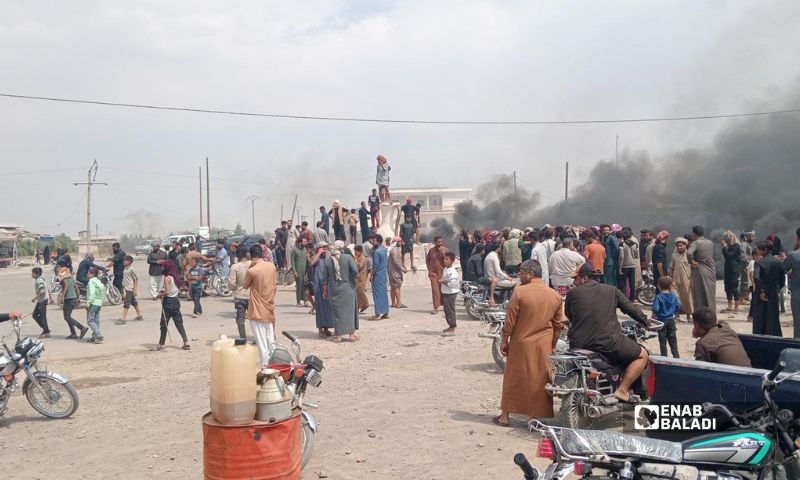
 Protests and road blockades in Raqqa countryside over fuel price hikes, September 13, 2026 (Enab Baladi)
Protests and road blockades in Raqqa countryside over fuel price hikes, September 13, 2026 (Enab Baladi)
The town of Markada (southern al-Hasakah governorate, northeastern Syria) witnessed protests today, Sunday, September 13, against a decision to raise fuel prices. Protesters burned tires and blocked the main road linking al-Hasakah and Deir Ezzor governorates, which passes near the town, demanding that the decision be reversed.
The protests spread to a number of towns and villages in the countryside of al-Hasakah, Deir Ezzor and Raqqa, where protesters blocked roads with burning tires and prevented crude oil tankers heading toward the Syrian interior from passing, in opposition to the new increase in fuel prices.
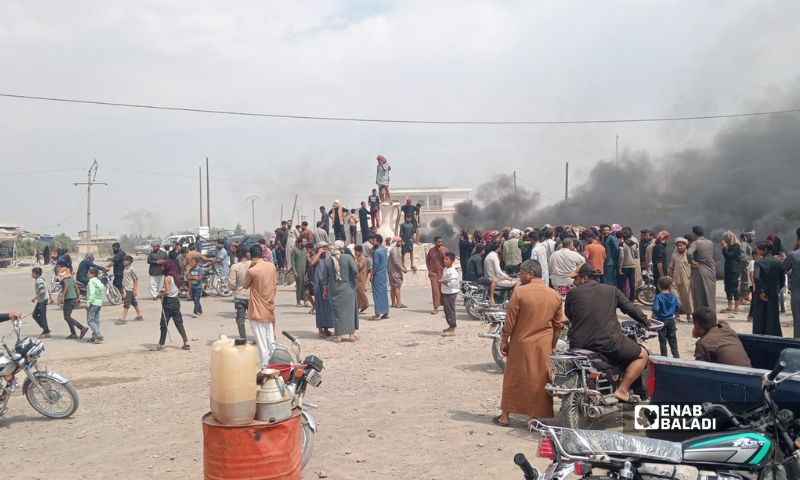
In the Raqqa countryside, protesters blocked the international road linking Deir Ezzor and Aleppo near the town of Huwayjat Shnan (Raqqa governorate, northeastern Syria) and prevented crude oil tankers from passing. The towns of al-Tayyana and al-Hurayjiya in the Deir Ezzor countryside also witnessed protests and road blockades, while the town of al-Karama in the Raqqa countryside saw a protest for the same reason.
In the southern al-Hasakah countryside, residents of several towns blocked the al-Hasakah to Deir Ezzor road, known as the “al-Kharafi” road, and prevented oil tankers heading toward the Syrian interior from passing.
The protests coincided with road blockades along routes used by crude oil tankers in the “47” area near al-Shaddadi, south of al-Hasakah, where demonstrators expressed their rejection of the new increase in fuel prices.
Ibrahim al-Ahmad, one of the protesters in the al-Hasakah countryside, told Enab Baladi that attempts were underway to reopen the road through promises to residents that the decision to raise fuel prices would be reconsidered within the coming hours.
He added that residents were waiting for a clear position on the decision, noting that continued increases in fuel prices directly affect the costs of transportation, services and daily necessities.
The protests came as local groups and residents called for demonstrations today in a number of cities and towns across al-Hasakah, Deir Ezzor and Raqqa governorates in opposition to the new prices.
The protests followed the entry into force of a new fuel price bulletin as of today, Sunday, September 13.

Protesters in southern al-Hasakah countryside block roads in opposition to fuel price hikes, September 13, 2026 (Enab Baladi)
The increase affected transportation fares between cities and towns in al-Hasakah governorate. Residents of al-Hasakah city and its countryside also said they had begun to notice rising costs for other essential services, including water delivery.
Ali al-Salem, a resident of al-Hasakah city, told Enab Baladi that transportation fares within the city’s neighborhoods had risen to 50 new Syrian pounds, while the price of a water tank had reached 750 new pounds per cubic meter.
Al-Salem added that he was surprised by the price increases on Sunday morning, explaining that “everything suddenly became more expensive” as a result of the fuel price increase.
He said the impact was not limited to transportation fares but had extended to services dependent on fuel, noting that families now have to pay additional amounts for water and transportation within the city.
He added that higher fuel prices were “no longer just another number on the bills,” as he put it, explaining that transportation costs had become a burden on families at a time when households were struggling to secure their basic needs.
He noted that higher transportation fares have a greater impact on people who depend on public transportation every day to reach their workplaces or meet daily needs, as the increase becomes a recurring expense paid throughout the month.
The increase was not limited to transportation within cities, as fares also rose on a number of routes connecting cities and towns across al-Hasakah governorate.
Suleiman al-Saeed, a resident of al-Hasakah city, told Enab Baladi that transportation fares between cities in the governorate had increased, noting that a passenger traveling from al-Hasakah to Qamishli now pays 500 new Syrian pounds, equivalent to 50,000 pounds in the old currency.
Al-Saeed described the new fare as “unreasonable,” explaining that the increase followed the rise in fuel prices.
He said a driver with whom he discussed the higher fare told him that the previous price no longer covered the vehicle’s operating costs after the increase in diesel prices. He added that drivers now faced two choices, either raise passenger fares or stop operating their vehicles.
He added that residents ultimately bear the cost of the increase, whether they use transportation within cities or travel between cities and towns across the governorate.
He noted that transportation fares now account for a larger share of a family’s daily spending, particularly for people who have to travel frequently between their homes and workplaces.
According to Enab Baladi’s monitoring, fares on some transportation routes rose compared with previous rates. The passenger fare to Qamishli reached 500 new Syrian pounds ($3.74), up from 300 pounds ($2.24), while the fare to al-Hasakah also rose to 500 pounds ($3.74) from 300 ($2.24).
The fare on the al-Darbasiyah to Tal Tamr route reached 500 new pounds ($3.74), compared with 300 ($2.24) previously, while the fare on the al-Darbasiyah to Amuda route reached 300 new pounds ($2.24).
According to drivers at the al-Hasakah bus station, the fare from al-Hasakah to Amuda, al-Darbasiyah and Qamishli is now 500 new pounds ($3.74) per passenger.

Protests and road blockades in Raqqa countryside over fuel price hikes, September 13, 2026 (Enab Baladi)
In the southern al-Hasakah countryside, residents said the increase came as the region prepares for the winter season, increasing concerns about the cost of heating.
Mohammad al-Ghazi, a resident of the southern al-Hasakah countryside, told Enab Baladi that people in the area “are not asking for luxuries,” but rather for access to basic needs, foremost among them bread, energy and the ability to reach their workplaces.
He added that the fuel price increase had affected the prices of goods and services, explaining that residents were finding it difficult to bear successive increases in their daily expenses.
He said higher transportation costs posed a particular problem for workers who need to commute every day, adding that salaries become less capable of covering basic needs as transportation and service costs rise.
He added that the approach of winter was increasing residents’ concerns because many families depend on fuel for heating.
He said the question facing families was, “How will we afford heating fuel?” He said the new price makes securing the amount of fuel needed for heating difficult for many families.
Al-Ghazi said the protests in Markada and the “47” area, and their spread to other areas, reflected residents’ objections to the decision. He called for reversing the price increase or establishing a mechanism that would allow residents to obtain fuel at prices suited to their ability to pay.
The Permanent Committee for Setting Prices of Petroleum Products and Mineral Resources issued a new temporary price bulletin for petroleum derivatives early today, Sunday, with the new rates taking effect the same day.
The price of one liter of 95-octane gasoline jumped to 195 Syrian pounds ($1.46) from 152 pounds ($1.14), while the price of one liter of 90-octane gasoline rose to 185 pounds ($1.38) from 147 ($1.10) previously.
Diesel recorded the largest proportional increase, reaching 175 Syrian pounds ($1.31) per liter, up from 125 ($0.94).
The increase was not limited to vehicle and heating fuel but also directly affected the gas sector. The price of a household gas cylinder rose to 1,600 Syrian pounds ($11.97) from 1,470 ($11.00) previously, while the price of an industrial gas cylinder climbed to 2,570 pounds ($19.23) from 2,350 ($17.58).
Energy Minister Mohammed al-Bashir had issued a decision on June 23 establishing the Permanent Committee for Setting Prices of Petroleum Products and Mineral Resources.
The committee includes representatives of several government bodies and relevant institutions. It is chaired by Deputy Energy Minister for Oil Affairs Ghiath Diab and includes representatives of the ministries of finance, economy and industry, the Central Bank of Syria, as well as specialized bodies in the oil and mineral resources sector.
Under the decision, the committee is responsible for studying the prices of petroleum products and mineral resources in light of factors affecting them locally and internationally, including global prices, costs, the Syrian pound exchange rate, subsidy mechanisms and other market-related indicators.
The committee also works to establish the principles and criteria needed to set prices and update them periodically.
The Energy Ministry said the increase in petroleum product prices resulted from an exceptional rise in the global cost of securing these products, coinciding with the Banias refinery undergoing a comprehensive overhaul.
The ministry explained that the refinery overhaul, which will last about two months, temporarily increases the need to import finished petroleum products, noting that the Syrian market is affected by higher global costs for securing gasoline, diesel and fuel oil.
The ministry stressed that the price adjustment is temporary and said it is intended to ensure continued supplies and the availability of petroleum products in the domestic market.
As the new price bulletin took effect, protests continued in several areas along routes used by oil tankers, while calls were issued for new demonstrations in cities and towns across al-Hasakah, Deir Ezzor and Raqqa, with protesters demanding that the fuel price increase be reversed.
if you think the article contain wrong information or you have additional details Send Correction


 A
A
A
A
A
A




 More Economic Reports