
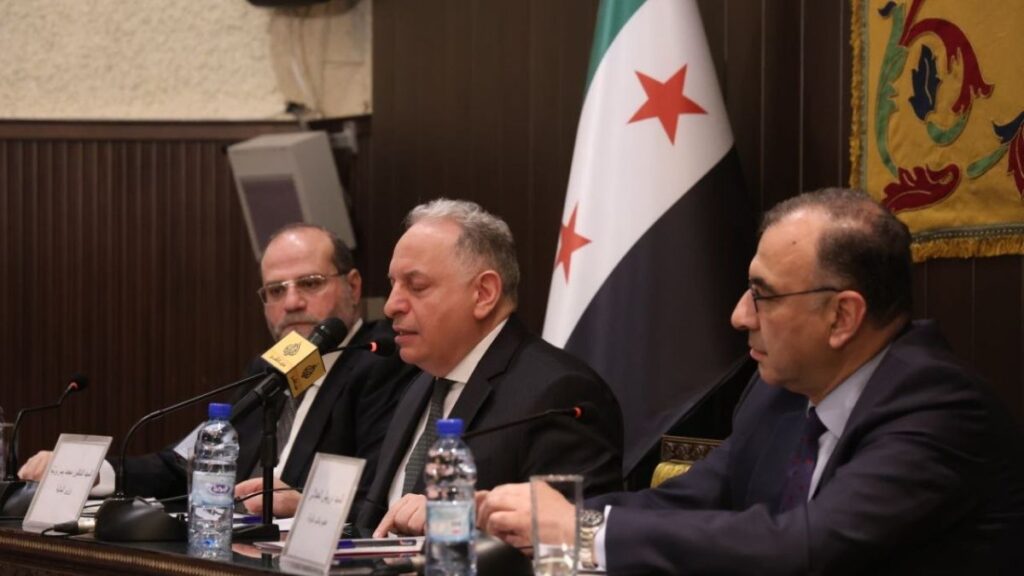

Syrian Finance Minister Mohammed Yisr Barnieh said today, Thursday, May 21, that he will sign a decision to revoke the licenses of “corrupt” transaction brokers and send a letter to the craftsmen’s association to bar them from entering finance directorates.
Barnieh revealed, during a meeting with traders at the Damascus Chamber of Commerce attended by Enab Baladi, that he will also sign a second decision today to revoke and freeze the licenses of a large number of legal accountants because they are “corrupt.” He warned customs clearance agents who engage in similar conduct that their licenses will be revoked.
The minister’s remarks came in response to an intervention by a member of the Damascus Chamber of Commerce, who cited an incident at the Central Bank of Syria involving a violation by an importer who imported goods under a fictitious name, as well as the presence of customs clearance offices importing under fictitious names.
Barnieh to Traders and Industrialists: I Advise You to Submit Real Invoices
The Syrian minister said everyone with a culture of corruption will be exposed, have their license revoked, and be barred from practicing their profession for five or 10 years. He noted that this is not within his authority, but said he will not allow corruption and that it will be eliminated.
He asked how a customs clearance agent or transaction broker could use fake invoices for fictitious importers, adding, “Therefore, all corrupt people will be held accountable, and every trader or industrialist who participates in this culture will also be held accountable.”
Barnieh advised traders and industrialists to submit real invoices for their imports. He said invoice valuation for all imported shipments will be carried out using modern technologies and in the finest detail, and no case will be handled selectively or subjectively. Chambers of commerce and industry will be involved in setting indicative prices for goods and commodities.
Broad Tax Exemptions
Syrian Finance Minister Mohammed Yisr Barnieh said every citizen whose annual income is below 640,000 new Syrian pounds will be exempt from income tax, in a step aimed at protecting low-income earners and easing living burdens. He said the maximum taxes imposed on the business sector will not exceed 15%, as part of a flexible tax policy that seeks to encourage investment and stimulate economic activity.
Barnieh said the brackets that include more than 90% of employees will be exempt from income tax, while very low rates will be imposed on higher income brackets, ranging from only 2.5% to 5%, compared with previous rates under the defunct regime that reached 15%.
The government is not moving toward imposing new taxes, Barnieh said, but is working to reorganize and activate current laws more transparently and fairly, while maintaining a balance between supporting the public treasury and protecting citizens.
Spending Fee in June and Until Year-End
Barnieh explained that the decree on the consumer spending fee will take effect starting in June, stressing that the law has existed since 2015 but was not fully activated in recent years, causing losses in state revenues.
He said the delay in implementation was not intentional, but resulted from the incomplete electronic system linked to collection and oversight. Previous months since the “start of liberation” will not be calculated for taxpayers, and no fees will be collected for them.
Barnieh revealed that the spending fee will remain in force only until the end of this year, after which there will be a full transition to the sales tax system, as part of a plan to modernize the tax system and unify financial procedures.
He also stressed that the new sales tax will include full exemptions for food, medicines, education supplies, and basic living necessities, meaning the tax rate on them will be 0% in the anticipated new law.
This confirmation by the finance minister comes despite the presence of an article in the consumer spending fee law carrying a “retroactive effect” and allowing the Tax and Fees Authority to collect the consumer spending fee on goods imported between December 8, 2024, and May 30 of this year.

ders and industrialists during a meeting with Syrian Finance Minister Mohammed Yisr Barnieh at the Damascus Chamber of Commerce, May 21, 2026. (Enab Baladi)
Tax Advances Are Not Additional Fees
Regarding tax advances, the finance minister said they are not a new measure, but a previously used mechanism based on paying advance installments of the tax owed by a trader or importer.
He said the ministry reexamined and amended tax advance schedules in line with the nature of different sectors and goods. Some goods have become subject to a 0% rate after the latest amendments. He said the mechanism does not represent an additional burden on traders, but aims to facilitate the payment of tax obligations in a flexible and organized way that eases financial pressure on taxpayers.
Barnieh said the ministry relies primarily on tax declarations submitted by taxpayers themselves, while giving them wide space to submit invoices and documents, under a policy based on trust and simplified procedures.
In a step aimed at strengthening tax compliance, the minister announced the launch of the “Golden List” project, which will include financially compliant and disciplined traders and industrialists.
Those who join this list will receive special facilities, most notably exemption from paying tax advances and reduced administrative procedures, in a way that strengthens trust between the private sector and the Ministry of Finance.
The finance minister said this step also aims to eliminate the phenomenon of the “fictitious importer” and encourage committed businesspeople by granting them real privileges and turning them into supporting partners for the ministry. At the same time, the minister stressed that the ministry will take strict measures against tax evaders, including naming violators publicly and taking legal action against them.
Exceptional Reductions to Support Industry
Barnieh revealed major tax incentives for industrial facilities, saying taxes can be reduced by two or three brackets, and may reach four brackets depending on the number of workers in the facility.
He explained that these reductions could bring the effective tax down to around 9% or 10%, in an attempt to support local production, encourage industrial expansion, and create new job opportunities. He said this model of tax simplification and installment payments is among the most flexible globally, adding that the government is betting on support for the national industry as a basic entry point for economic growth.
He also noted that the ministry seeks to build a genuine partnership with the private sector based on trust and cooperation, while viewing tax as a tool for development and prosperity, not merely a means of collection.
The Ministry of Finance is currently working to launch financing programs and credit facilities to rehabilitate and modernize production lines with modern technologies that strengthen the competitiveness of the Syrian industry.
Barnieh: Tax Revenue Equals 3.5% of GDP
The finance minister said the government is working to move from a traditional, complex tax system to a modern system that is simpler and clearer, limits corruption, and shortens procedures for citizens and taxpayers. He said the ministry will issue a detailed procedural guide explaining the differences between the old and new systems, with a simplified explanation of procedures, fees, and implementation mechanisms.
Barnieh said current tax revenue compared with gross domestic product remains very low compared with other countries, amounting to no more than 3.5% of GDP, while in many countries around the world it reaches 15%. However, he said the government does not seek to increase burdens on citizens, but to improve tax efficiency and expand voluntary compliance.
He announced that the ministry is preparing a national strategy to combat poverty, including 26 programs to assist low-income earners. He stressed that all fees and tax advances will be collected only in Syrian pounds and not in dollars, in support of monetary stability and to strengthen confidence in the local currency.
Increases in Fees on Marble, Tobacco, and Products
The increases in the new consumer spending fee, issued by a Ministry of Finance decision, included tobacco products, including cigars, cigarettes, and mu’assel, at 20%, after they had previously been set at around 5%. The increases also included marble, limestone, granite, and cement at 15%, after the spending fee on all types of cement had previously been set at a very low rate of 0.5%, due to growing reconstruction needs resulting from the extensive destruction that has affected the country.
The increases in consumer spending fees also included 10% on perfumes, cosmetics, and hair polish, and 5% on imported silver jewelry. Categories were set for imports that are subject only to import fees of $600 or less, with a spending fee imposed on them ranging from 0, exempt, to 5%.
The main impact of the new consumer spending fee will appear through higher import costs, according to economist Mulham al-Jazmati of Karam Shaar Advisory, who spoke to Enab Baladi.
The nature of this fee is that it is an indirect tax, meaning the legal burden falls on the importer who pays it during customs clearance, but the economic burden is often passed on to the consumer through the final price.
In other words, the consumer does not pay the fee directly to the state when making a purchase, but pays its effect indirectly when this cost is included in the price of the good.