


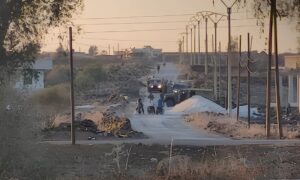
 Members of the Interior Ministry dismantle a cell involved in planning attacks in the city of Quneitra, April 19, 2026. (Syrian Interior Ministry)
Members of the Interior Ministry dismantle a cell involved in planning attacks in the city of Quneitra, April 19, 2026. (Syrian Interior Ministry)
Syria’s Interior Ministry announced it had foiled what it described as a “sabotage” plot in Quneitra province, saying a cell linked to Hezbollah was allegedly preparing to carry out a rocket attack and destabilize the area.
The Internal Security Command in Quneitra said on Sunday, April 19, that the operation was carried out in cooperation with the General Intelligence Service. It said the raid followed “precise” monitoring and surveillance of the movements of suspected individuals, without specifying the time frame of the operation.
According to the statement, members of the cell had prepared a civilian vehicle in a concealed manner to hide equipment intended for launching rockets, in an apparent attempt to carry out a surprise attack. Security forces said they seized the vehicle and the equipment before they were used.
The ministry added that security units confiscated several rockets and their launch platforms, saying they had been prepared and hidden “professionally” inside the vehicle for use in what it described as “hostile acts.”
The ministry said two people it identified as members of the cell were arrested over activities it said threatened the area’s security, while a third suspect remains at large, and search operations are continuing to capture him. The statement did not clarify the likely targets of the planned attack or the sites that would have been struck. It also gave no further details about the detainees’ alleged links to the named party or how they obtained the equipment.
The ministry said investigations are continuing to uncover the full circumstances of the case before referring the detainees to the competent judiciary. At the time of writing, no independent information was available to confirm the details of the operation or its circumstances.
In a statement published on its official accounts on Saturday, April 11, the ministry said the operation followed what it called “precise” security monitoring of suspicious movements inside the capital, without specifying the time frame of the operation.
According to the statement, specialized units tracked a woman whom the ministry said belonged to the cell while she was allegedly attempting to plant an explosive device outside the home of a religious figure near the Mariamite Church in the Bab Touma area of Damascus. Activists close to the government and media outlets quoted an official source as saying the target was rabbi Michael Houri in Damascus, though there has been no independent confirmation of that information so far.
The ministry added that security forces dismantled the explosive device before it detonated. It said the operation caused no injuries or material damage, and that five people, whom it described as all members of the cell, were arrested.
According to the statement, preliminary investigations showed links between the cell and Hezbollah. The ministry said the group’s members had received military training outside Syria, including training in planting explosive devices.
Lebanon’s Hezbollah denied accusations by the Syrian Interior Ministry that it was linked to a cell the ministry said had been planning an assassination operation in the capital, Damascus, describing the claims as “false and fabricated.”
In a statement issued Sunday, April 12, Hezbollah said it “has no activity, connection, or relationship with any party in Syria,” adding that it has no presence on Syrian territory. The statement was a direct response to claims made by the Syrian Interior Ministry.
The group added that it is committed to “Syria’s security, stability, and the safety of its people in all their components,” and called on Syrian authorities to “verify carefully before making accusations,” particularly amid what it described as the presence of “intelligence agencies seeking to ignite tension between Lebanon and Syria.”
if you think the article contain wrong information or you have additional details Send Correction


 A
A
A
A
A
A


 More Politics