


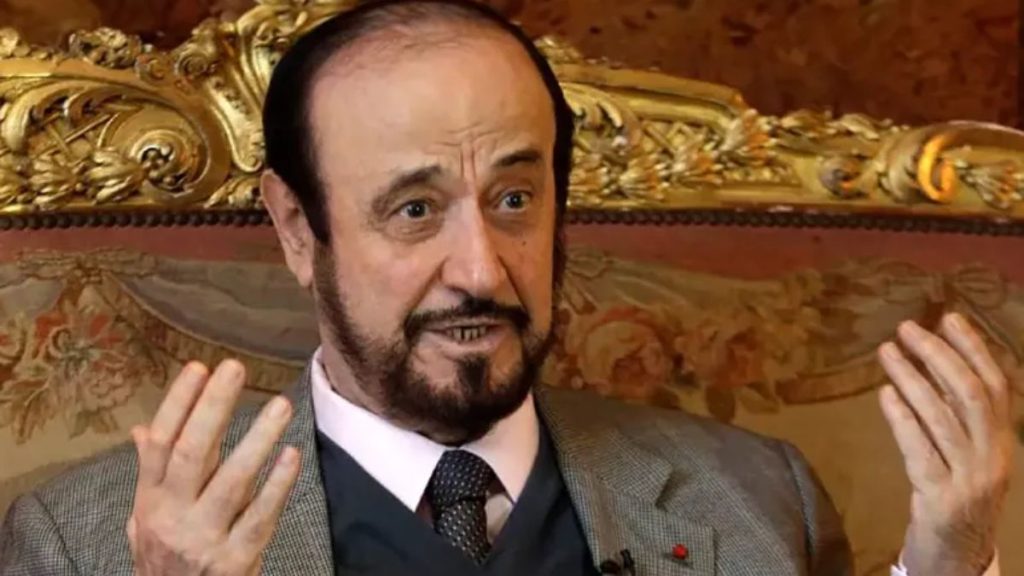
 Rifaat al-Assad, uncle of ousted Syrian president Bashar al-Assad, October 2021 (AP)
Rifaat al-Assad, uncle of ousted Syrian president Bashar al-Assad, October 2021 (AP)
Rifaat al-Assad, the uncle of the ousted Syrian president Bashar al-Assad, died today, Wednesday, 21 January, at the age of 88, after a sudden deterioration in his health, according to social media pages belonging to members of his family.
Reuters also confirmed the death, citing two unnamed sources.
Rifaat al-Assad leaves behind a long record of military and political conflicts, from helping entrench the Assad family’s rule in the 1970s to decades in exile and legal pursuits in Europe on charges including embezzlement of Syrian state funds.
Rifaat, the brother of Hafez al-Assad, began his military career by taking part in the 1963 coup following his graduation from the military academy. As his brother rose to power after the 1970 coup, Rifaat’s influence expanded, and he assumed command of the Defense Companies and the 569th Brigade, turning them into a hard-hitting force tasked with protecting the regime.
Alongside his military power, he held civilian and academic posts. He headed the Constitutional Court and the Higher Education Bureau (1975 to 1980), earned a doctorate in economics and history from Damascus University, and remained a member of the Baath Party’s Regional Command for more than two decades.
His name became linked to some of the darkest chapters in Syria’s modern history. He was directly responsible for the Tadmor Prison massacre in June 1980 (in Tadmor, Palmyra, central Syria), which followed a failed assassination attempt against Hafez al-Assad.
He also led military operations in Hama (central Syria) in 1982, events that resulted in the killing and disappearance of tens of thousands of Syrians and the destruction of entire neighborhoods.
The year 1983 marked a pivotal turning point in his life when he attempted to overthrow his brother Hafez, taking advantage of the latter’s illness. The attempt ended with Rifaat’s temporary exile, after which he returned as vice president with reduced powers.
In 1984, the dispute flared again, and he left Syria in 1985 to France under a controversial financial deal.
Despite later attempts to reenter the political scene, including declaring himself the “legitimate heir” to power after Hafez al-Assad’s death in 2000, the transfer of authority to his nephew Bashar al-Assad kept him in exile for decades.
In exile, Rifaat built a vast real estate and media empire. While he avoided convictions in Spain, French courts sentenced him on 17 June 2020 to four years in prison on charges of embezzling Syrian public funds and money laundering, ordering the confiscation of assets estimated at tens of millions of euros.
In October 2021, Rifaat returned to Damascus to evade serving the French sentence, spending his final years in Syria, which he left after the fall of the Assad family’s rule in December 2024.
Media outlets reported that Rifaat fled to Lebanon after the fall of Bashar al-Assad’s regime, before moving to Dubai in the United Arab Emirates on 26 December 2024.
if you think the article contain wrong information or you have additional details Send Correction


 A
A
A
A
A
A






 More Politics