


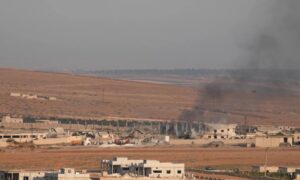
 Syrian army engineering units work to clear landmines around the Tishreen Dam in eastern Aleppo countryside, January 29, 2026. (SANA)
Syrian army engineering units work to clear landmines around the Tishreen Dam in eastern Aleppo countryside, January 29, 2026. (SANA)
The Syrian government and the Syrian Democratic Forces (SDF) announced a new agreement that provides for a comprehensive ceasefire, alongside a phased integration of military and administrative structures.
In a joint text published by both sides today, Friday, January 30, 2026, the agreement includes the withdrawal of forces from contact lines and the deployment of Interior Ministry security forces into the centers of al-Hasakah and Qamishli (both in northeastern Syria) to bolster stability and begin integrating local security forces.
Militarily, the parties agreed to form a division comprising three SDF brigades, and to establish a brigade for the Kobani Forces (Ain al-Arab, northern Aleppo countryside) within a division affiliated with Aleppo Governorate (northern Syria).
The agreement also provides for integrating the institutions of the Autonomous Administration (the SDF’s governing arm) into Syrian state institutions, while retaining civil employees in their posts.
It also refers to addressing the Kurdish community’s civil and educational rights and ensuring the return of displaced people to their areas.
According to the joint statement, the agreement aims to unify Syrian territory, enforce the rule of law, and achieve full integration in the region by strengthening cooperation among the relevant parties and unifying efforts to rebuild the country.
Enab Baladi’s correspondent in al-Hasakah reported on Thursday, citing sources close to the SDF, that the two sides would disclose the outcome of the Damascus meeting held between the government and an SDF delegation on Tuesday, provided no changes occurred.
The correspondent quoted the sources as saying the meetings were positive and produced compromise solutions for both sides. The parties agreed on most of the provisions of the January 18 agreement, paving the way for a comprehensive ceasefire and the start of implementation as soon as possible.
Syrian transitional President Ahmed al-Sharaa signed an agreement on January 18 containing 14 provisions. It stipulated a ceasefire between the government and the SDF, the handover of Raqqa and Deir Ezzor governorates to the government, and the integration of all civil institutions in al-Hasakah Governorate into Syrian state institutions and administrative structures.
It also stipulated that all SDF military and security personnel would be integrated into the structures of Syria’s Ministries of Defense and Interior on an “individual” basis, following the necessary security vetting. The agreement included granting them military ranks and financial and logistical entitlements in line with regulations, while preserving the specific character of Kurdish areas.
The agreement also included removing heavy military deployments from Ain al-Arab/Kobani and forming a local security force made up of the city’s residents, while maintaining a local police force that is administratively affiliated with Syria’s Interior Ministry.
Despite the signing of the agreement, which the government had announced unilaterally at the time, clashes continued, enabling the government to expand its control at the expense of the SDF.
On January 20, the government announced a new ceasefire agreement with a four day deadline, then extended it to 15 days after the deadline expired.
The SDF, for its part, pledged to abide by the agreements, and fighting gradually subsided on the al-Hasakah and Ain al-Arab/Kobani fronts in eastern Aleppo.
During the recent military operation, the government took control of Raqqa city and the areas previously held by the SDF in Deir Ezzor, east of the Euphrates River, as well as parts of al-Hasakah Governorate and villages in the countryside of Ain al-Arab/Kobani.
if you think the article contain wrong information or you have additional details Send Correction



 A
A
A
A
A
A


 More Politics