


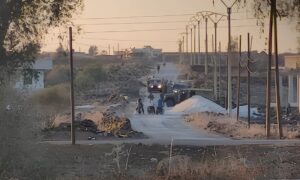
 Tabqa crossing, 8 January 2026 (Hawar News Agency)
Tabqa crossing, 8 January 2026 (Hawar News Agency)
The “General Administration for Border Crossings and Arrivals,” affiliated with the Autonomous Administration, announced today, Thursday 15 January, the closure of all crossings linking its areas with those controlled by the Syrian government in the “Tabqa, Raqqa, and Deir Ezzor regions until further notice,” amid escalating military tensions.
In circular No. 32, the administration attributed the closure to “serious security developments,” and to what it described as the “transitional government in Damascus” closing crossings on its side, which it said directly affected the safety of civilians, staff, and travelers.
The decision exempted “urgent humanitarian cases” and accredited humanitarian organizations only.
This escalation comes as the area witnesses heightened security tensions between the Syrian Democratic Forces (SDF) and the Syrian army, alongside ongoing military operations in the eastern countryside of Aleppo governorate (northern Syria).
Sources for Enab Baladi in al-Hasakah and Raqqa said markets saw a noticeable rise in consumer goods prices hours before the closure decision was issued, driven by anticipation and military tension.
The closure is expected to trigger a new wave of price increases in areas under the Autonomous Administration, especially since crossings such as the Tabqa crossing (western Raqqa governorate, northern Syria) serve as a vital commercial artery for transporting goods and food supplies from inside Syria.
Today’s decision follows a series of closures that began in early November, imposed by the Syrian government. This was followed by the Internal Security leadership in Deir Ezzor closing river crossings, such as al-Shuhayl and Dhiban (eastern Deir Ezzor governorate, eastern Syria) on 9 January.
Contact points and crossings between the two sides are spread across two main areas:
On the other hand, Syria’s state news agency SANA quoted Farhad Khourto, a member of Aleppo governorate’s Executive Office and deputy head of the Central Response Committee, as saying that relevant government-affiliated bodies had been stationed since morning in front of the Hamima crossing (eastern Aleppo countryside, northern Syria), waiting for civilians to leave. He claimed, however, that the SDF prevented them from crossing, and erected booby-trapped concrete and earthen barriers that blocked access.
Khourto said today, Thursday 15 January, that information indicated around 200 civilian cars were stranded inside the area, with civilians facing direct threats of being shot by snipers if they approached the crossing.
He added, according to SANA, that humanitarian and security readiness was at its highest level, with ambulances, medical teams, and nearby shelter centers prepared in case residents are forced to remain for a day or two.
if you think the article contain wrong information or you have additional details Send Correction


 A
A
A
A
A
A




 More Politics