


 Fighters of the Turkistan Islamic Party take part in the Battle to Repel the Aggression, 7 December 2024 (Voice of Islam Media Center)
Fighters of the Turkistan Islamic Party take part in the Battle to Repel the Aggression, 7 December 2024 (Voice of Islam Media Center)
The Syrian Ministry of Foreign Affairs and Expatriates has denied handing over Uyghur fighters to China.
State-run Syrian Arab News Agency (SANA) reported on Monday, 17 November, quoting a source at the Foreign Ministry, that there is no truth to what Agence France-Presse (AFP) reported about the Syrian government’s intention to hand over fighters to China.
Earlier on Monday, AFP had quoted two Syrian sources as saying that Syria plans to hand over Uyghur fighters to China.
According to the agency, the Syrian authorities would hand over 400 fighters from the Muslim Uyghur minority to China.
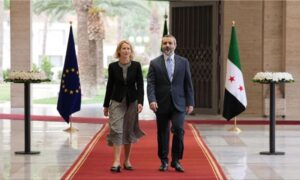
Syrian Foreign Minister Asaad al-Shibani arrived in China on Monday, 17 November, where he met Chinese Foreign Minister Wang Yi, and the two ministries issued a joint statement after the meeting.
The statement said that the talks between the two sides were “constructive”, with an exchange of views on bilateral relations and issues of common concern.
It noted the two sides’ readiness to strengthen cooperation in economic and development fields, in Syria’s reconstruction, in capacity building, and in improving the living standards of Syrian citizens, while also reaffirming the fight against terrorism in all its forms and the enhancement of security coordination between the two countries.
The Syrian side confirmed its support for the “One China” principle and its recognition of the sovereignty of the People’s Republic of China, including rejection of any interference in China’s internal affairs and support for the Chinese government’s efforts to achieve national reunification.
Syria also expressed its appreciation for China’s various initiatives, including the Global Development Initiative and the Belt and Road Initiative, stressing its desire to participate actively in them, and underlining that Syrian territory will not be used for any activities that threaten China’s security or interests.
For its part, China affirmed its full respect for Syria’s sovereignty and territorial integrity and its recognition of the Syrian government as the legitimate representative of the Syrian people, while supporting the domestically led political process in Syria.
The Chinese side praised Syria’s efforts in combating drugs, strengthening the rule of law, fighting terrorism, and protecting citizens’ rights without discrimination, and reiterated its support for Syria’s development path in line with its national circumstances, while stressing that the international community recognizes the Golan as occupied Syrian land.
China abstained from voting on a draft resolution submitted to the UN Security Council to remove the name of Syria’s transitional president, Ahmad al-Sharaa, from the sanctions lists, justifying its position by saying that the draft did not meet the principles and considerations it deems necessary for achieving stability in Syria and combating terrorism.
China’s Permanent Representative to the United Nations, Fu Cong, stated in his address to the Security Council on 6 November that China’s position on sanctions has been “clear from the outset”, and that any adjustment of the sanctions regime must take into account “the security situation in Syria, the fight against terrorism, the complex effects that could result from any change, as well as the long term interests and actual needs of the Syrian people”.
Fu added that the latest draft resolution “did not embody these principles”, which led China to abstain, despite its active participation in consultations on the text and, together with several member states, the submission of “constructive proposals” on counter terrorism and foreign fighters.
A diplomatic source told Al Jazeera Net on 6 November that China had submitted amendments proposing to also mention foreign fighters in the wording of the draft resolution.
The Chinese envoy said that Syria must fulfill its obligations in the framework of combating terrorism and take resolute measures to address terrorist acts and the threat posed by foreign fighters, including members of the East Turkestan Islamic Movement (ETIM) present inside Syrian territory, who are predominantly Chinese Uyghurs.
The East Turkestan Islamic Movement, also known as the Turkistan Islamic Movement, was founded in 1993 and has its main base in the Waziristan region of northern Pakistan. It is considered an extension of the state declared by Uyghurs in what is now the Xinjiang region in northwestern China.
The United States Department of the Treasury designated the East Turkestan Islamic Movement a “terrorist” organization in 2002, before lifting this designation in October 2020.
The group aims to establish an independent “East Turkestan” in China. Since its creation, it has forged close ties with the Taliban, al-Qaeda, and the Islamic Movement of Uzbekistan.
It was founded by Hasan Mahsum, who came from China’s Xinjiang region and was killed by Pakistani soldiers in October 2003.
According to information verified by Enab Baladi in 2019, around 3,000 Uyghur fighters are fighting within the Turkistan Islamic Party, most of whom arrived with their families and are living in the western countryside of Idlib and the northern countryside of Latakia (northwestern Syria).
Uyghurs are subjected to repression and attempts to erase their cultural and religious identity by the Chinese government, which has detained about one million of them, according to Amnesty International.
The Chinese government refuses to recognize them as an indigenous people and sees them only as a regional minority within a multiethnic state.
Uyghurs speak a Karluk branch of the Turkic language, and this shared linguistic background with Turks has helped make Turkey a transit point for them on their way to Syrian territory.
if you think the article contain wrong information or you have additional details Send Correction






 A
A
A
A
A
A


 More Politics