


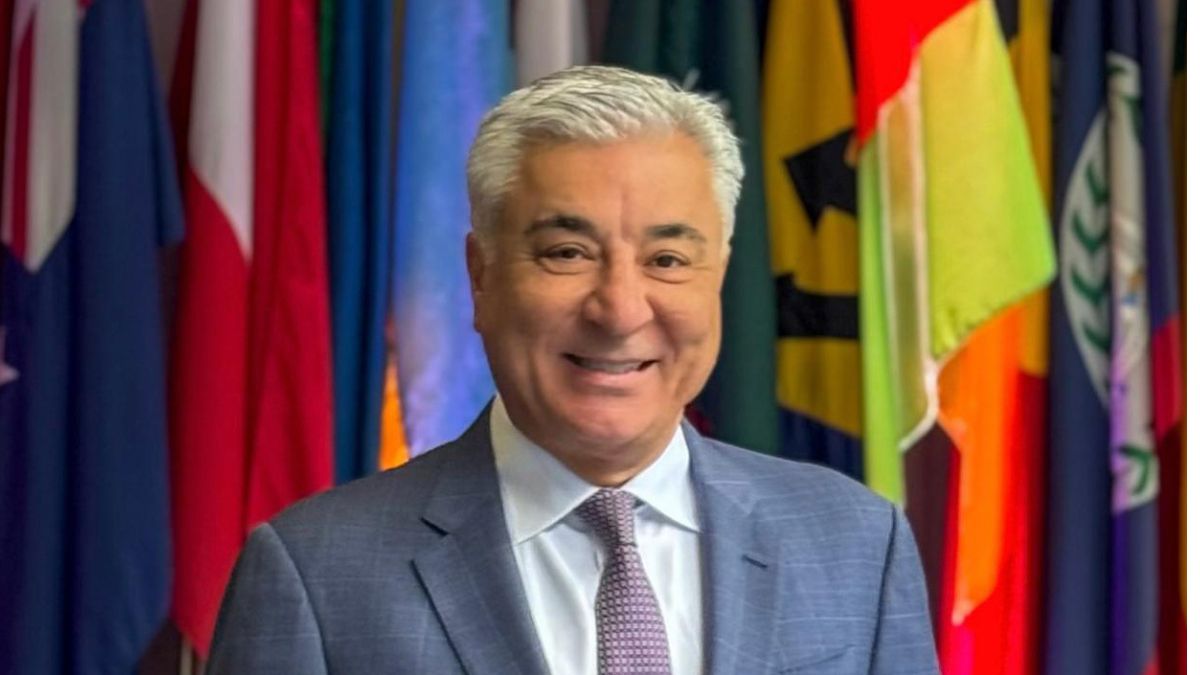
 Jihad al-Salqini, Chairman of the US–Syria Business Council, October 6, 2025 (USSYBC website)
Jihad al-Salqini, Chairman of the US–Syria Business Council, October 6, 2025 (USSYBC website)


 A
A
A
A
A
A
Amid Syria’s economic transitions, the US–Syria Business Council is emerging as an independent platform aimed at strengthening commercial cooperation between Damascus and Washington.
Founded in June 2025 in Washington, the council works to support reconstruction and sustainable development in Syria through training programs for small and medium enterprises, organizing reciprocal business missions, and fostering a legal and regulatory climate that enables U.S. investment to enter the Syrian market.
The council’s activity has increased recently as economic relations between Syria and the United States have improved at a rapid pace, with a U.S. policy shift toward lifting sanctions and facilitating trade.
It has played a coordinating role in meetings that brought together representatives of the banking and industrial sectors in both countries, and contributed policy papers to the U.S. administration recommending opening the Syrian market to American investment and removing customs duties.
In an interview with Enab Baladi, Jay Salkini, chairman of the US–Syria Business Council (USSYBC), said small and medium enterprises are the backbone of any recovering economy. He noted that chambers of commerce and industry and the relevant ministries in Syria have begun focusing on establishing such firms as a hallmark of an opening and recovering Syrian economy.
Salkini, who also chairs Tecore Networks, a telecommunications company described as the first direct U.S. investment in Syria after the “liberation,” said the council is playing a pivotal role in rebuilding bridges between Damascus and Washington through the economy after decades of isolation and sanctions, and in shaping the contours of Syria’s new economic phase.
The US–Syria Business Council is an independent, nonprofit organization that aims to enhance economic and commercial cooperation between Syria and the United States. Among its objectives, it seeks to support reconstruction and sustainable economic development in Syria.
The council’s chairman said Syria today is a frontier market rich with opportunities. He outlined sectors most attractive to U.S. investors as follows:
According to Salkini, the council is working on a four-phase roadmap that includes:
“We are working to launch an annual forum to qualify Syrian manufacturers and train them on export standards for the U.S. market, with guidance to ensure their products succeed globally,” he said.
Salkini described U.S. President Donald Trump’s decision, announced in Saudi Arabia, to move toward ending the comprehensive sanctions program on Syria as a historic turning point in bilateral economic relations.
Since its establishment earlier this year, the council has undertaken intensive political and economic efforts, including direct meetings with the White House, the U.S. Treasury, and U.S. Special Envoy for Syria Thomas Barrack. He pointed to an important meeting with Barrack in Turkey in July 2025.
He said these efforts helped build momentum toward lifting sanctions and opening the way for the U.S. private sector to return to the Syrian market in a legal and organized manner.
“We have worked quietly with decision-makers in Washington to show that building bridges with the Syrian economy serves both regional security and U.S. interests,” Salkini said.
He argued that Syria is no longer merely a sanctions arena, but is becoming a promising frontier market moving steadily toward recovery.
He added that the U.S. State Department and the administration have recently issued a formal request to Congress to repeal the Caesar Act entirely by incorporating it into the 2026 National Defense Authorization Act.
The council’s chairman revealed that USSYBC submitted a comprehensive economic policy paper to the U.S. administration with recommendations to remove customs duties and to open the Syrian market further to U.S. investment.
He said the council’s efforts laid a solid groundwork that paved the way for successful visits by Syrian government delegations to Washington.
Salkini referenced a series of meetings conducted by the council prior to those delegations’ trips, beginning with its meeting in Turkey with U.S. Special Envoy Thomas Barrack, followed by sponsoring and supporting banking meetings that brought together representatives of Syrian and American banks in the presence of the Governor of the Central Bank of Syria. He also cited the visit of U.S. Congressman Abraham Hamadeh to Damascus in August, which the council organized under its direct supervision.
Salkini described transitional president Ahmad al-Sharaa’s participation in the UN General Assembly and the Concordia Summit in New York as an official announcement of Syria’s return to the international stage, notably through a clear invitation for American companies to enter the Syrian market.
Ahead of the visit, the US–Syria Business Council announced a strategic partnership with the Concordia Summit and took part in a closed-door roundtable that brought al-Sharaa together with leading global investors before he met with General David Petraeus.
Salkini said the council arranged a series of meetings for the two official Syrian delegations that recently visited Washington with major institutions, including the Atlantic Council, the Middle East Institute, and the U.S. Department of Commerce, in addition to meetings with members of Congress.
The U.S.–Syrian discussions focused on encouraging U.S. investment, easing trade restrictions, and reopening organized channels of exchange between the two countries.
He also mentioned a meeting, sponsored and supported by the council, between Syria’s finance minister and the governor of the Central Bank of Syria and JPMorgan Chase Bank, during which both sides discussed reintegrating Syria into the global financial system. The Syrian delegation presented a comprehensive monetary and banking reform plan to restore confidence in state institutions.
“The council is an important, essential platform that brings together Damascus, Washington, and the private sectors in both countries,” Salkini said. “We are working pragmatically and calmly to link Syria’s domestic reforms with external opening, and our vision is for Syria to become a new model of transparency and openness.”
According to Salkini restoring Syria’s economy is a priority for the council’s team, a gateway to regional stability, and a historic opportunity for U.S. companies to be partners in building this future.
The US–Syria Business Council recently disclosed a meeting in Washington held on the sidelines of the IMF and World Bank meetings between October 14 and 21. It brought together a high-level Syrian government delegation led by Finance Minister Mohammed Yosr Bernieh and Central Bank Governor Abd al-Qader al-Hasriyeh with senior executives at JPMorgan Chase Bank. The meeting was facilitated and sponsored by the council.
According to a report the council published on LinkedIn, the meeting is part of ongoing efforts to reintegrate Syria financially. Al-Hasriyeh and Bernieh outlined comprehensive measures the Syrian government is pursuing to restore monetary stability, rebuild institutional credibility, modernize public finance and tax frameworks, and attract foreign capital.
JPMorgan Chase Bank is a U.S. global banking and financial services institution. It is the largest bank in the United States and one of the largest in the world. It offers a wide range of services, including consumer and commercial banking, investment banking, and asset management. The bank was formed through the 2000 merger of Chase Manhattan Bank and J.P. Morgan and Co.

USSYBC board members met Syria’s Minister of Economy and Industry in Washington, October 15, 2025 (US–Syria Business Council)
The USSYBC Board of Directors comprises:
Jay Salkini, Chairman, founder, and CEO of Tecore Networks
Abdul Akel, Board Member, co-founder and CEO of T-Cetra LLC
Bassel Yassine Ojjeh, Board Member, CEO, and President of LigaData
Iyad Betinjaneh, Board Member, CEO of Habib Betinjaneh Est., and Chairman of Bank of Syria and Overseas
Mohamed Ali Sharaf, Board Member, Chairman of Sharaf Company, Victron Energy
Laila Al Samman, Board Member, Managing Partner at Al Samman & Co.
Hassan Daaboul, Board Member, CEO of Madar Group
Ihsan Hafez, Board Member, General Manager of Al-Hafez Co.
Bashar Kalai, Board Member, CEO of Amerapex Corporation
Issam Ghreiwati, Board Member, Chairman of Ghreiwati Holdings, and Chairman of the Damascus Chamber of Commerce
The Advisory Council comprises:
Sameer Saboungi, USSYBC Director General, attorney, and policy expert
Kamal Haykal, Advisory Council Member, co-founder and CEO of Officelogix
Louay Homsi, Advisory Council Member, CEO of Voyage Consulting
Markie Britton, Advisory Council Member, co-founder, Ammoora Hospitality
Jihad Daaboul, Advisory Council Member, founder and CEO of American Premium Surplus
Majd Abbar, Advisory Council Member, Regional Director for Microsoft Middle East
Fadi Haddad, Advisory Council Member, CEO of Motif
Ghazwan Tarabishi, Advisory Council Member, Chief Operating Officer, T-Cetra LLC
Abdulhadi Tabba, Advisory Council Member
Rabih Najib, Advisory Council Member, Chief Operating Officer, Itenology Corporation
if you think the article contain wrong information or you have additional details Send Correction








 More Economic Reports