


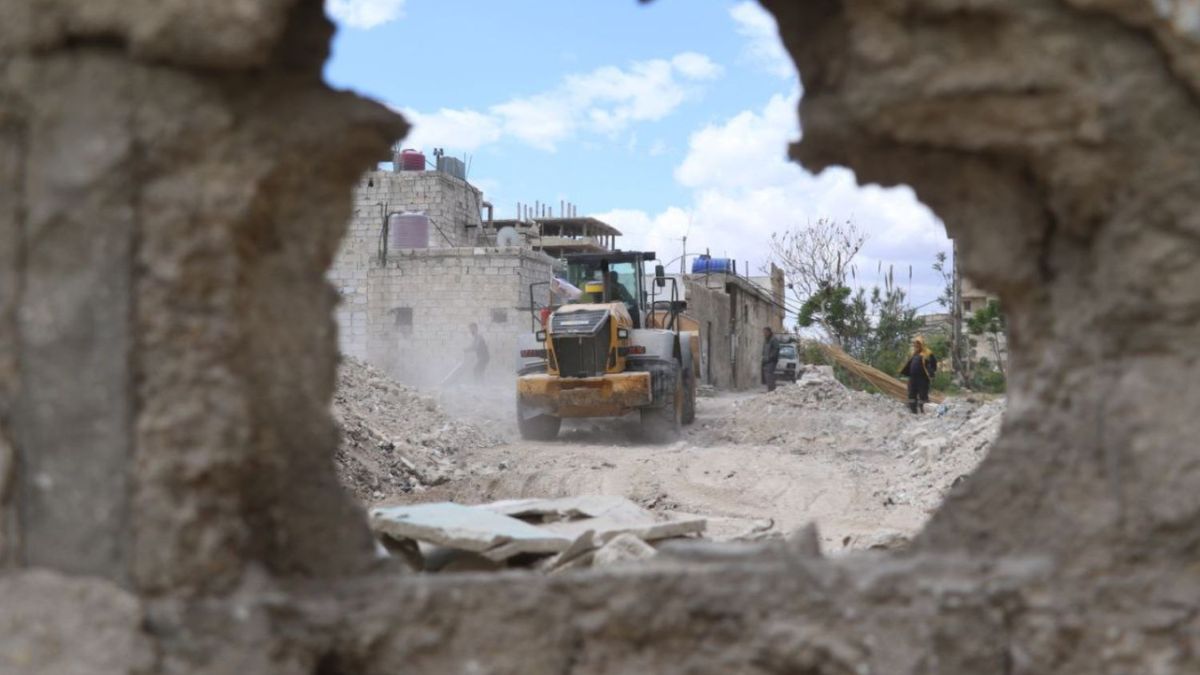
 The Syrian Civil Defense removes rubble in Eastern Ghouta (Rif Dimashq, southwestern Syria) – April 16, 2025 (Civil Defense/Telegram)
The Syrian Civil Defense removes rubble in Eastern Ghouta (Rif Dimashq, southwestern Syria) – April 16, 2025 (Civil Defense/Telegram)
The World Bank estimates the average cost of rebuilding Syria at approximately $216 billion, according to a report released on Tuesday, October 21.
The report presents a nationwide assessment of physical damage and reconstruction needs to tangible assets, public infrastructure, and buildings, covering the period from 2011 to 2024.
According to the report, the conflict damaged nearly one-third of Syria’s pre-war fixed capital stock. Direct physical damage to infrastructure and residential and non-residential buildings was estimated at around $108 billion.
Infrastructure was among the hardest-hit categories, accounting for 48% of total damage ($52 billion), followed by residential buildings ($33 billion), then non-residential buildings ($23 billion).
Aleppo, Rif Dimashq, and Homs are the most affected governorates by total damage.
Reconstruction costs for damaged physical assets are estimated between $140 billion and $345 billion, with a conservative baseline of $216 billion.
This figure comprises $75 billion for residential buildings, $59 billion for non-residential buildings, and $82 billion for infrastructure, the Bank said, expecting Aleppo and Rif Dimashq to require the largest shares of reconstruction investment.
The World Bank noted that physical reconstruction costs are roughly 10 times Syria’s projected 2024 GDP, underscoring the scale of the challenge and the need for substantial international support.
It added that the war has severely impacted the Syrian economy, with real GDP declining by approximately 53% between 2010 and 2022.
In nominal terms, GDP fell from $67.5 billion in 2011 to about $21.4 billion in 2024, according to a macro-financial assessment of Syria published earlier this year.
The Bank stressed that these figures are subject to “a high degree of uncertainty,” due to the ongoing conflict and its methodological constraints.
The report does not provide sector-by-sector breakdowns or asset-type details; rather, it aims to offer an overall estimate of damage and reconstruction costs and to inform discussions around recovery planning.
Syrian Finance Minister Mohammed Yosr Bernieh said the report provides “a critical baseline” for understanding the scale of destruction and the cost of rebuilding.
He considered it essential for the international community to support Syria in rehabilitating core infrastructure, reviving communities, and laying the foundation for a more resilient future.
Jean-Christophe Carré, World Bank Regional Director for the Middle East, said the challenges ahead are immense, but the Bank stands ready to work alongside the Syrian people and the international community to support recovery and reconstruction efforts.
He added that collective commitment, coordinated action, and a comprehensive, well-structured support program are necessary to help Syria on the path to recovery and long-term development.
Over 14 years of war, Syria has seen massive destruction of housing and public and private facilities amid military operations between the opposition and the former Syrian government.
Reconstruction cost estimates have varied, with some placing the bill at $180 billion and others as high as $900 billion.
UN estimates suggest a range of $250–$400 billion.
For his part, Syria’s transitional president, Ahmad al-Sharaa, put the reconstruction cost between $600 and $900 billion, calling on the international community to support Syria, in an interview aired by CBS on October 13.
if you think the article contain wrong information or you have additional details Send Correction


 A
A
A
A
A
A




 More Economic Reports