


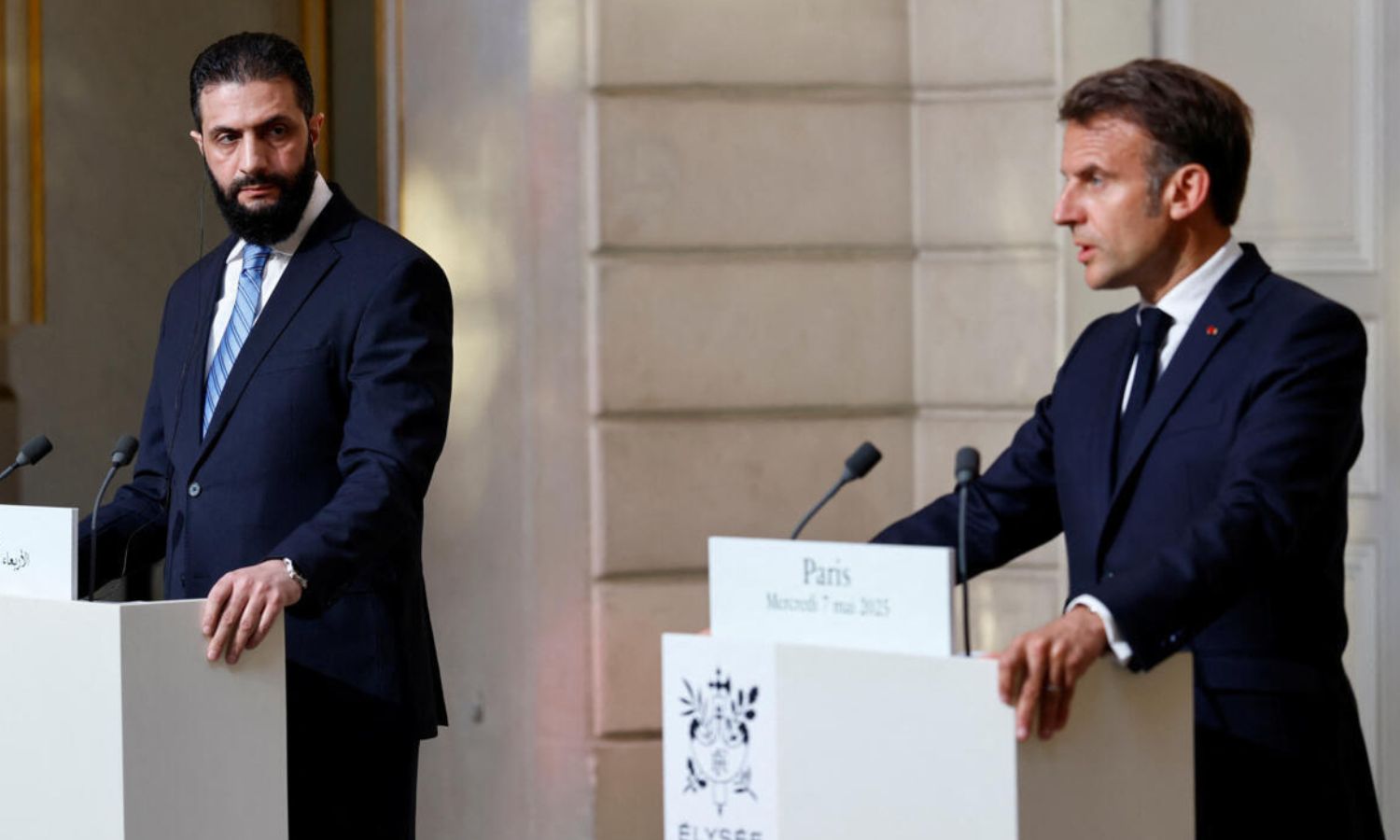
 Syrian President Ahmed al-Shar’a and France’s Emmanuel Macron during a joint press conference after a meeting at the Élysée Palace in Paris — May 7, 2025 (Reuters)
Syrian President Ahmed al-Shar’a and France’s Emmanuel Macron during a joint press conference after a meeting at the Élysée Palace in Paris — May 7, 2025 (Reuters)
Enab Baladi – Shaaban Shamieh
Since the fall of the Assad regime, Paris has played a role in Syrian affairs by expanding its political and economic footprint and deepening coordination across several files. Press reports indicate that France has taken on an active role that goes beyond the protection of minorities.
Paris opened its doors early to Kurdish officials as the first European state to support the “Autonomous Administration” and the Syrian Democratic Forces (SDF), hosting numerous meetings with Kurdish leaders during the tenure of former French president François Hollande and continuing under the current president, Emmanuel Macron.
According to reports, France’s role weighed on the southern Syria file after the events in Suwayda (southern Syria) last July, paving the way for Foreign Minister Asaad al-Shibani to be present in Paris and to communicate with the Israeli side. As a result, Paris now plays a role in both northeastern Syria and the south, amid talk of a “hidden” role on the Syrian coast.
Salam Kawakibi, Director of the Arab Center for Research and Policy Studies in Paris, told Enab Baladi it is difficult to speak of an effective French role in Syria given the dominance of the US role and its extensions over the scene, downplaying the likelihood of any covert French role on the coast.
Kawakibi added that there is no competition, as Paris knows its limits and its modest capacity to influence today’s Syrian reality. He said it is trying to be constructive with the new leadership in Damascus, reflected in invitations to President Ahmed al-Sharaa and his foreign minister to Paris, and that Damascus is expected to reciprocate positively by taking concrete steps on issues that could otherwise be used as pressure cards against it.
He noted that France’s limited capacity to influence does not erase the legacy of its historical, cultural, and social ties to Syria, nor its political and economic ambitions. Any Syrian leadership, he argued, should be careful not to rebuff this legacy, but rather make use of it economically, legally, and administratively, especially since the administrative and legal systems of both countries are similar and Syria can benefit from French expertise.
Despite France’s current domestic political confusion, Kawakibi said its foreign policy still rests on the principles laid down by General de Gaulle, with minor changes. Those engaging with France must understand its history and the imperatives of its statecraft.
Kawakibi said French interest in Syria centers on two core issues: protecting minority rights and safeguarding human rights.
He pointed out that, unlike Germany, France does not face large numbers of Syrian refugees and thus does not build its relationship with Damascus primarily around the file of French citizens affiliated with the Islamic State (ISIS) held in SDF-run detention, as their numbers are limited, most were killed, with comparatively higher numbers of their children and wives remaining.
France is also keen on the reconstruction file to “secure its share of the Syrian pie,” like many other countries, Kawakibi said. Beyond direct interests, Paris has a further priority: minorities, their protection, and inclusion in political life to guarantee equality and balance among all Syrian citizens of various components.
He added that this is what Syria’s new authorities have promised, yet certain daily practices suggest otherwise, an issue that worries Western observers, particularly the French.
The lack of accountability for crimes and violations committed on the Syrian coast and in Suwayda, and the failure to hold perpetrators to account, further deepens doubts about the seriousness of any talk of reform or transitional justice, he said, undermining confidence in the new authorities’ ability to build a state of law and citizenship.
Moreover, the violation of individuals’ rights outside the rule of law, regardless of identity or affiliation, raises concerns among all human-rights monitors watching the Syrian file, according to Kawakibi.
Eli Hatem, a lawyer at the Paris Bar and the International Criminal Court, and an adviser to the founder of France’s “National Front” party, told Enab Baladi it is currently difficult for France to play a role in Syria, despite attempts, even if President Macron has launched initiatives, because the United States has for decades been pushing France out of the Middle East and other regions where it once played a role, notably in Africa.
Hatem said that during Macron’s first term, the French president tried to revive France’s global role, an extension of de Gaulle’s “Arab policy of France”, but he was opposed by the US and its allies.
He pointed to France’s declining influence in Lebanon, adding that the same has happened in Syria. These pressures come either from within countries that have historical or natural ties with France (as in Lebanon) or via regional powers backed by the “Anglo-Saxon” world to curb France’s role.
Regarding Syrian Kurds, Hatem said France supported them, particularly in countering political Islam, whether al-Qaeda or ISIS, amid a belief that such organizations were spontaneous and posed dangers not only to Syria and the region, especially Iraq, but also to Europe, including France, which suffered attacks by groups affiliated mainly with ISIS and even Hayat Tahrir al-Sham, as he put it.
He then claimed the picture had become clearer: both organizations were “creations” of US and Zionist services to stir discord in the Middle East and inflame European public opinion against Muslims, especially Arab Muslims. He added that those who carried out terrorist attacks in France were of North African Arab origin with Arabic names, whereas hundreds of French citizens with French names joined ISIS and took part in atrocities, especially in Syria, yet were spared from carrying out attacks in France.
Hatem further alleged that Israeli Mossad and US services used individuals amid broad propaganda to push some into political-Islam groups “aligned with political Judaism,” as he put it.
Because of the Kurds’ contribution to curbing such groups by fighting ISIS and Jabhat al-Nusra, and after French services obtained this “information,” France relied on the SDF and backed it, he said. But the picture has since grown more complicated, particularly after December 8, 2024.
Hatem concluded that France’s role is now in retreat, particularly with economic and political deterioration at home. It is hard, he argued, for France to prioritize foreign policy while facing the risk of bankruptcy and internal political crises that could push the country toward civil strife. Despite Macron’s preference to focus on foreign policy, leaving the prime minister and cabinet to run domestic executive affairs, he now faces uncertainty over remaining in power, resigning, or dissolving parliament, given the turmoil that saw a cabinet formed and resign within less than 14 hours.
According to Hatem, it is necessary to wait and see what happens domestically and whether French institutions can stabilize under a strong government and strong leaders who break free from the EU’s US-dominated grip, following the examples of de Gaulle, François Mitterrand, or even Jacques Chirac, so that France can regain an independent foreign policy serving mutual interests with countries with which it has natural and historical ties.
He said political analysis of France’s role in Syria has intensified since Manaf Tlass appeared in Paris, with some taking this as a sign of international arrangements in the making and of a potential alternative or political partner. This is not the first time Tlass, controversial due to his and his family’s proximity to the Assad regime, has been floated.
Analysts attribute Tlass’s reemergence to France’s interest in presenting figures that are relatively acceptable to all sides to play an advisory or pivotal role if a consensus emerges, even if Paris does not officially impose him as an alternative leader. Rather, it offers him a platform to discuss institutional reform and governance in Syria and provides him with protected access in Western circles, signaling that France is open to scenarios beyond traditional alliances.
Others argue this fits a French approach of keeping platforms open to various Syrian figures without implying a clear French plan or strategic bet on Tlass. Accordingly, France’s role remains complementary, operating within narrow margins under limited political cover, and not exceeding US influence over any Syria-related track.
if you think the article contain wrong information or you have additional details Send Correction


 A
A
A
A
A
A


 More Politics