


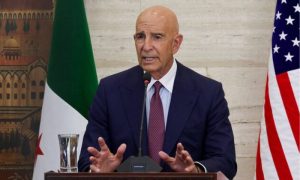
 US Chamber of Commerce Fall Meeting with the International Monetary Fund and the World Bank, October 21, 2025 (US Chamber of Commerce)
US Chamber of Commerce Fall Meeting with the International Monetary Fund and the World Bank, October 21, 2025 (US Chamber of Commerce)
The US Chamber of Commerce has called on Congress to enact a full and permanent repeal of the “Caesar Syria Civilian Protection Act,” arguing that the fall of Bashar al-Assad’s regime and the formation of a transitional government in Syria render the law “misaligned with US strategic interests.”
In a letter addressed to the chairs and members of the foreign affairs committees in the Senate and House, published on Tuesday, October 21, the Chamber said the law, passed in 2019 to hold the Syrian government accountable for human rights violations, “no longer serves US objectives.” It noted that other legal tools allow sanctions on individuals or entities responsible for such abuses.
The letter added that continuing to apply the law would constrain American companies’ ability to invest and engage in commerce in Syria due to the “uncertainty” created by semiannual renewal cycles and the possibility of snapback at any time, creating an environment that discourages long-term investment.
The Chamber stressed that US companies need “legislative clarity and stability” to operate effectively, warning that uncertainty surrounding the law’s future places the United States at a competitive disadvantage compared with countries already engaging in the reconstruction of Syria’s economy.
The letter concluded by urging Congress to act decisively to repeal the law, framing the step as serving US economic interests and contributing to “enhancing regional stability and the long-term prosperity of the Syrian people.”
On October 10, the Syrian American Council announced that the US Senate had approved lifting the “Caesar” sanctions imposed on Syria in 2020.
Mohammed Alaa Ghanem, a member of the Council, wrote on X that the Senate passed a provision in the National Defense Authorization Act (NDAA) stipulating the repeal of the Caesar Act, with a vote of 77 in favor to 22 against.
Ghanem added that another provision was also approved, comprising a set of benchmarks for the Syrian government to meet; while nonbinding, it would automatically reinstate Caesar sanctions in case of failure to comply.
He noted a further nonbinding clause stating that Congress should consider reimposing the Caesar Act if the Syrian government fails to make progress on the required steps for 12 consecutive months.
The provisions related to repealing the Caesar Act set out conditions that the Syrian government must implement for a full cancellation of sanctions to take effect.
These amendments followed the visit of Syria’s transitional president, Ahmed al-Sharaa, and his team, led by Foreign Minister Asaad al-Shaibani, to the United States on the sidelines of UN Week in New York at the end of September.
The Syrian diaspora in America also played a role in advancing the legislation after months of attempts that faced obstruction by Syrian actors such as the “Alawite Association,” and non-Syrian actors such as Israel, which wields significant influence in Congress and is strongly supported by members, including Lindsey Graham.
if you think the article contain wrong information or you have additional details Send Correction


 A
A
A
A
A
A







 More Politics