


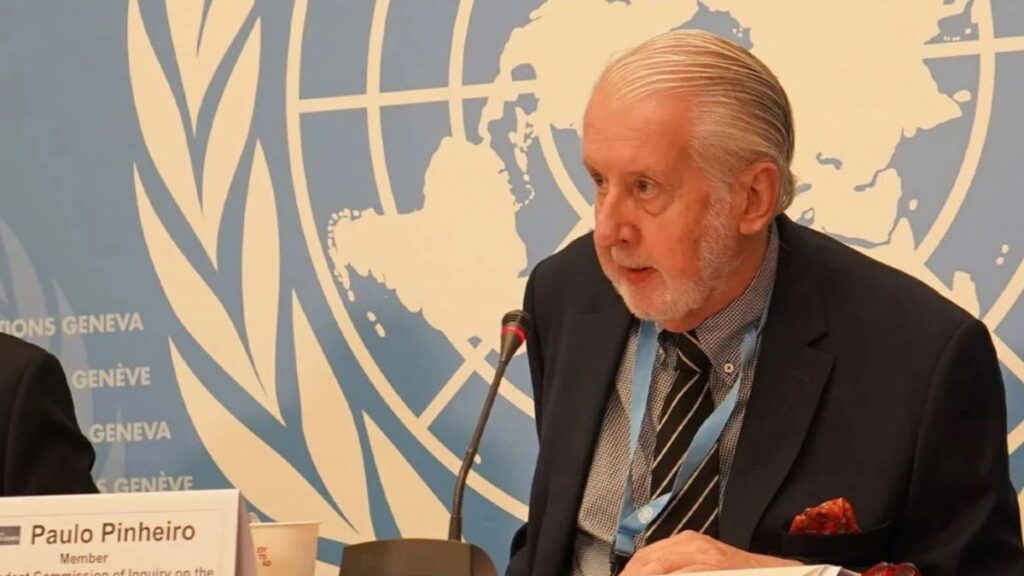
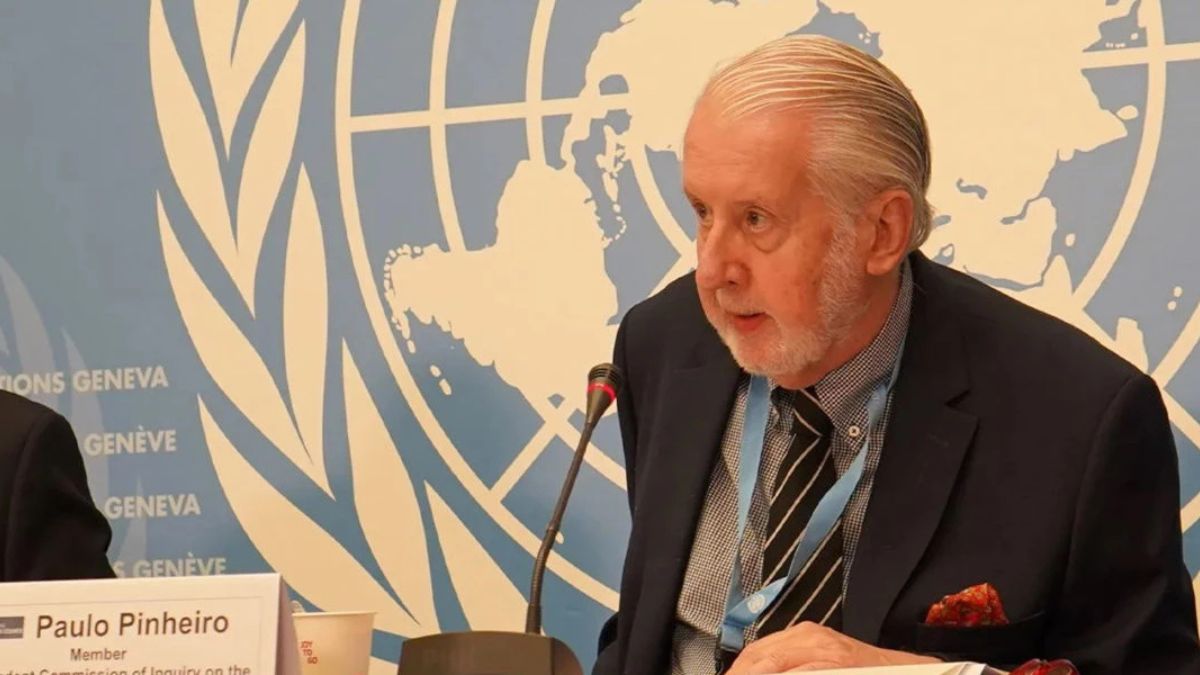
 UN Independent International Commission of Inquiry on Syria – 30 October 2025 (United Nations)
UN Independent International Commission of Inquiry on Syria – 30 October 2025 (United Nations)


 A
A
A
A
A
A
Paulo Sérgio Pinheiro, Chair of the Independent International Commission of Inquiry on Syria, said that despite positive steps taken by the Syrian government toward state-building, recurring and troubling waves of violence have dampened optimism about its ability to end the entrenched cycles of conflict in Syria.
He told the UN General Assembly’s 80th session on Thursday, 30 October, that the Syrian government has granted the Commission’s investigators free access to various parts of the country. In June, they conducted field visits to Latakia and Tartus, and more recently to Suwayda (southern Syria) and surrounding areas.
The team was able to visit Suwayda city and rural areas severely affected by the July violence, meeting victims, survivors, and witnesses to what he described as “atrocious events.”
According to Pinheiro, the Commission witnessed firsthand the scale of destruction across dozens of Druze-majority villages in western Suwayda, where more than 30 villages were almost entirely emptied of their residents, looted, and burned. Many bodies remain missing, and hundreds are still unaccounted for.
Investigators met families and witnesses who recounted the brutal killings of relatives taken from their homes. Pinheiro emphasized that the humanitarian needs of displaced Druze and Bedouin families are “immense and require urgent action as winter approaches.”
The July events, he added, not only left physical scars but also deepened mistrust between communities and the interim government, making swift and concrete steps toward accountability and reform essential to prevent recurrence.
The Suwayda events began on 12 July after mutual abductions between residents of al-Maqous neighborhood, home to a Bedouin-majority population, and several members of the Druze community, which escalated into armed clashes the following day.
The Syrian government intervened on 14 July to contain the conflict, but its actions were accompanied by violations against Druze civilians, prompting local factions, including those formerly cooperating with the Defense and Interior Ministries, to retaliate.
On 16 July, government forces withdrew from Suwayda after Israeli airstrikes, which were followed by retaliatory abuses against Bedouin residents. This triggered the deployment of tribal militias in what became known as “tribal mobilizations.” The violence subsided after a U.S.-brokered agreement between Syria and Israel to halt military operations.
Local factions now control the governorate, while Syrian security forces remain stationed on its outskirts and in its western countryside. The government faces accusations of besieging the province and blocking food and medicine, which it denies, accusing local factions of looting aid instead.
Pinheiro said that in March, an estimated 1,400 men, women, and children were killed in massacres across Latakia, Tartus, and Hama provinces, including at the hands of security forces affiliated with the interim government.
He added that armed men filmed themselves committing grave human rights violations, including executions and walking beside burned corpses in the streets. Before being executed, victims were subjected to sectarian slurs referencing their Alawite identity.
Tens of thousands fled to Lebanon, raising fears of continued displacement. The Commission continues to receive reports of extrajudicial killings, torture, ill-treatment, and forced displacement of Alawite civilians in Damascus and western provinces.
Pinheiro warned that in the aftermath of the March coastal events, and amid rising hate speech both online and in public gatherings, the situation remains volatile and could lead to further violence unless swift action is taken.
He stressed that progress must begin with serious, transparent accountability for those events, as well as for lesser-known violations committed since the formation of the interim government.
The UN official also expressed concern over rising violence and discrimination against women, noting numerous reports of women and girls abducted by unidentified armed groups, with some subjected to sexual violence and forced marriage. Families, he said, reported that despite notifying local authorities, “no action was taken to investigate or follow up.”
In response, Syria’s Minister of Justice Mazhar al-Wais said that public trials related to the coastal events will begin soon, inviting media outlets to attend. “There will be no impunity,” al-Wais told al-Mashhad TV on Wednesday, 29 October, stressing that accountability will apply to both “remnants” and those who committed violations against civilians.
He added that Syria has recently taken strict measures against individuals inciting sectarianism.
The coastal events broke out on 6 March after members of the former regime’s army attacked General Security personnel in rural Latakia (western Syria), leading to widespread violations and sectarian killings.
The Commission noted that tensions persist in northeastern Syria, with reports of clashes in Aleppo city and near the Tishrin Dam in early October.
Fighting in Aleppo’s Ashrafieh and Sheikh Maqsoud neighborhoods, between the Syrian army and the Kurdish-led Syrian Democratic Forces (SDF), halted after a ceasefire agreement was reached on 7 October, according to Syria’s state-run al-Ikhbariya TV.
Enab Baladi’s correspondent in Aleppo reported that hostilities stopped following sniper exchanges and artillery shelling that reached civilian areas in other parts of the city.
However, clashes between the SDF and government forces continue to flare intermittently across northeastern Syria, with both sides trading blame.
Pinheiro said that in December 2024, Israel launched incursions into southern Syria, leading to forced displacement and arbitrary detentions, while Israeli airstrikes, including in Damascus, have continued, causing civilian casualties.
He urged member states to prevent Israel from carrying out such actions, warning that third-party intervention risks further fueling the conflict and deepening Syrian suffering.
Pinheiro welcomed recent steps by several countries and the European Union to ease sanctions on Syria, saying they improved daily life for Syrians but adding that member states “can and must do more,” including funding the 2025 humanitarian appeal, which remains only 19% financed.
“We emphasized the unique opportunity available to Syrians to bring about a profound transformation in the landscape of truth, justice, and accountability in the country. While the challenges are immense, the opportunities are immense as well. We have already seen notable progress in establishing the new Transitional Justice Authority and the National Commission for the Missing. These two institutions are crucial to meeting victims’ needs for justice and ensuring non-repetition.”
Paulo Sérgio Pinheiro,
Chair of the Independent International Commission of Inquiry on Syria
Pinheiro previously called on Syrian authorities, during a 23 September session of the Human Rights Council, to urgently address the root causes of violence, prevent recurrence, and rebuild trust between the state and affected communities.
He said Syrians continue to hold onto hope despite ongoing violence and abuses, warning that failure to reconcile conflicting visions for Syria’s future threatens further fragmentation and could paralyze state-building efforts or even plunge the country into prolonged conflict.
The Commission, he added, met with government officials in Damascus to discuss political and institutional transition measures necessary to safeguard Syrians’ rights. It emphasized the importance of justice for all victims and urged greater engagement with local human rights organizations to support survivors and strengthen accountability.
Pinheiro said Minister of Justice Mazhar al-Wais assured the Commission that judicial oversight of detentions would be guaranteed and that detainees would be allowed contact with their families and lawyers. The Commission will closely monitor these promises, he added, renewing its call for a moratorium on executions as a step toward abolishing the death penalty.
if you think the article contain wrong information or you have additional details Send Correction




 More Politics