


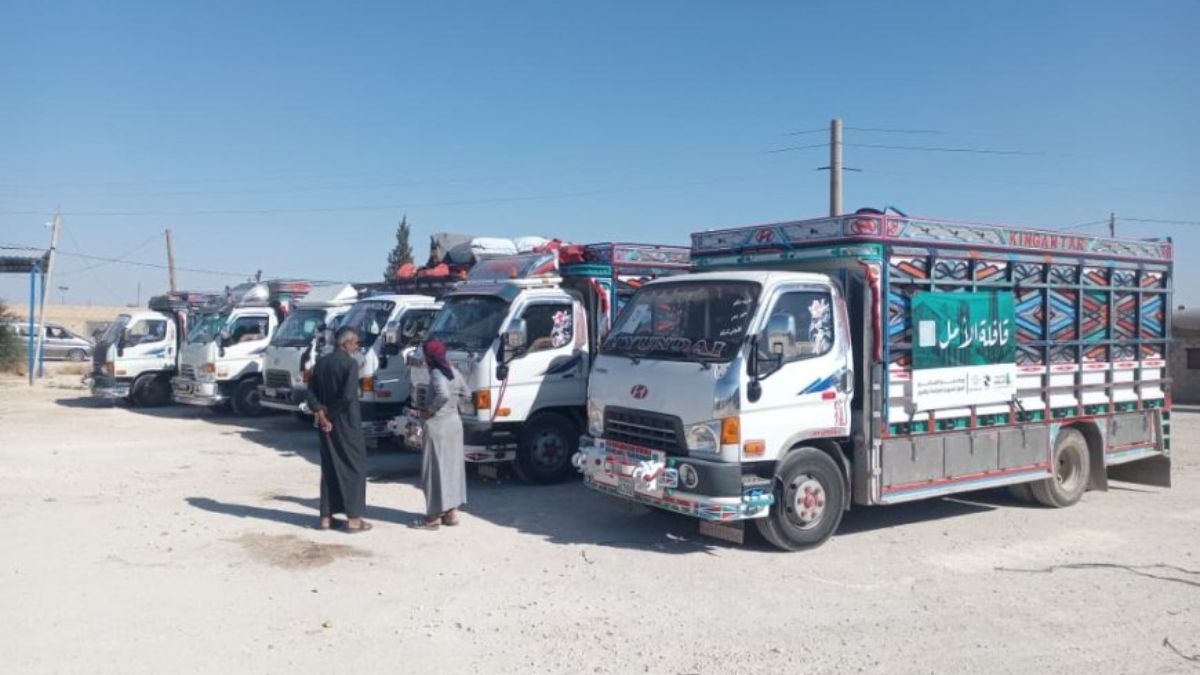
 12 families, totaling 55 people, depart al-Hol camp (near al-Hasakah, northeastern Syria) as part of “Caravan of Hope 3”, October 26, 2025 (Hawar).
12 families, totaling 55 people, depart al-Hol camp (near al-Hasakah, northeastern Syria) as part of “Caravan of Hope 3”, October 26, 2025 (Hawar).
A new group of 12 families, comprising 55 people, most of them women and children from Homs, Hama, Idlib, and Aleppo, left al-Hol camp on Sunday, October 26.
This is the third convoy under the “Caravan of Hope” initiative launched by the camp administration in coordination with the UN Refugee Agency office in Damascus and its branch in Qamishli (al-Hasakah, northeastern Syria), in cooperation with local organizations. The initiative is one of several steps the Autonomous Administration of North and East Syria says it is taking to close the displacement file, amid growing local and international calls to ensure a safe and dignified return for all displaced Syrians and refugees, according to the AANES-aligned Hawar News Agency.
The Administration said the move is part of a broader plan to return camp residents to their areas of origin, at a time when the Transitional Government in Damascus continues, in its words, to shirk its responsibilities toward the internally displaced inside Syria, adding to the burdens on the Autonomous Administration.
On January 23, the Administration issued a decision saying “it is time” for displaced people to return to their homes, declaring readiness to support humanitarian cases in camps across northeastern Syria to voluntarily return to their cities.
Al-Hol camp lies on the outskirts of al-Hasakah (northeastern Syria, near the Syrian–Iraqi border). It hosts former Islamic State fighters and their families alongside Syrian and Iraqi civilians.
The first “Caravan of Hope” convoy comprised 42 families totaling 178 people with chronic illnesses and other humanitarian cases, and headed to Aleppo on June 15.
Before departure, participating parties signed a formal agreement setting out coordination terms and mechanisms. At the time, Jihan Hanan, co-chair of al-Hol camp, said the administration was continuing to work with all concerned parties to ensure safe returns for all Syrians to their areas of origin, with “full respect for their will and dignity.”
The second convoy departed on July 30 with 36 families totaling 127 people from Homs, Aleppo, and Raqqa.
Hussein Shlash, project coordinator at the Syria Stabilization Support Unit, told Enab Baladi then that the second convoy consisted of five buses and 20 trucks to carry families’ belongings, in addition to ambulances, doctors, and mental-health specialists to support children and provide psychosocial care, noting that many of these children were emerging from harsh humanitarian conditions and psychological distress.
Rami Hayek, a physician with the Aleppo Health Directorate, told Enab Baladi that five ambulances and an equipped medical team would accompany the convoy to evacuate families from al-Hol camp.
The Autonomous Administration in northeastern Syria said it reached an understanding with the Syrian government to set up a mechanism to remove Syrian families from al-Hol, which hosts families of Islamic State fighters in eastern al-Hasakah governorate.
On May 26, the Administration published a statement by Shekhmus Ahmed, head of its Office of Displaced Persons and Refugees Affairs, announcing agreement with the government on a joint mechanism to release Syrian families from al-Hol and return them to their home areas.
Ahmed said a trilateral meeting was held at al-Hol camp that brought together a delegation from the Syrian Transitional Government, a delegation from the International Coalition, and representatives of the Autonomous Administration. He added the meeting ended with agreement on a joint mechanism to end the suffering of these families by facilitating their exit from the camp.
The Syrian Interior Ministry spokesperson, Nour al-Din al-Baba, said al-Hol’s management would be different from before, aiming to transform it “from an inhumane hotspot into a comprehensive community rehabilitation file.”
The Internal Security Forces (Asayish) affiliated with the Autonomous Administration launched a new security campaign in al-Hol to prevent the Islamic State from “exploiting the most vulnerable groups and spreading extremist ideas inside the camp,” as they put it.
In a statement on September 5, Asayish announced a new phase of the “Humanity and Security” operation to “protect camp residents and ensure that humanitarian organizations can continue working safely.”
According to the statement, recent months saw an uptick in attacks by Islamic State cells inside the camp, with 30 incidents recorded targeting humanitarian workers and damaging facilities and basic services.
Al-Hol hosts 46,500 people, including Syrians, Iraqis, and third-country nationals, according to Amnesty International estimates in May 2025.
if you think the article contain wrong information or you have additional details Send Correction


 A
A
A
A
A
A




 More Politics