


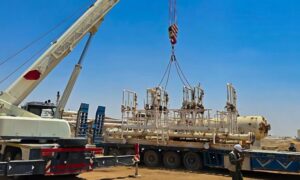
 Installation of a new power transformer at the Ibn al-Nafis substation in Damascus – July 28, 2025 (Ministry of Energy)
Installation of a new power transformer at the Ibn al-Nafis substation in Damascus – July 28, 2025 (Ministry of Energy)
Several regions across Syria, including Damascus, its countryside, Aleppo, and Daraa (southern Syria), have experienced a noticeable decline in electricity supply in recent days, raising questions about the extent of benefit from Azerbaijani gas that began flowing into Syria via Turkey on August 2.
Enab Baladi’s correspondent in Rural Damascus reported earlier that cities and towns in the province suffer from irregular power supply and the absence of a fixed rationing schedule, with electricity available between four and eight hours daily across different areas.
Residents of the village of Tsil (in Daraa province) also complained of long power outages, according to a video report published by Enab Baladi on September 30.
In Damascus, residents of the Qaboun neighborhood expressed frustration over the deteriorating state of the city’s electrical network and the frequent interruptions in supply.
Amid this challenging situation, the Syrian Ministry of Energy explained the reasons behind the decline in power generation.
Spokesperson for the ministry, Ahmed al-Suleiman, said in a statement published on October 4 that “after Azerbaijani gas entered our network in recent days, we witnessed a significant improvement in electricity generation and distribution, consistent with previous promises.”
However, al-Suleiman added that due to “technical challenges and infrastructure deterioration in certain sites,” a malfunction occurred in the compressors of the Twinan station, causing a drop in electricity production.
He said ministry teams are working to repair the fault and restart the compressors, promising a “tangible and relative improvement” once maintenance is completed.
Al-Suleiman noted that sustainably improving Syria’s power sector requires “time and continuous effort” given the major challenges facing the “generation, transmission, and distribution system,” in addition to network losses, illegal connections, and weak consumption efficiency.
Khaled Abu Di, Director General of the General Organization for Electricity Transmission and Distribution, told Enab Baladi on September 22 that electricity available for distribution “is not fixed but fluctuates depending on available generation levels. When output increases, rationing hours decrease, and vice versa.”
He stressed that accurate data is essential for grid analysts at the coordination center.
Abu Di explained that before the arrival of Azerbaijani gas, the adopted rationing schedule provided one hour of supply for every five and a half hours of outage, with some variation in Damascus due to its high population density and apartment-style housing, which tend to lower consumption compared to rural areas.
After the gas began flowing, the schedule improved to two hours of supply for every four hours of outage. But the improvement was short-lived, as supply later fell again to about one hour on for every five and a half or six hours off, due to the shutdown of several fuel-powered turbines after emergency breakdowns, most notably at the Aleppo Thermal Power Plant and the al-Zara station, according to Abu Di.
He added that rationing schedules are determined by distribution companies based on available generation, but sudden failures in generation or transmission can disrupt these schedules and cause irregular supply in some regions.
As for the distribution mechanism, Abu Di clarified that all generated electricity is pumped into the national transmission grid, which operates in a loop structure ensuring even distribution of any increase in generation across regions. Allocation to provinces is determined based on several criteria, including:
Natural gas from Azerbaijan began flowing into Syria through Turkey on August 2. Turkish Energy Minister Alparslan Bayraktar said at the time that electricity exports to Syria were conducted through eight connection points, with plans to initially increase export capacity by 25% and later more than double it.
Youssef al-Youssef, Director of the Syrian Gas Company, told Enab Baladi then that Syria receives 3.4 million cubic meters of gas daily from Azerbaijan via Turkey, which is immediately fed into Syria’s gas network. He added that the supply ramped up gradually during the first week before stabilizing at the declared rate.
if you think the article contain wrong information or you have additional details Send Correction


 A
A
A
A
A
A




 More Economic Reports