


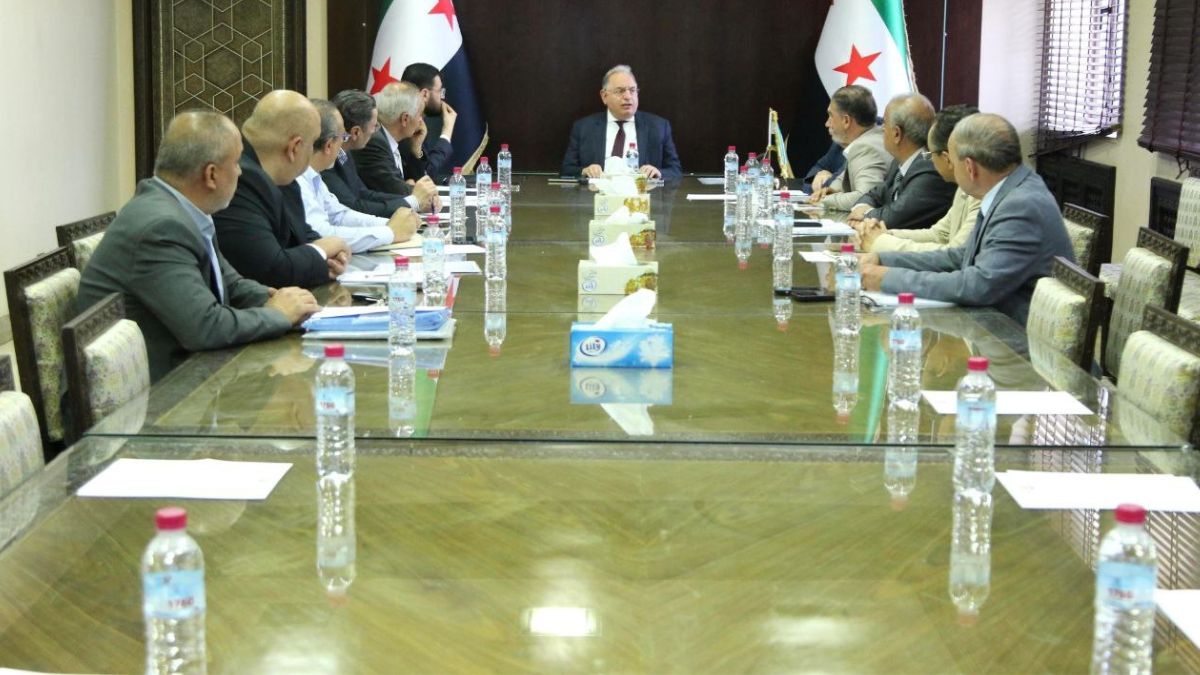
 Finance Minister Mohammed Yosr Bernieh during a meeting of the Tax Reform Committee in Damascus, 5 July 2025 (Ministry of Finance)
Finance Minister Mohammed Yosr Bernieh during a meeting of the Tax Reform Committee in Damascus, 5 July 2025 (Ministry of Finance)
Syria’s Finance Minister, Mohammed Yosr Bernieh, said this year’s budget will post either a small surplus or a minor deficit that the ministry can finance without economic pressure.
In an interview with Al Arabiya aired on Monday, 20 October, Bernieh added that the ministry began drafting the 2026 budget several weeks ago, noting that no figures have been set yet.
He stressed that the upcoming budget will “carry substantial economic and social policy content, not just numbers, collections, and spending.”
Bernieh said the ministry is determined to reform legislation, systems, and requirements to make Syria’s financial system clean and highly efficient, adding that anyone who reviews the overhauled national anti–money laundering plan will be reassured it is comprehensive.
In January, the Presidency of the Council of Ministers in the Damascus-based government adopted the “one-twelfth” rule for the 2025 fiscal year, allowing monthly spending up to one-twelfth of 2024 appropriations.
According to the decision reported by the Syrian Arab News Agency (SANA), payroll and allowances may exceed their allocated lines to cover actual dues for public-sector employees. The decision also adjusts the fuel line (gasoline and diesel) to current prices while keeping allocated quantities unchanged.
At the same time, the decision restricts general expenditures to necessities and, in the narrowest possible scope, to ensure efficient resource allocation.
Bernieh said the draft budget law introduces safeguards to avoid deficit monetization by borrowing from the Central Bank of Syria, noting that the Finance Ministry has not and will not borrow from the central bank.
If a deficit must be financed, the ministry will rely on “real” sources, he said, tax revenues, fees, and some export proceeds such as phosphates.
He added that government finances are sound, with tax receipts rising month after month due to reforms and anti-corruption measures. The ministry has repaid all prior advances owed to the central bank, he said.
According to Bernieh, the ministry wants a fully independent central bank and clear rules for the Syrian pound within public finance, which would help stabilize the currency.
Bernieh said the ministry is considering issuing domestic sukuk of a certain size next year to create a benchmark that helps price financial assets in the Syrian market. He said the instruments could be used to finance any budget deficit, while ruling out, for now, any issuance of bonds or sukuk on international markets, without excluding that possibility in the future.
Central Bank Governor Abdul Qader Hasriyeh stated in early July that, by order of President Ahmed al-Sharaa, Syria will not resort to external debt and will not seek borrowing from the International Monetary Fund, the World Bank, or similar institutions. For deficit financing, he pointed to domestic sukuk as a primary tool, alongside continued cash-flow from internal and external borrowing over an estimated 15–20 years.
Bernieh has made similar points on multiple occasions, including in a mid-June interview with Enab Baladi, saying Syria is not seeking loans from international financial institutions at present. He left the door open, however, pledging that “if we ever decide to borrow, we will tell our people and be transparent about the reasons.”
if you think the article contain wrong information or you have additional details Send Correction


 A
A
A
A
A
A


 More Economic Reports