


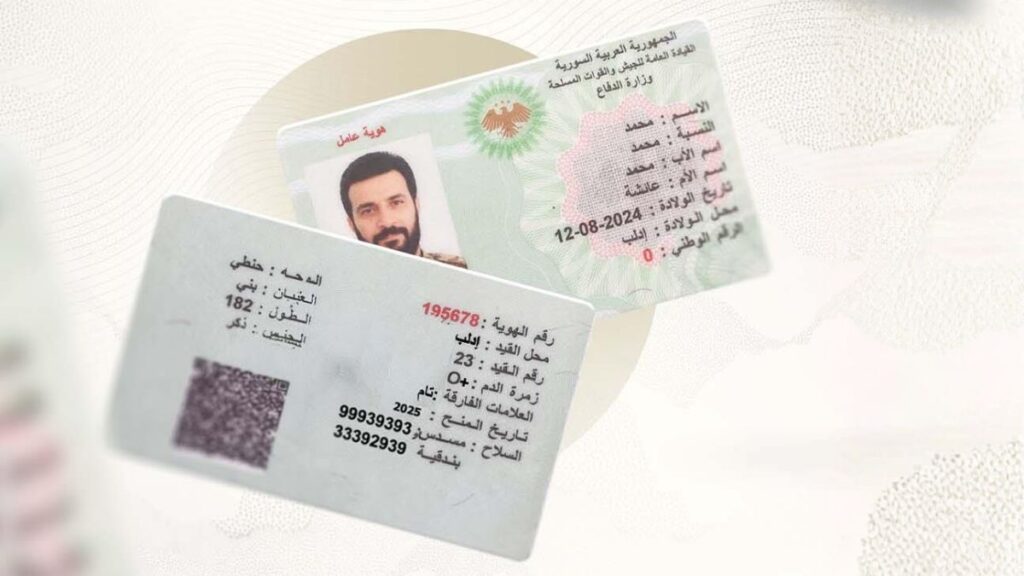
 The new model of military identification cards for Defense Ministry personnel – October 9, 2025 (Syrian Ministry of Defense/Facebook)
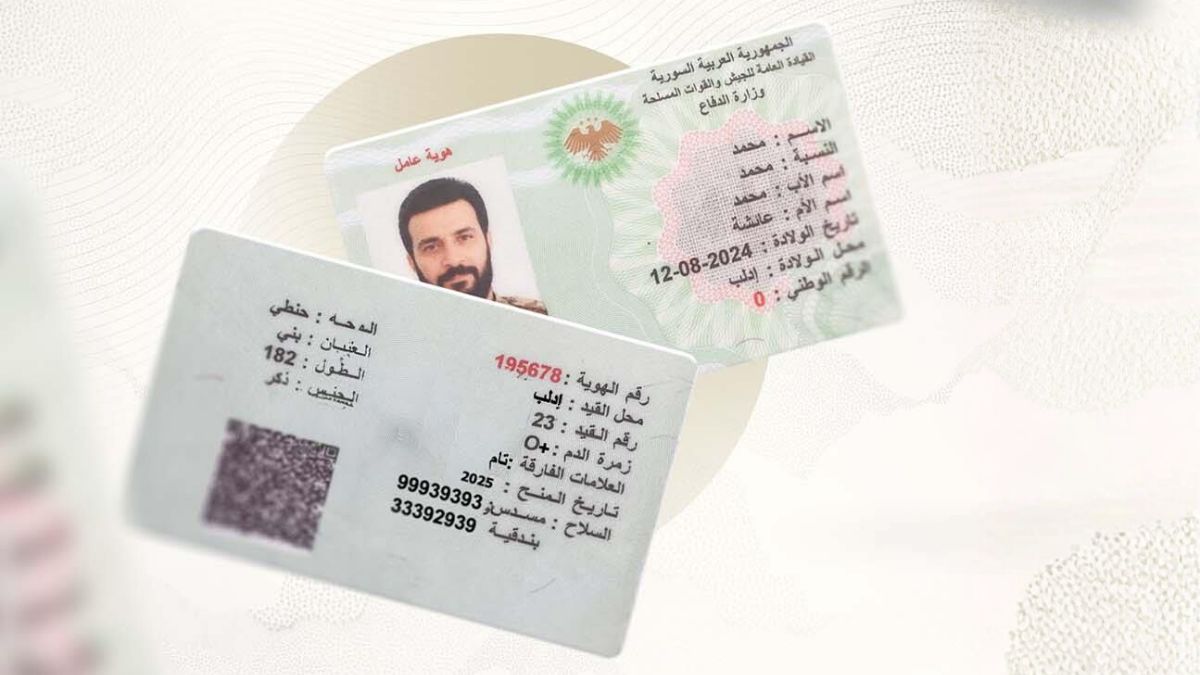
The new model of military identification cards for Defense Ministry personnel – October 9, 2025 (Syrian Ministry of Defense/Facebook)
The Syrian Ministry of Defense has begun issuing new military identification cards for members of the Syrian army as part of efforts to reinforce discipline, institutional belonging, and unified identity.
In a statement on Thursday, October 9, the ministry said the new card serves as an official document for all personnel of the Syrian Arab Army, accurately recording their data and facilitating both military and civilian administrative procedures. It also represents “a symbol of belonging and pride in joining the ranks of the Syrian Arab Army.”
According to the ministry, the rollout aims to:
Strengthen discipline and institutional identity among army personnel
Ensure accurate and reliable data documentation
Simplify administrative and organizational procedures
Promote the image of the army as a modern, organized institution
The Ministry of Defense stated that the new military ID offers several benefits to members of the army, including verifying their military identity, protecting their personal and professional data, and enhancing internal coordination between units.
The ID also supports the army’s organization by:
Standardizing identity to strengthen institutional and administrative discipline.
Managing data and records in a professional and advanced manner.
Facilitating human resources and task management.
Enhancing efficiency in internal monitoring and oversight.
Defense Minister Marhaf Abu Qasra stated on X Wednesday evening that “the military ID is not merely an administrative tool or a step toward institutionalization, but a banner of belonging, a pledge of honor, and a reminder that its bearer is among the protectors of the homeland and the makers of its glory.”
The Defense Ministry issued a directive on September 30 prohibiting the production or embroidery of military insignia to regulate their use.
In the circular, published on Facebook, the ministry instructed all tailoring and embroidery workshops, both public and private, to stop producing or stitching military patches, emblems, or ranks in order to prevent unauthorized circulation.
It warned that violators would face legal accountability and noted that the ministry’s Supply and Logistics Directorate emphasized strict compliance with the decision, holding violators fully responsible under the law.
In June, an official from the Defense Ministry’s media office revealed that the ministry was preparing to issue advanced encrypted military identification cards containing both personal and digital data, designed to strengthen institutional reliability and identity.
The source did not specify when the new cards would be launched, despite Enab Baladi’s inquiry about the timeline for the ministry’s broader organizational process.
On June 18, the Defense Ministry held a meeting to discuss administrative arrangements and the organizational structure of the Syrian armed forces.
The meeting, chaired by Defense Minister Marhaf Abu Qasra and the Organization and Administration Directorate, was part of ongoing efforts to enhance discipline and institutional modernization within the ministry.
Discussions focused on regulating the army’s structure, organizing the issuance of military IDs and weapon-carrying permits, ensuring accuracy and transparency, and preventing misuse.
The meeting also covered priority files related to reassessing structures and positions, redistributing manpower within military formations, and improving readiness in line with current needs.
According to the ministry, the discussions fall within “the Defense Ministry’s approach to meet the requirements of institutional and administrative development and to ensure the efficiency of organizational work while reinforcing the prestige of the armed forces.”
On May 30, the Defense Ministry issued a code of conduct for recruits following the near-complete integration of former factions into the national army.
The charter aims to consolidate discipline, legal commitment, and respect for rights and freedoms as the foundation for building a professional national army.
The code outlines the core duties of military personnel, including:
Defending the homeland, its sovereignty, and territorial unity
Sacrificing for the security of the nation and its citizens
Protecting civilians, especially women and children, under all circumstances
Executing lawful orders
Respecting civil and military laws
Preserving public and private property and treating citizens with dignity regardless of religion, ethnicity, or affiliation
Adhering to international humanitarian law in dealing with enemies, the dead, wounded, and prisoners during operations
Upholding the chain of command and internal discipline
It also specifies prohibitions for army recruits, including:
Disobeying lawful military orders
Assaulting civilians
Damage to public and private property
Promoting slogans or positions that harm national unity or civil peace
Insulting detainees or failing to hand them over respectfully to competent authorities
Disclosing military secrets or sensitive information
Photographing sites or operations without authorization
Making media statements or publishing data without Defense Ministry approval
Violating public morals or social customs in the areas where the armed forces operate
if you think the article contain wrong information or you have additional details Send Correction


 A
A
A
A
A
A



 More Politics