


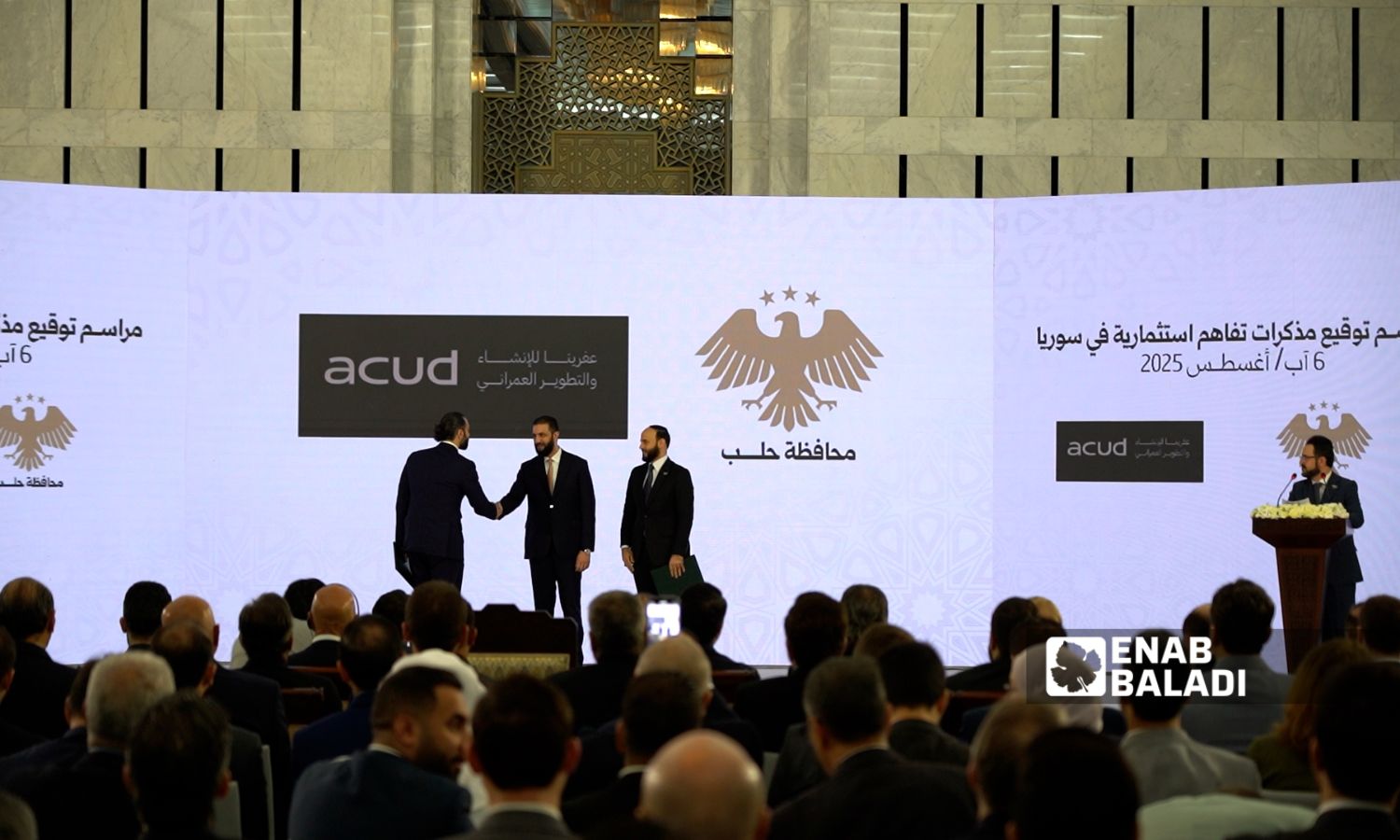
 Syrian President Ahmad al-Sharaa oversees the signing of memoranda of understanding between Arab investors and Syrian provinces – August 6, 2025 (Enab Baladi/Anas al-Khuli)
Syrian President Ahmad al-Sharaa oversees the signing of memoranda of understanding between Arab investors and Syrian provinces – August 6, 2025 (Enab Baladi/Anas al-Khuli)


 A
A
A
A
A
A
The Governor of the Central Bank of Syria, Abdul Qader Hasriyeh, announced on Monday, October 6, that the bank has prepared a draft of the executive regulations for Investment Banking Law No. 56 of 2010, without clarifying whether this is the first such regulation or a revision of earlier ones.
In a statement published on Facebook, Hasriyeh described the preparation of the regulations as a “qualitative step contributing to the development of Syria’s financial and banking system, meeting the financing needs of reconstruction, and enhancing the investment environment in line with regional and international transformations in financial services.”
Law No. 56 defines an “investment bank” as a financial institution that aims to finance private-sector investment activities, participate in funding public-sector economic projects, provide advisory services, and contribute to establishing companies, in accordance with the provisions of the law.
According to Hasriyeh, the law and its executive regulations aim to:
He added that licensing investment banks in Syria, once the executive regulations of Law No. 56 are issued, would represent “a strategic step toward building a modern Syrian economy based on investment, transparency, and accountability.” He did not, however, mention whether any investors or businessmen had submitted applications for investment bank licenses.
In August, the Central Bank denied reports that new banks had been established, confirming via its Telegram channel that no licenses had been granted for any new banks in Syria.
“It has come to our attention that some outlets are circulating news about the establishment of new private banks,” the bank said. “We clarify that no new bank licenses have been issued in Syria.”
However, it acknowledged that “several Arab and foreign banks have expressed interest in entering the Syrian banking market to benefit from the investment opportunities linked to reconstruction and new projects.”
The bank added at the time that it welcomes applications to establish private banks and conducts the necessary studies for licensing new institutions in accordance with Law No. 28 of 2001 and its amendments, as well as international standards and the needs of the Syrian economy. Any licensing, it said, is subject to formal registration procedures and public announcement in the Central Bank’s register of banks.
Under Law No. 28 of 2001, “banks may be established as private Syrian joint-stock companies or as joint Syrian shareholding companies, in which the public banking sector, the Syrian General Insurance Corporation, and other savings institutions may hold up to 25% of the capital by decision of the Council of Ministers.” Such banks operate under the supervision of the Central Bank of Syria.
According to Law No. 56 of 2010, investment banks in Syria may exclusively engage in the following activities:
if you think the article contain wrong information or you have additional details Send Correction









 More Economic Reports