


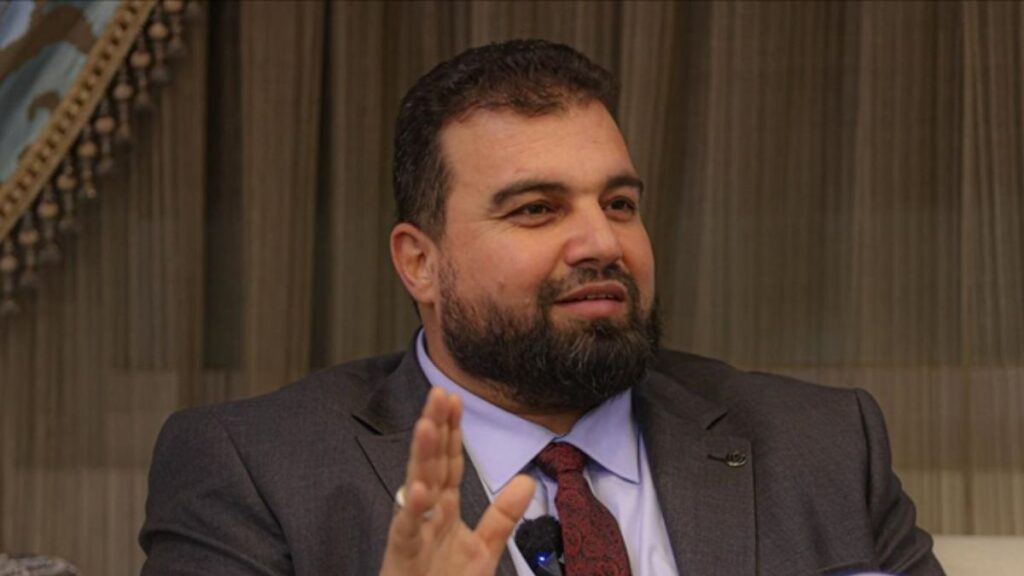
 Suwayda Governor during an interview with Turkey’s Anadolu Agency – April 24, 2025 (Anadolu)
Suwayda Governor during an interview with Turkey’s Anadolu Agency – April 24, 2025 (Anadolu)
Suwayda Governor Mustafa al-Bakour said the deterioration of public services in the southern province is not due to government negligence but to “internal positions” and the absence of official communication channels with Damascus.
He stressed that “the state is ready to provide resources and services, but certain parties are preventing that and insist on acting outside legal frameworks.”
During a meeting with journalists and media representatives on October 8, attended by Enab Baladi, al-Bakour explained that recent developments pushed Suwayda to adopt “special positions” that isolated it from state institutions. He added that some actors “allowed countries like Israel and the United States to speak on their behalf in international forums,” further complicating the situation.
The governor said that anyone who tried to contact the government “was threatened,” prompting the authorities to wait until “some local figures began reopening channels for dialogue.”
Al-Bakour noted that while the government has secured quantities of wheat and flour for the province, the “absence of an official entity to receive them” prevented their organized distribution.
He added that Damascus was also ready to supply large amounts of fuel on the condition that financial processing take place in the capital, something the “forces controlling the province” refused, insisting instead on keeping funds within Suwayda’s bank, which he said is “under the control of armed factions.”
The governor revealed that an “illegal committee” had seized about 20 billion Syrian pounds (approximately 1.5 million USD) and one million dollars from the Suwayda bank without oversight or official reports. This, he said, hindered the payment of salaries and the direct transfer of government funds.
According to al-Bakour , the government proposed delivering salaries through the Syrian Arab Red Crescent for distribution to local directorates, but local authorities refused, arguing that this would “bypass the illegal committee and the factions,” while continuing to claim they were “under siege.”
Local factions in Suwayda, led by Sheikh Hikmat al-Hijri, had formed a “legal committee” to handle public affairs in the province. The committee rejected the government’s roadmap for resolving the crisis, while Damascus denied having coordinated with it.
Al-Bakour emphasized that state institutions remain operational within Suwayda’s administrative structure despite limited external communication. He said the government continues to provide hospitals with medicine and supplies and is working on temporary solutions to maintain services in villages under state control, particularly in the western, northern, and eastern countryside.
He announced the reactivation of security directorates in the towns of al-Surah and al-Mazraa and the opening of offices to facilitate citizens’ paperwork.
On education, al-Bakour said that several high school students were transferred to examination centers in rural Hama and Latakia in coordination with the Ministry of Education, with security escorts to ensure their safety. He added that the government had proposed holding secondary exams in Damascus “to avoid any threats” after protesters stormed the Education Directorate in Suwayda and objected to the ministry’s official logo.
Regarding humanitarian assistance, the governor spoke of efforts to secure the main road between Damascus and Suwayda through the city of Shahba, describing it as “the only safe route” for aid deliveries. He said the Ministries of Interior and Defense had deployed checkpoints along the road to safeguard convoys.
Al-Bakour said that “media campaigns are attempting to portray Suwayda as ostracized,” announcing the launch of an initiative titled ‘Suwayda Is Part of Us’ involving youth from various Syrian provinces. The campaign aims to “restore national cohesion and improve infrastructure” in the western and northern countryside.
According to the governor, donations from the campaign will be directed toward repairing water wells, rehabilitating 50 schools, 35 mosques, 50 Druze religious centers, and 15 churches, in addition to equipping 20,000 homes, 40 municipalities, cultural centers, streets, lighting, and electricity networks. It will also fund the rehabilitation of the Samia water station that supplies the western and northern countryside.
The governor concluded by urging residents to “remain calm and trust the state,” affirming that the government “is systematically addressing pending issues” and warning that further escalation “will only increase people’s suffering and delay stabilization efforts.”
The Suwayda (southern Syria) unrest began on July 12 following reciprocal kidnappings between residents of the Bedouin-majority al-Maqous neighborhood and members of the Druze community.
The next day, the situation escalated into armed clashes.
The Syrian government intervened on July 14 to contain the conflict, but its involvement was accompanied by violations against Druze civilians, prompting local factions, including groups previously cooperating with the Defense and Interior Ministries, to retaliate.
On July 16, government forces withdrew from Suwayda after Israeli airstrikes targeted them. The withdrawal was followed by retaliatory attacks and abuses against Bedouin residents, leading to the mobilization of tribal convoys to support them.
Subsequently, the Syrian government and Israel reached a ceasefire agreement brokered by the United States, ending military operations in the province.
if you think the article contain wrong information or you have additional details Send Correction


 A
A
A
A
A
A


 More Politics