


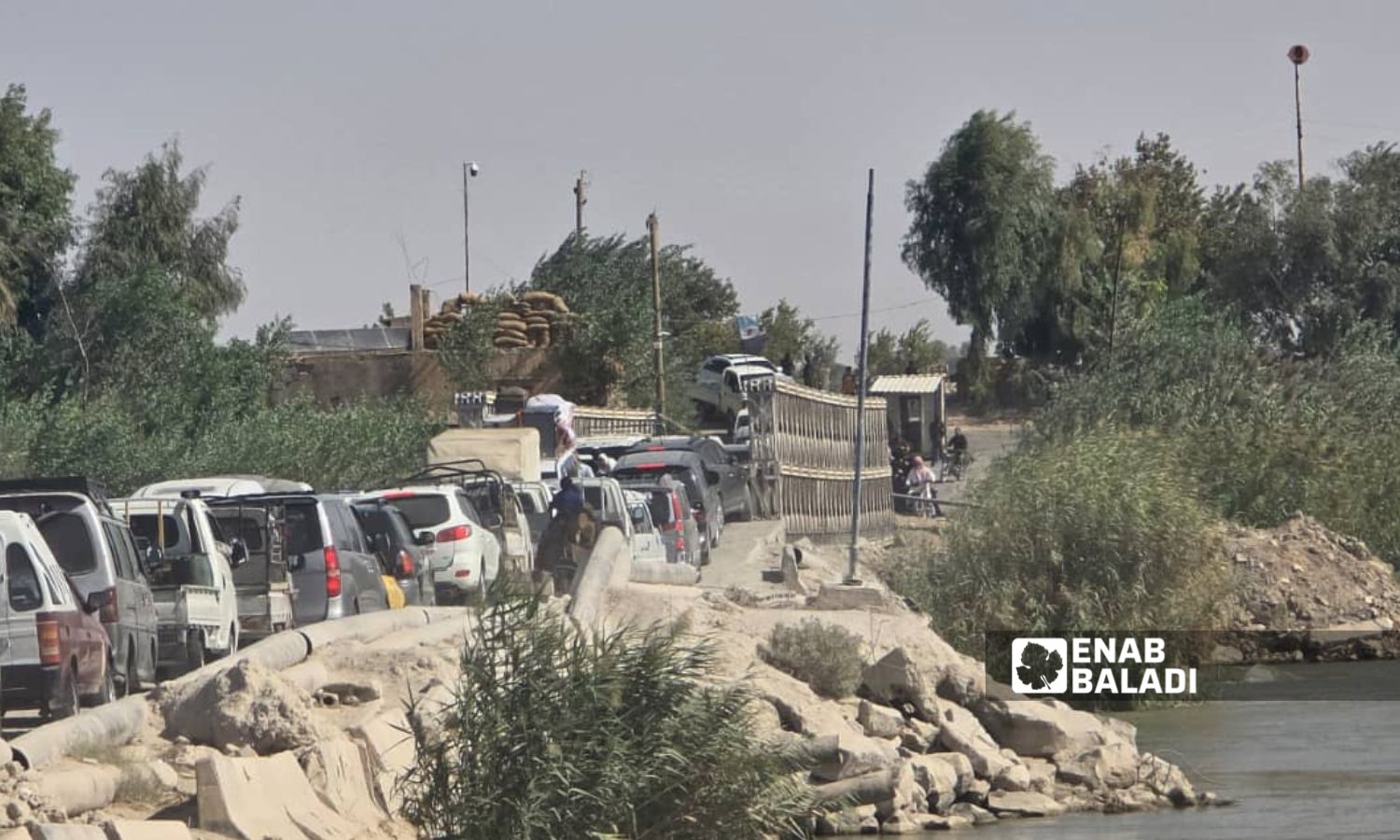
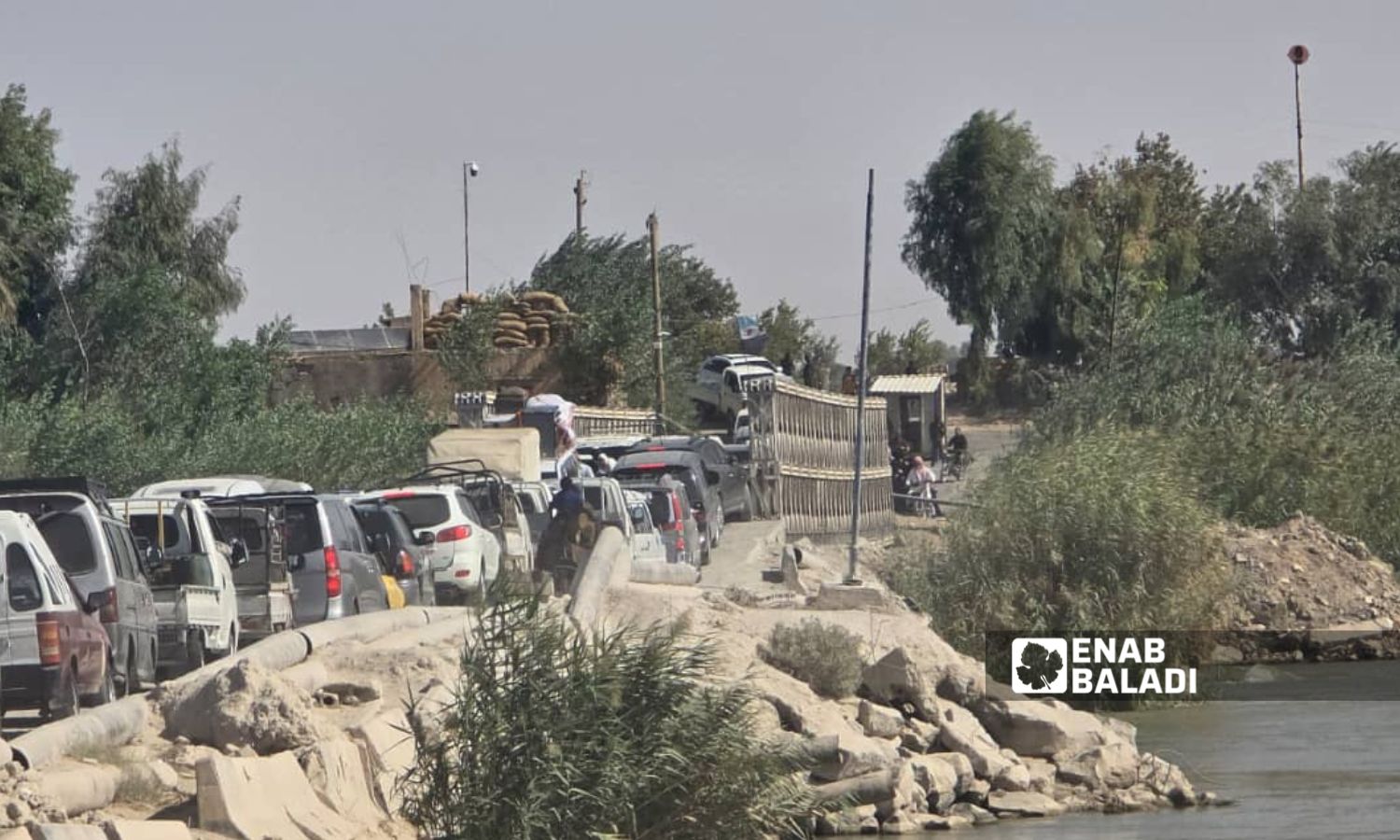
 Crowds on the dirt bridge between SDF-held areas and Syrian government areas after all crossings in Deir ez-Zor were closed, 6 October 2025 (Enab Baladi/Obada al-Sheikh)
Crowds on the dirt bridge between SDF-held areas and Syrian government areas after all crossings in Deir ez-Zor were closed, 6 October 2025 (Enab Baladi/Obada al-Sheikh)
Enab Baladi – Mowaffak al-Khouja
The repeated opening and closing of crossings between the Syrian government and the Syrian Democratic Forces (SDF) has continued following a military escalation along contact lines between the two sides. This has negatively affected the local economy, in addition to social and political impacts, despite the agreement reached on 10 March and the ceasefire on 7 October.
SDF-held areas connect with government-held areas via several crossings in three main governorates. In Aleppo, the crossing is in the Deir Hafer area (eastern Aleppo). In Raqqa, the crossing is in the southern part of the governorate. In Deir Ezzor (eastern Syria), residents rely on river crossings to move between the two banks of the Euphrates, along with a single unprepared dirt crossing.
The sudden closure more than two weeks ago put pressure on residents and traders, especially those whose livelihoods depend on moving and distributing goods across both areas.
This report examines the impact on Syria’s economy at the national level and on local traders in the region.
Economic analyst Radwan al-Dibs told Enab Baladi that closing the crossings between government areas and SDF-held areas negatively affects the Syrian economy, but not to the point of causing structural damage. He said the closures are used for political rather than economic purposes.
He added that preventing people from moving between the two sides and imposing high taxes exerts indirect pressure on residents, whose purchasing power is weak whether they live under government control or in SDF-held areas.
The closures were initiated by the government after military tensions with the SDF along the front lines in the first week of October.
The closures were not simultaneous across all crossings. The government shut the road leading to SDF-held areas in September for military reasons after clashes and mutual shelling, while crossings in Raqqa and Deir Ezzor were closed later without reports of clashes at those points.
Despite the ceasefire signed on 7 October, the closures remain in place amid public calls to reopen them due to the harm caused to residents.
Crossings between the two sides serve as corridors for trade among local merchants, especially in foodstuffs. Traders import goods coming from Iraq via the land crossings under SDF control, in addition to certain food and agricultural products.
Abdullah Khalil, a prosthetics and orthotics technician who owns a private prosthetics center in the al-Hamidiyah neighborhood of Deir Ezzor city, confirmed that patients in SDF-held areas can only come to his center with extreme difficulty due to repeated road closures.
For his part, Khaled al-Kadro from Deir Ezzor, a food trader who sells in both the city and the countryside through a fixed outlet and rural distribution, said his business declined after the repeated closures because he relies on customers in SDF-held areas.
Three traders interviewed by Enab Baladi, two in al-Hasakah and one in Raqqa, confirmed that prices have risen significantly due to the repeated closures of the crossings between the government and the SDF.
One of the three traders, who asked not to be named for security reasons, said vegetable prices in Raqqa rose sharply after the closures, with some items tripling.
He added that residents have been severely affected, with shortages of essential foods and higher daily living costs. He called for insulating civilians from political and economic disputes that only deepen their suffering.
Another trader who owns a pharmaceutical warehouse in the al-Mansour neighborhood of Raqqa city explained that closing the crossings directly impacted the pharmaceuticals sector, halting the entry of many essential items needed by pharmacies and medical centers.
Medicines used to reach Raqqa from inside Syria, specifically from Damascus and Homs. The current closure has almost completely halted supply, causing acute shortages and higher prices, he said.
He added that medicine prices have risen by large margins exceeding 50 percent for some products, especially drugs for chronic diseases such as hypertension, diabetes, and heart conditions, while other items disappeared entirely from the market.
In another sector, a fabric merchant from Qamishli (northeastern Syria, al-Hasakah governorate) said he mainly sources his goods from Aleppo, based on regular shipments that met local market demand.
He added that he sells cloth to residents in Qamishli and had stable profits before the crossings were closed.
After the crossings between government areas and SDF-held areas were shut, he said his shop was almost entirely emptied of stock and he can no longer secure the types of fabrics customers need.
He noted that the prices of remaining fabrics rose significantly due to scarcity and import difficulties, warning that continued closures will force many workshops and tailoring shops in Qamishli to stop working.
According to economic analyst Radwan al-Dibs, closing the crossings harms what he termed the social economy for traders whose work depends on moving goods and materials across the lines of control.
He said SDF-held areas rely on goods coming either from government-held areas of Syria or from Erbil in the Kurdistan Region of Iraq.
He added that SDF-held areas are not industrial. They contain primary commodities such as oil, wheat, and other crops, but lack plants that transform raw materials into consumer goods, such as oil refineries, mills and factories that turn wheat into food products like pasta, or facilities that process fruit into jams and other canned foods.
Al-Dibs stressed that the need is mutual. Other Syrian regions need the raw materials produced in SDF-held areas, just as the latter need industrial and food products manufactured elsewhere.
He pointed out that despite the closures and political and economic pressure, the two sides still exchange goods and materials, especially oil and wheat, from the government side.
He also noted that people on both sides are linked by tribal and family ties. They need to move for healthcare and education. Their movements involve spending money and transporting goods, which contributes to the local economy.
He considered students and patients to be the biggest losers from the closures because they must travel between the two sides and end up paying the price for political jockeying and efforts to secure economic or media gains.
Northeastern Syria is the country’s food basket. It contains the most important crops, chiefly wheat and cotton. The Jazira region produces more than two million tons of wheat annually, about 55 percent of Syria’s output, and more than 500,000 tons of cotton, about 78 percent of national production.
Al-Dibs said the harm caused by closing the crossings extends to large domestic trades, most notably petroleum products. He noted that the Syrian government imports oil from SDF-held areas under a mutually recognized payment mechanism.
Other sectors are affected by the stoppage of oil supplies from SDF-held areas, whereas halting the import of other goods has a relatively smaller impact, he added.
The SDF controls roughly one-third of Syria in the northeast, specifically Raqqa and al-Hasakah governorates, parts of eastern rural Aleppo, and the eastern bank of the Euphrates River that splits Deir Ezzor.
Reports indicate that the SDF-held region east of the Euphrates contains about 90 percent of Syria’s oil wealth and 45 percent of its natural gas. The SDF controls 43 of 78 oil fields, including key fields such as Rmeilan, al-Suwaydiya, al-Omar, and al-Tanak.
Since February, the government has been purchasing oil from the SDF via temporary contracts at prices the government does not disclose, but says are cheaper than importing from abroad.
Riad Al Jobasi, deputy director of the General Directorate of Oil Affairs at the Ministry of Energy, told the Erbil-based outlet Rudaw that there is no direct agreement between the government and the SDF, noting that there are contractors on both sides.
He added on 2 July that negotiations among intermediaries secure what he called preferential and comfortable prices for the Syrian government.
He indicated that the quantity purchased from the SDF is about 15,000 barrels, according to refinery needs.
if you think the article contain wrong information or you have additional details Send Correction


 A
A
A
A
A
A



 More Economic Reports