


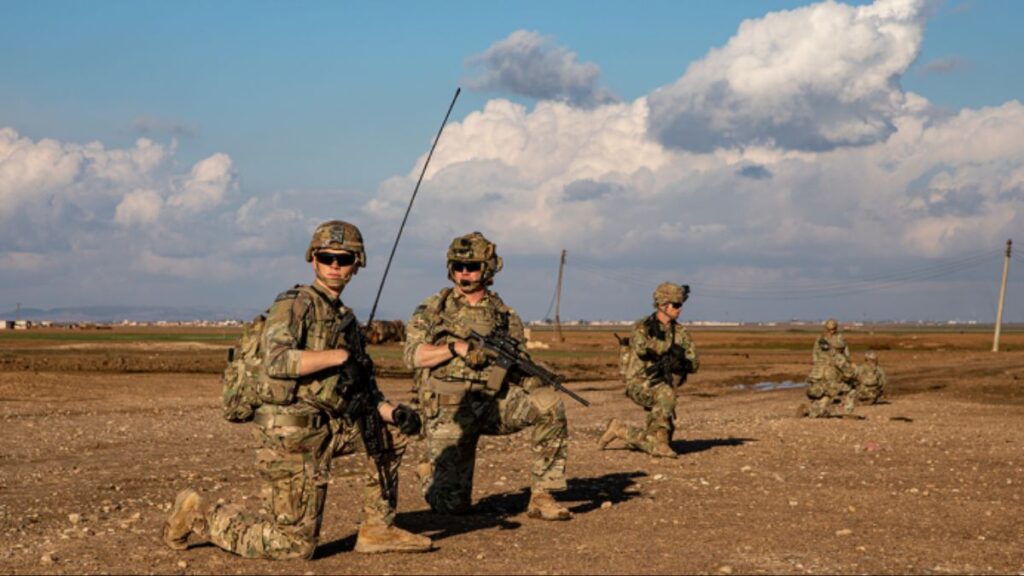
 Members of the International Coalition to Combat the Islamic State in Syria – 27 October 2025 (Middle East Institute)
Members of the International Coalition to Combat the Islamic State in Syria – 27 October 2025 (Middle East Institute)
A report published by the Middle East Institute (MEI) in Washington on Monday, October 27, revealed multiple operational agreements between the Syrian government and the U.S.-led International Coalition, discussing possible scenarios for cooperation between the two sides—including the potential for Damascus to join the coalition, which it deemed the most likely outcome.
According to the report, citing a “high-ranking source” in the General Security Directorate, the recent coordination with the Coalition Command included several operational arrangements, most notably:
The report added that Coalition forces carried out a joint operation with the Syrian government against the Islamic State in the city of al-Dumayr, northeast of Damascus, on October 18. It was the fifth coordinated operation between the Coalition and the Syrian government against the group.
According to the Middle East Institute report, the Syrian government has concluded that joining the Coalition is the best way to achieve its political, military, and economic goals amid Western calls for it to officially join the international effort to address the most serious global security threat since 2014.
Damascus sees several advantages to joining the Coalition:
The report noted that some politicians in Washington have linked lifting sanctions on Syria to its joining the Coalition, while the Syrian government views its participation as conditional on easing those sanctions.
This divergence, it said, raises the question of which side will take the first serious step to end the current stalemate, and what risks prolonged inaction may pose to international efforts for stability in Syria and to regional and global security if negotiations collapse.
The report indicated that Damascus recognizes major internal obstacles to joining the Coalition. Chief among them is that the Defense Ministry remains in an early stage of institutional development, with the recruitment process still suffering from weak background screening and overall limited military capacity.
These structural challenges make it difficult for the Coalition to fully trust the Defense Ministry’s ability to conduct joint operations. As a result, coordination currently occurs primarily between the Coalition and the Interior Ministry, not the Defense Ministry.
Another key obstacle is the lack of agreement with the SDF, which complicates coordination among forces operating in overlapping areas under varying degrees of tension.
Citing a Western source, the report said the discussions are not limited to Washington but also focus on whether the Syrian government can ensure that shared intelligence does not leak to extremist factions within the Syrian army or security institutions, particularly given the continued presence of foreign fighters in government ranks.
It added that senior officials from the former Trump administration and other Coalition members remain wary of the new Syrian government, fearing it has not fully distanced itself from its “violent extremist past.”
The report outlined four potential scenarios for the evolution of cooperation between Syria and the Coalition in counterterrorism, each with distinct political, security, and strategic implications.
1. Syria joins the Coalition – the most likely scenario
Syria’s official entry into the Coalition appears the most probable outcome, given the growing number of joint operations—five in the past three months—and the mutual Syrian and international interest in formalizing cooperation.
The Coalition seeks to expand its operations in Syria through an official partnership to accelerate the defeat of the Islamic State, while the Syrian government seeks political and logistical backing to stabilize the country, facilitate reconstruction, and reinforce state sovereignty.
Such a partnership would establish a unified counterterrorism front, improve the efficiency of operations against the Islamic State, enhance the new Syrian government’s legitimacy through formal international cooperation, and improve intelligence sharing, operational coordination, and long-term support for post-war stabilization and reconstruction.
2. Continued coordination without formal membership
If a comprehensive agreement remains out of reach, informal cooperation may continue as a test of mutual commitment. However, prolonged informal coordination carries risks, such as delayed operations, limited information sharing, and potential misunderstandings undermining trust.
While this approach maintains flexibility and avoids the political cost of formal membership, it also limits Syria’s political and reconstruction gains and could hamper international counterterrorism efforts due to inefficiency and lack of accountability.
3. Collapse of coordination
A complete breakdown in coordination would return the situation to square one, leaving the Syrian government unable to conduct large-scale operations against the Islamic State, as many of the areas where the Coalition and the SDF operate remain outside government control.
The Coalition, in turn, would struggle to achieve a decisive victory against the group amid Syria’s fragmented control map, creating security gaps the Islamic State could exploit to reestablish its presence.
Such a scenario would destabilize Syria, deter international investment, and slow reconstruction efforts.
4. Unilateral operations
If both coordination and accession talks fail, each side may revert to unilateral action, similar to previous years when Hayat Tahrir al-Sham (now defunct) carried out separate operations against Islamic State cells in Idlib while the Coalition operated independently east of the Euphrates.
These disjointed efforts would likely prove ineffective due to the lack of intelligence sharing and operational freedom across large areas—conditions the Islamic State has repeatedly exploited to adapt and survive amid chaos and fragmentation.
The report presented several recommendations for ensuring Syria’s accession to the Coalition, calling it a “deliberate and coordinated political effort” to turn existing operational cooperation into an institutional partnership.
Success, it said, hinges on mutual flexibility: Western actors must respect Syria’s sovereignty concerns, while the Syrian government must demonstrate credible commitment to inclusive governance and rule-based coordination.
For best results, the United States should maintain diplomatic engagement to bridge the gap between Damascus and the SDF, signal readiness to formalize cooperation frameworks that respect Syrian sovereignty, and provide technical and logistical support for integrated operations.
For its part, Damascus must prove its commitment to inclusive governance, reconciliation with Kurdish and local forces, and institutional reforms that ensure transparency and effective coordination with international partners, while maintaining operational discipline to prevent incidents that could erode trust.
The Syrian Interior Ministry announced it had dismantled an Islamic State cell in Maadamiyat al-Qalamoun in northern Rif Dimashq province.
In a Facebook post on October 19, the ministry said the operation resulted in dismantling a three-member cell, killing one militant as he attempted to detonate an explosive belt, with another dying of his wounds, and the third captured alive.
The ministry did not mention Coalition involvement, but Charles Lister, Director of the Syria Program at the Middle East Institute, wrote on X that Coalition forces conducted their first-ever airdrop operation in al-Dumayr, leading to the arrest of Ahmad Abdullah al-Masoud al-Badri, 47.
Lister said al-Badri was a longtime Islamic State member who had been hiding in the Syrian desert for years and recently returned to al-Dumayr after the fall of the Assad regime.
Al-Dumayr is located about ten kilometers from Maadamiyat al-Qalamoun, and the two areas overlap geographically.
He confirmed that Coalition forces arrested al-Badri in a joint operation with Syrian Defense Ministry special forces.
Commenting on Lister’s post, U.S. Envoy to Syria Tom Barrack wrote on X: “Syria is back on our side.”
if you think the article contain wrong information or you have additional details Send Correction


 A
A
A
A
A
A







 More Politics