


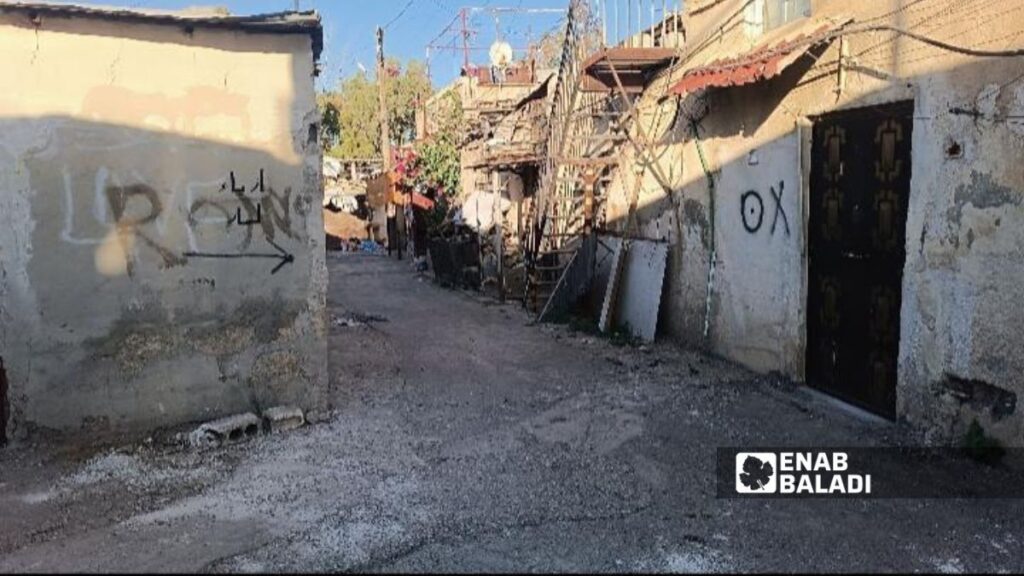
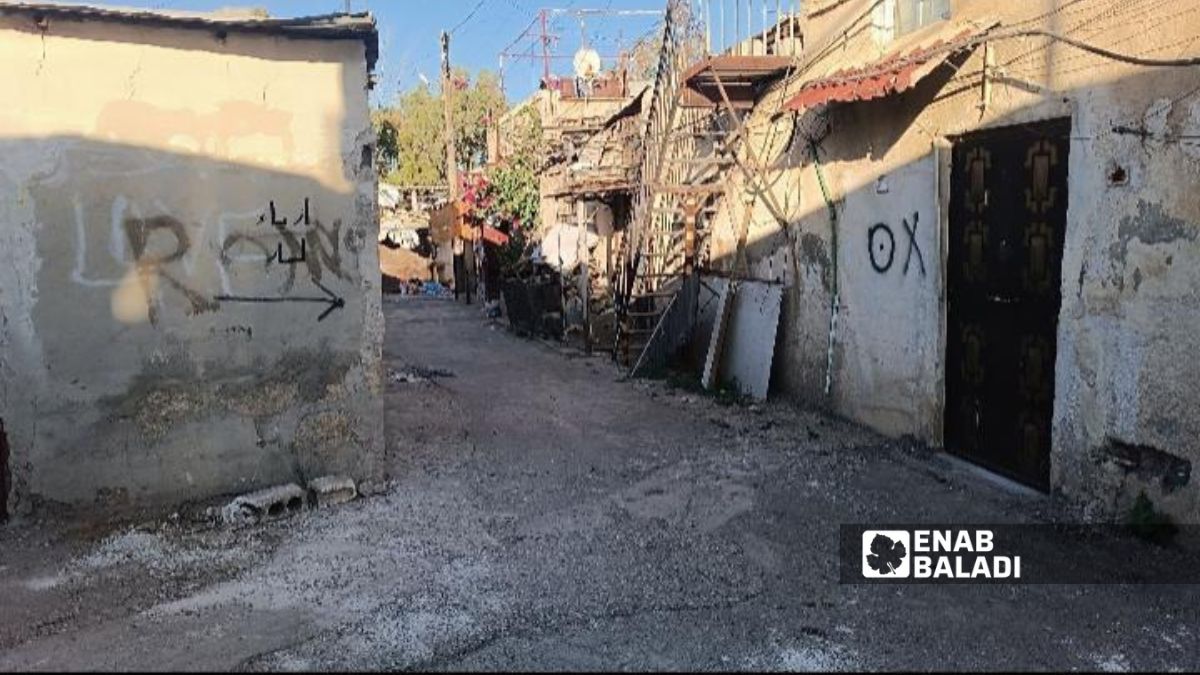
 “X” and “O” markings on homes in al-Sumariyah neighborhood (Damascus) during an eviction campaign, 31 August 2025 (Enab Baladi/Amir Huquq)
“X” and “O” markings on homes in al-Sumariyah neighborhood (Damascus) during an eviction campaign, 31 August 2025 (Enab Baladi/Amir Huquq)
Syria’s Ministry of Justice has launched a plan to tackle unlawful seizures of real estate through a unified, swift, and fair approach, according to Decision No. 526 issued Thursday, 23 October.
The decision allocates dedicated courts and judicial chambers to hear these cases exclusively, with the aim of unifying jurisprudence, avoiding contradictory rulings, shortening case timelines, and simplifying procedures without undermining fair trial guarantees.
The decision preserves full defense rights for all parties, in line with principles of justice and the law.
The ministry explained that enabling rightful owners to recover their properties through binding, equitable court rulings issued within reasonable timeframes and under transparent procedures is intended to address conflict-related impacts on property ownership and to restore rights to their lawful holders. The measure also aims to bolster social stability, reduce drivers of tension and property disputes, and strengthen citizens’ trust in the judiciary.
The Public Prosecutor’s Office has overseen the work of the “Blatant Usurpation Committees,” contributing to the resolution of many cases under existing laws, the ministry added, describing this as an effort to entrench the rule of law and safeguard citizens’ property rights in response to documented practices that led to unlawful takeovers of properties belonging to Syrians who were widely and systematically displaced after the Syrian revolution.
Given the volume, complexity, and interference surrounding these cases, the ministry said judicial reference was needed to decide them. Following an in-depth study of many aspects of such cases, and after reviewing citizens’ complaints, the ministry expressed a desire to expedite judicial solutions.
It called on all citizens harmed by such acts to approach the competent judicial authorities and exercise their legal rights under the approved simplified mechanisms.
The issue of expropriated properties across Syrian governorates, especially Damascus and its countryside, has been contentious. It has shifted from demands to restore ownership and land to confrontations with neighborhood residents, fueled by the country’s sectarian and regional polarization.
Al-Ward Mountain in the al-Hama area (Rural Damascus) and, earlier, al-Sumariyah neighborhood (Damascus) recently witnessed security tensions over expropriated land in both areas. The situation prompted interventions by armed factions and Syrian government personnel to evacuate housing, resulting in violations against residents.
Damascus Governor Maher Marwan Idlibi said on 3 September that recent events in al-Sumariyah were the result of what he called decades of “unjust expropriation and real-estate corruption” under the deposed regime.
According to the state news agency SANA, Idlibi said legal committees from the Damascus and Rural Damascus governorates are being formed to review the expropriation affecting al-Sumariyah and the informal settlements that followed for decades due to the previous regime’s “unjust” handling of the property file.
Idlibi noted that the legal committees will draw on experts from among residents of Muadamiyat al-Sham and al-Sumariyah.
“The Syrian government is committed to resolving these cases fairly and transparently, away from displacement or forced eviction,” he said.
“We are a state of institutions and law, and community property cases must be resolved on legal bases and procedures.” He stressed that respect for property rights is a legal, moral, and religious duty that should not be infringed except through judicial committees or fair laws, not by individuals, to avoid chaos.
Human rights activist Rana Alsheikh Ali previously suggested to Enab Baladi that residents of informal housing be addressed, drawing on international experiences, through one of the following options:
Attorney and legal researcher Alaa Younes, with the Syrian Legal Development Program (SLDP), argued that a just solution balances three rights: the state’s right to planning and the rule of law, the rights of original owners harmed by unfair or unimplemented expropriations, and the stability of current occupants who have lived for decades with implicit or explicit official tolerance.
She recommended:
Al-Sumariyah: A battle over land and identity on the walls of Damascus
if you think the article contain wrong information or you have additional details Send Correction


 A
A
A
A
A
A






 More HLP