


 Scene from the play “Memory of Detention,” September 6, 2025 (SANA)
Scene from the play “Memory of Detention,” September 6, 2025 (SANA)
The play “Memory of Detention” mirrors the suffering of detainees in the prisons of the former regime, portraying the abuses they endured over years of repression and disappearance while delving into the human depth of their experience.
The production presents scenes that distill the struggle between freedom and restraint, hope and despair, on a pared-down stage charged with symbolism.
The play premiered at the Damascus International Fair, then moved to Aleppo, Idlib (northwestern Syria), Latakia (western Syria), and Hama (central Syria), and continues to tour Syrian cities in succession, turning theater into a space for remembrance and an artistic record of suffering.
Before the show begins, the stage fills with the synchronized, unsettling sound of dripping water. Against the black backdrop hangs a gallows rope at center stage; slightly to the left, a dangling light. A grimy barrel of murky water sits nearby, alongside two suspended pulleys used to torture prisoners.
The performance opens with the sounds of pro-freedom protests and live fire. Two young men are killed and remain at the front, stage right and left, throughout the show, while inside the cell, a single prisoner is left behind: the narrator of the play’s news-style storyline.
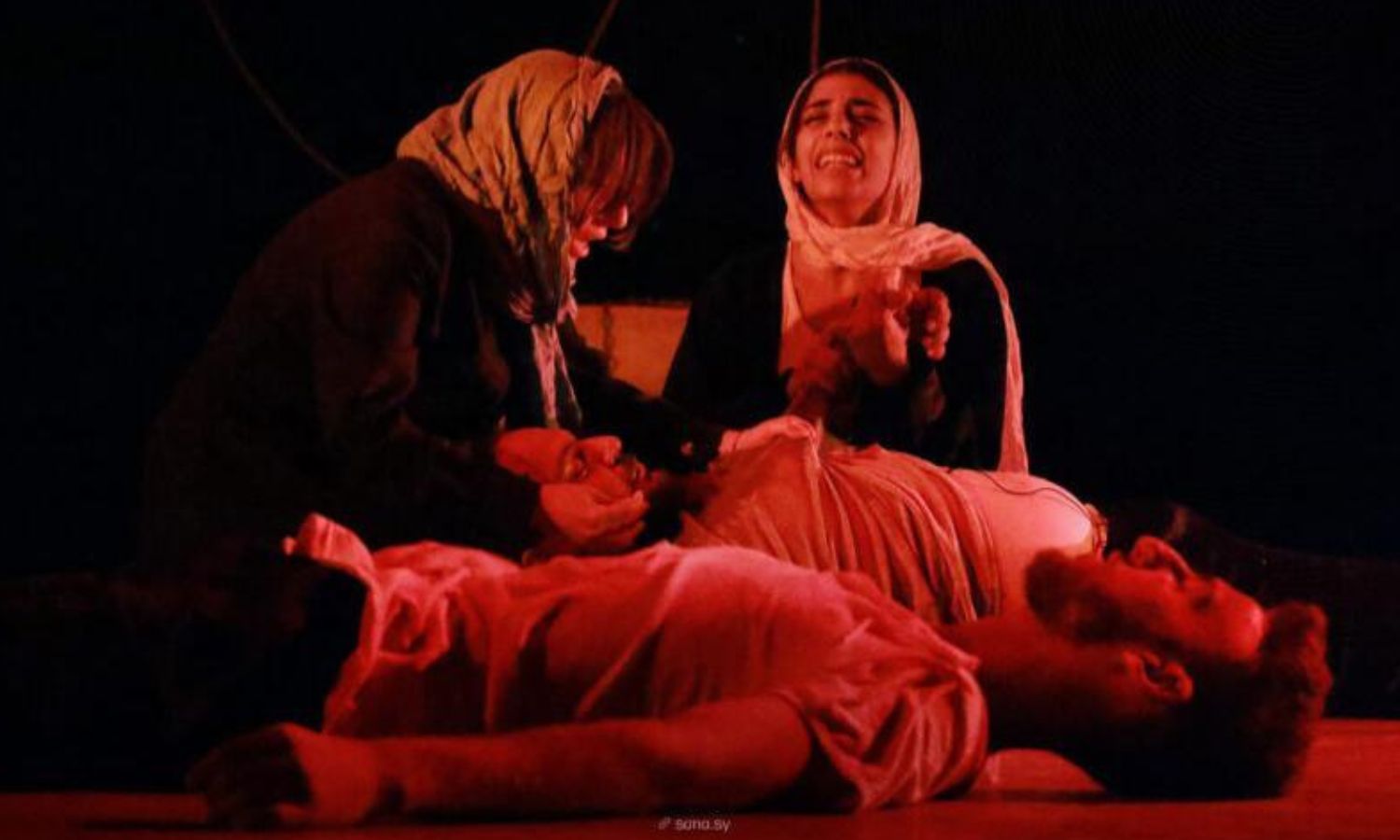
The detainee, played by Mahmoud Zakkour, is not a single real individual but a symbolic figure representing the thousands of Syrians deprived of their liberty and the families waiting for them.
In the final scene, the jailer flees just before liberation is announced, a nod to the triumph of human will over repression and the collapse of fear before the voice of freedom.
The play relies heavily on visual symbols. Throughout the show, two silent corpses accompany the detainee inside the cell, representing victims of repression and the disappeared whose fates remain unknown, a personification of the “ongoing death” that haunts detainees even after release.
Silence in these scenes is not emptiness but another language, expressing powerlessness and the postponed death a Syrian endures when voice and dignity are stripped away.
Mahmoud Zakkour delivers a striking performance that embodies detention in its physical and psychological detail, shifting between collapse and defiance, pain and hope.
Written and directed by Mohammad Marwan Idlbi, the production features Mohammad Mulqi as the jailer, with Fatima Abd and Sanā’ Saqr adding a humane layer through roles that channel longing, motherhood, and loss.
The cast brings together actors from Hama, Aleppo, Idlib (northwestern Syria), and Latakia (western Syria), a deliberate choice by the director to make the work a national project uniting artists around a common human cause.
Makeup design is by Abdulghani Sayyadi. Ammar Jarrah handled lighting and sound, which serve a narrative function by amplifying the characters’ inner tensions.
The creators say “Memory of Detention” is more than a work of art: it is an act of fidelity to the sacrifices of detainees and the disappeared, and an effort to anchor them in Syrians’ collective memory.
It is not merely a stage performance but an artistic outcry against forgetting, a human document that preserves what remains of the memory of those behind bars.
“Memory of Detention” reminds us that memory cannot be erased and that art can recount what reports and testimonies alone could not.
if you think the article contain wrong information or you have additional details Send Correction


 A
A
A
A
A
A





 More Society