Agence France-Presse reported on Thursday, 23 October, that Paris investigating judges signed a new arrest warrant for deposed Syrian president Bashar al-Assad on 29 July on suspicion of complicity in crimes against humanity and war crimes. The warrant follows the quashing, days earlier, of a November 2023 warrant that had been issued while Assad was in office and therefore protected by personal immunity as a sitting head of state.
Al-Assad has been residing in Moscow under humanitarian asylum, and Syria’s President Ahmed al-Sharaa requested his extradition during his 15 October meeting with Russian President Vladimir Putin.
Human-rights lawyers Jeanne Sulzer and Clémence Witt, representing a coalition of nongovernmental organizations involved in the case, the Syrian Center for Media and Freedom of Expression (SCM), Physicians for Human Rights (PHR), the Open Society Justice Initiative (OSJI), Mnemonic, the Center for Research and Documentation of Human Rights Violations (CRD), and Women Now for Development (WND), welcomed the new arrest warrant, along with several victims. They said victims “have consistently called since the first warrant for its swift and effective circulation at European and international levels and for the use of available judicial cooperation mechanisms,” expressing hope that French authorities would take proactive steps to prevent al-Assad’s impunity and ensure these crimes do not go unpunished.
A related warrant was issued on 16 July for Talal Makhlouf, former commander of the Syrian Republican Guard’s 105th Brigade. Maher al-Assad, al-Assad’s brother and then commander of the 4th Division, along with Generals Ghassan Abbas and Bassam al-Hassan, have also been subject to warrants since November 2023.
Confirmation after quashing
On 25 July, France’s Court of Cassation, the country’s highest court, held that Al-Assad, then the former head of state, had enjoyed personal immunity at the time the December 2021 chemical-attacks warrant was issued, which led to the nullification of that particular warrant concerning the 2013 sarin attacks in Douma (Eastern Ghouta, Rif Dimashq, near Damascus) and across Eastern Ghouta (near Damascus).
Jelnar Ahmad, director of the Syrian Archive program, told Enab Baladi earlier that al-Assad’s personal immunity was in force when that December 2021 warrant was issued, which is why the appeal was accepted. She added that the court indicated investigators could continue their work and issue new warrants, and that a fresh arrest warrant remained possible since al-Assad is no longer Syria’s president and no longer enjoys personal immunity.
How the al-Assad warrant came about
In March 2021, survivors and NGOs filed a criminal complaint in France urging an investigation into the 2013 sarin attacks that targeted Adra (Rif Dimashq, near Damascus), Douma (Eastern Ghouta, Rif Dimashq) and Eastern Ghouta (near Damascus) as war crimes and crimes against humanity.
An official investigation opened in April 2021, and two investigating judges were appointed. Syrian human-rights and civil organizations collected dozens of testimonies from victims, families and eyewitnesses, as well as expert statements and hundreds of documentary exhibits.
On the basis of the volume and detail of the evidence, the judges found serious, corroborated indications that the following individuals participated in planning and executing the chemical-weapons attacks and bear individual criminal responsibility:
• Bashar al-Assad – then President of the Syrian Arab Republic.
• Maher al-Assad – de facto commander of the Syrian Arab Army’s 4th Armored Division.
• Brig. Gen. Ghassan Abbas – then head of Branch 450 of the Syrian Scientific Studies and Research Center (SSRC).
• Maj. Gen. Bassam al-Hassan, then presidential adviser for strategic affairs and liaison between the Presidential Palace and the SSRC.
The judges therefore determined that the appropriate response to the victims’ complaint and the submitted evidence was to issue international arrest warrants for the identified individuals on charges of complicity in crimes against humanity and war crimes.
“In the French judicial system, an arrest warrant is a judicial order directing law enforcement to search for and locate the named individual and bring them before the investigating judge. These arrest warrants have been circulated at the European and international levels through Interpol and Europol.”
Syrian Center for Media and Freedom of Expression (SCM)
After the Paris warrants were issued on 23 December 2023, the National Anti-Terrorism Prosecutor’s Office (PNAT) appealed and referred the al-Assad warrant to the Paris Court of Appeals’ Investigation Chamber, seeking its annulment.
Two additional al-Assad warrants
Two further warrants have also been issued for al-Assad: the first on 20 January 2025 for complicity in war crimes in connection with the 2017 shelling of a residential area in Daraa (southern Syria); and the second on 19 August 2025 for complicity in war crimes and crimes against humanity over the 2012 shelling of a media center in Homs (central Syria) that killed American journalist Marie Colvin of The Sunday Times and French photojournalist Rémi Ochlik, and wounded French journalist Edith Bouvier, British photographer Paul Conroy, and Syrian translator Wael al-Omar. In the Homs case, investigating judges also issued warrants for six senior former officers, including Maher al-Assad and Ali Mamlouk, then head of the General Intelligence Directorate.


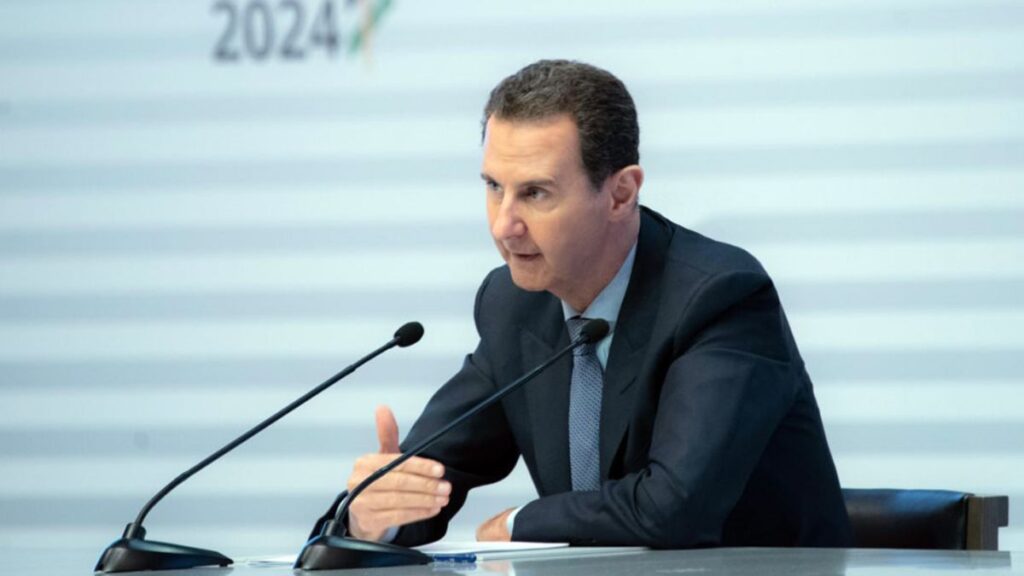
 Deposed Syrian president Bashar al-Assad – May 4, 2024 (SANA)


 A
A
A
A
A
A





 More Politics