


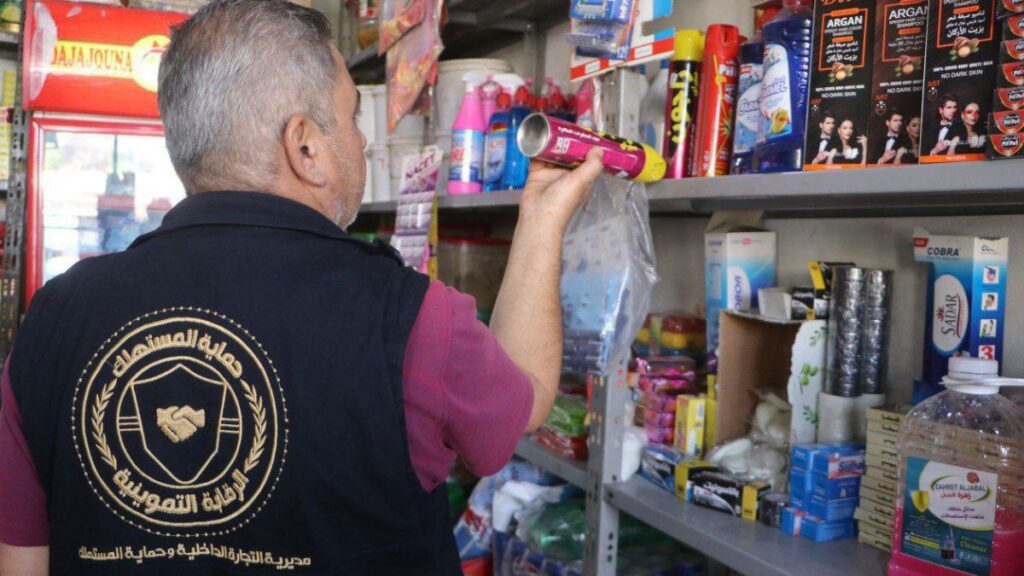
 An inspector from the Directorate of Internal Trade and Consumer Protection on an inspection visit in Rural Damascus on August 24, 2025 (Directorate of Internal Trade and Consumer Protection)
An inspector from the Directorate of Internal Trade and Consumer Protection on an inspection visit in Rural Damascus on August 24, 2025 (Directorate of Internal Trade and Consumer Protection)


 A
A
A
A
A
A
The Damascus Chamber of Commerce issued a statement on Tuesday, October 14, clarifying its position on the Ministry of Economy and Industry’s new pricing mechanism and stressing its commitment to defending merchants’ interests and organizing economic activity in the country.
The Ministry’s decision, issued on October 12, obliges all producers and importers to display the final retail price to the consumer.
According to the Chamber’s statement, published on its Facebook page, it contacted several ministry officials immediately after the decision was issued and received clarifications that the measure does not impose price-setting on producers or industrialists as some have suggested. Rather, it requires announcing the price at the final point of sale, similar to practice in most countries, to ensure the consumer’s right to see prices clearly before purchase and to promote greater transparency and fairness in the market.
Ministry officials, the statement added, said the core objective is to protect consumers from unfair pricing while also safeguarding the rights of compliant merchants, helping to strike a balance between both sides of the transaction.
The Chamber backed the Ministry’s move to organize public price displays and to require official invoices, describing the step as one that builds trust between seller and buyer and helps curb violations and organize the market.
It also said it asked the Ministry to issue a formal clarification detailing implementation procedures to ensure accurate, unambiguous application that serves the interests of industrialists, traders, and consumers alike.
The Chamber called on all economic actors to remain calm and await the Ministry’s forthcoming clarification, affirming that it will continue following up with the relevant authorities to protect the commercial and industrial sectors’ rights and support market stability.
The Ministry of Economy and Industry’s decision obliges all producers and importers to display the final consumer price clearly and legibly in Arabic, in a visible font, and in a way that cannot be removed or erased on products.
The Ministry says the measure aims to regulate markets, reduce fraud and price manipulation, and guarantee the consumer’s right to know the true price before buying, thereby enhancing transparency in sales.
The decision prohibits trading, displaying, storing, or selling any item unless its final consumer price is marked. Retailers may sell below the marked price.
Producers and importers have until December 31, 2025, to clear products that do not carry the final consumer price. During this grace period, sellers must announce the prices of such goods on storefronts and at the point of display in a clear font.
Any violation will be penalized under applicable laws and regulations.
Price disparities persist in Syrian markets amid weak oversight and volatile economic conditions. Residents expect more active monitoring from the Directorate of Internal Trade and Consumer Protection and question whether authorities can rein in price chaos.
Bilal al-Akhras, the Directorate’s media official, previously told Enab Baladi that inspectors focus on whether a clear price is displayed on products. A difference in price from one shop to another is not a violation so long as each merchant clearly posts their price, he said. If two adjacent shops sell the same item at different prices, customers are free to choose the cheaper option, while only the merchant who fails to show a clear price is fined.
Asked whether a single official price could be enforced, al-Akhras said this is not practically possible in an open market, where merchants are free to set prices. Consumers can compare offers and choose the product whose price and quality suit them.
if you think the article contain wrong information or you have additional details Send Correction









 More Economic Reports