Damascus’ aging taxis: Drivers seek protection, passengers seek a meter

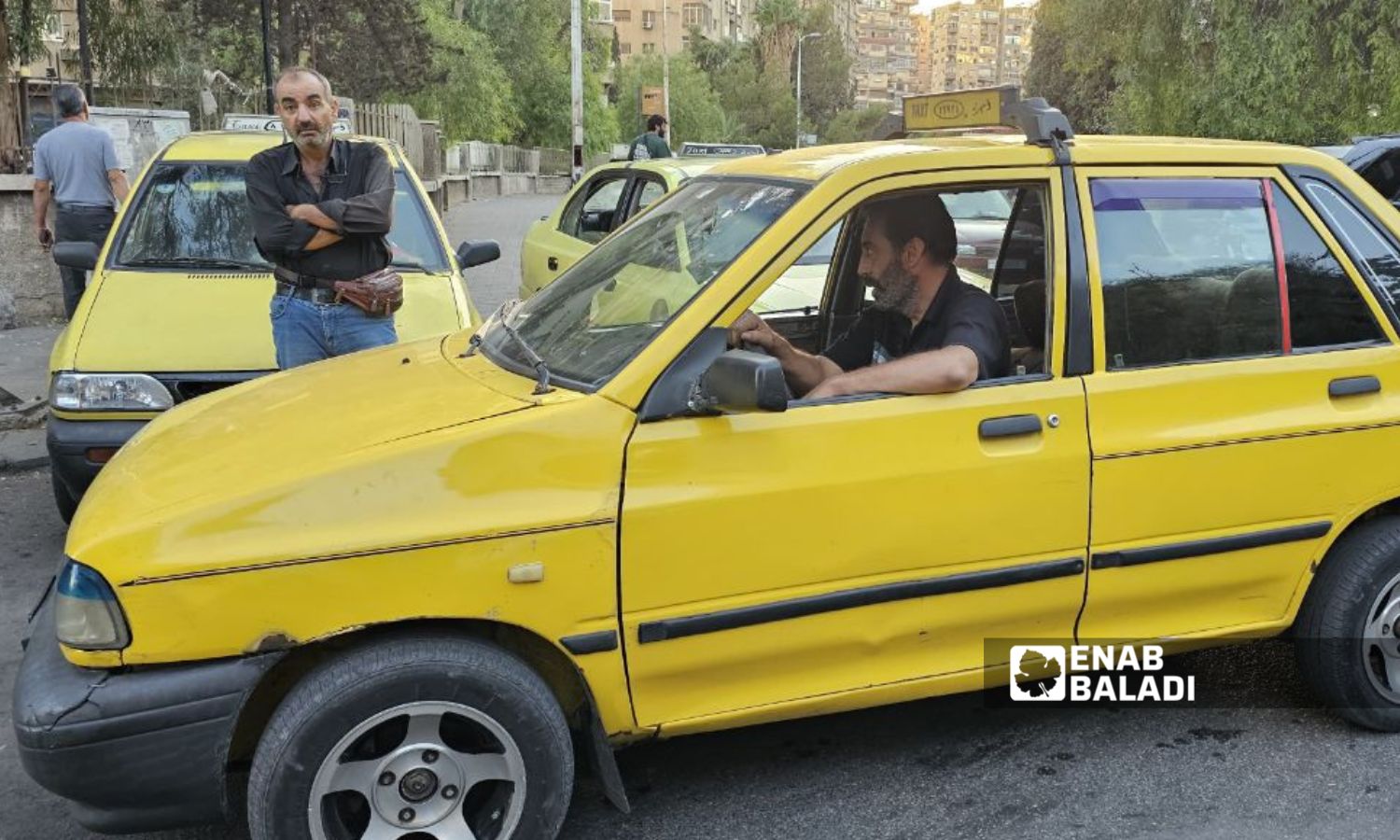
Taxis in the Mezzeh Villas area of Damascus – October 2, 2025 (Enab Baladi/Ahmad Muslmani)

Taxis in the Mezzeh Villas area of Damascus – October 2, 2025 (Enab Baladi/Ahmad Muslmani)

A A A

Enab Baladi – Christina al-Shammas

Taxi drivers in Damascus (the Syrian capital) are facing a noticeable decline in their work, as their profession no longer meets even the minimum of their daily needs. Most public taxis have long exceeded their lifespan and have become a constant financial burden due to frequent breakdowns and costly maintenance. Drivers are unable to replace or renew their vehicles.

Alongside these burdens, taxi drivers are also struggling with growing competition from private cars and smart ride-hailing apps that attract passengers with greater comfort and clearer pricing, cutting into their customer base.

Old cars, unbearable costs

Most taxis in Damascus have been in service for more than 20 years, turning them into a burden for both their owners and passengers.

Frequent mechanical failures have become a part of drivers’ daily routine, while maintenance costs continue to rise beyond what they can afford.

“Every week there’s a repair, sometimes mechanical, sometimes electrical, sometimes gearbox. I’m not working to feed my children anymore, I’m working to feed the repair shop,” said Mohammed Hussein, who has driven a taxi in Damascus for 30 years.

Mohammed has no other source of income, so he works from early morning until sunset, managing at best three trips by the end of the day.

Although car prices in the Syrian market have dropped slightly since the fall of the previous regime, they remain far beyond drivers’ reach. Buying a used car in decent condition costs around 10 million Syrian pounds (around $900 ), a sum far exceeding what a taxi driver earns daily, barely enough to meet his family’s basic needs.

Firas Dioub, who has been a taxi driver for 18 years, summarized the shared struggle of most drivers: they must either bear the costs of endless repairs or buy a replacement car at a price far beyond their means. As a result, many are forced to continue driving old, barely functioning vehicles that can hardly move through Damascus’ congested and deteriorating streets, he told Enab Baladi.

Enab Baladi contacted the Syrian Ministry of Transport to ask whether new conditions would be imposed during vehicle inspections for licensing, but received no response as of the time of publication.

Fare chaos and the missing meter

One of the main frustrations among passengers in Damascus is the “chaos” in taxi fares. A short trip can cost as much as 30,000 Syrian pounds (about $2.7), while the same ride booked through a ride-hailing app might be just half that, around 15,000 pounds (roughly $1.4).

To make matters worse, each driver sets a different fare for the same distance. For example, a trip from Bab Sharqi to Mezzeh might cost 50,000 pounds (about $4.5) with one driver and 60,000 pounds (around $5.4) with another.

Firas Dioub justified the high and inconsistent fares by pointing to rising costs, spare parts, oil, and fuel prices that increase daily. He argued that drivers are not overcharging but merely trying to cover their basic operating expenses.

Driver Mazen Awad explained that for a 30,000-pound (about $2.7) ride, half of that amount often goes to fuel alone.

Mazen added that drivers have no choice but to set their own prices if they are to continue working at all.

In an earlier statement to Enab Baladi, Omar Qattan, Director of the Public Transport Corporation, said there is a lack of compliance among taxi drivers with using meters, due to weak oversight from the bodies previously responsible for enforcement under the former regime, which opened the door to widespread irregularities.

Drivers’ demands

Taxi drivers share common demands, calling for strict enforcement of laws that prevent private cars from working as taxis and stronger monitoring of violators.

They also said they do not oppose a fair pricing system, provided it reflects fuel and maintenance costs.

Their main demands include:

  • Stronger regulation and enforcement: Control private cars operating without licenses.

  • Stop out-of-province cars: Ban vehicles from other governorates from working illegally in Damascus.

  • Protect livelihoods: Ensure the sustainability of a profession that supports thousands of families.

A future plan

Qattan told Enab Baladi that the Public Transport Corporation is developing a plan to reorganize and regulate taxi operations by requiring drivers to activate their meters and install them on vehicles that lack one. Charging fares inconsistent with the meter would be punishable by law.

He also called on citizens to report violations through a new complaints system. Stickers with QR codes have been placed on vehicles, allowing passengers to submit complaints directly without visiting the corporation in person. The complaints are received by a specialized office that follows up and responds to each case.

The corporation is also preparing a comprehensive plan to modernize the transport system, including the introduction of environmentally friendly vehicles and the use of unified digital applications to calculate fares fairly. The plan also aims to simplify digital transactions and link all transport services through an advanced technical network, according to Qattan.

النسخة العربية من المقال

Related Articles

  1. Ride-hailing apps in Syria: Safer and cheaper
  2. Daily life in Damascus
  3. Chaos in transportation fares in Damascus
  4. Raids, Coronavirus and internet in Syria's capital Damascus


Propaganda distorts the truth and prolongs the war..

Syria needs free media.. We need your support to stay independent..

Support Enab Baladi..

$1 a month makes a difference..

Click here to support