


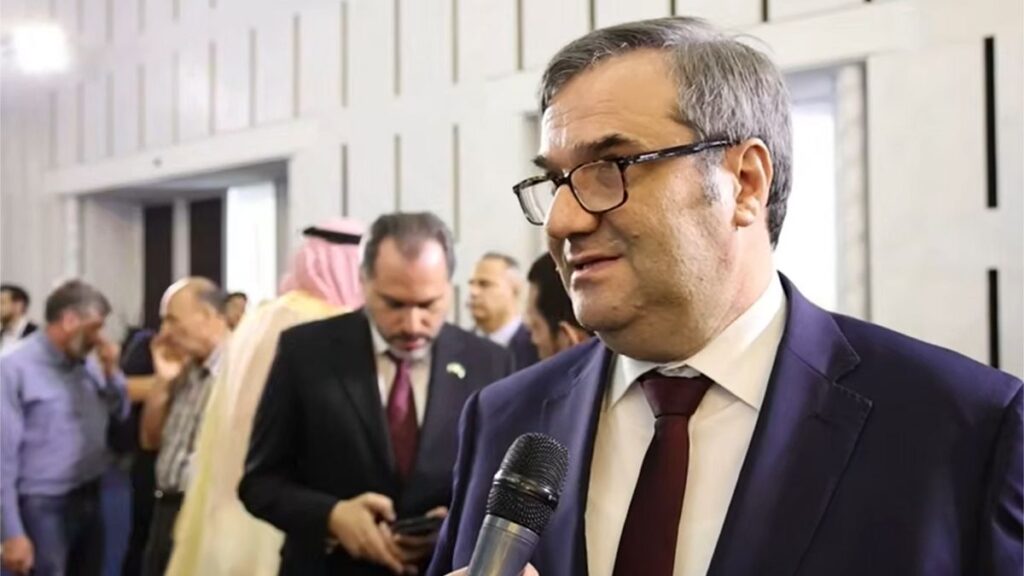
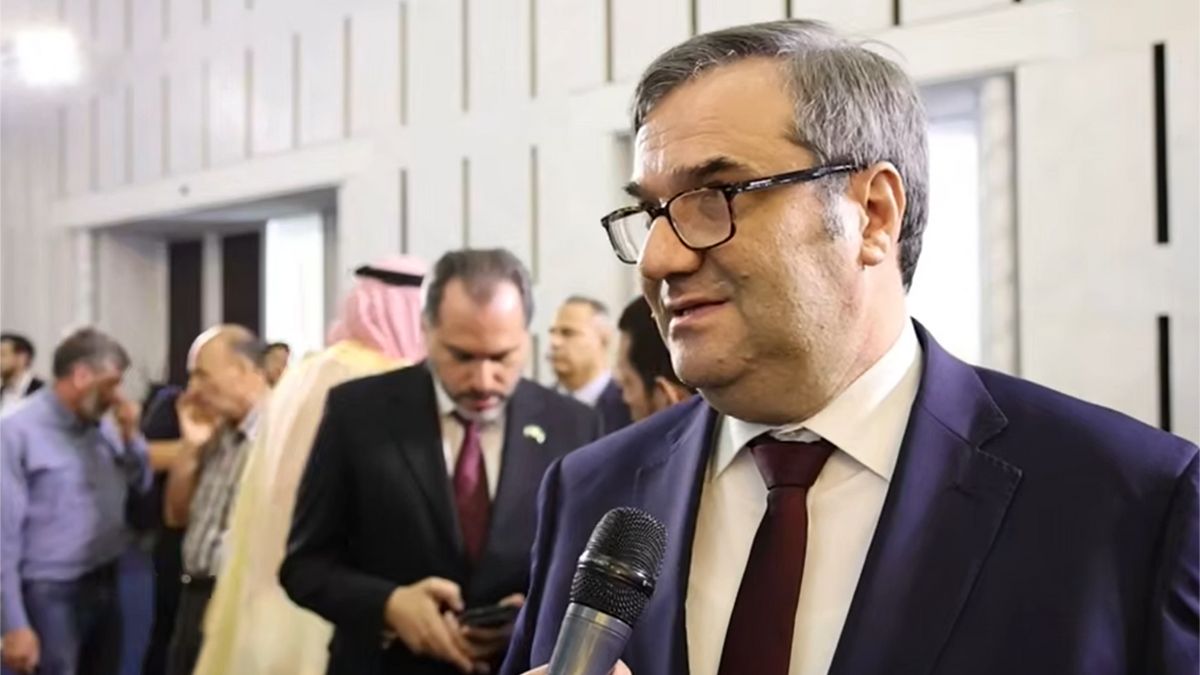
 Central Bank of Syria Governor Abdul Qader Hasriyeh, July 24, 2025 (Central Bank of Syria)
Central Bank of Syria Governor Abdul Qader Hasriyeh, July 24, 2025 (Central Bank of Syria)
The Central Bank of Syria has decided to include raised tactile printing on the country’s upcoming banknote series to help blind and visually impaired people independently distinguish denominations, according to Governor Abdul Qader Hasriyeh.
Hasriyeh said on Wednesday, October 15, that “in a long-overdue humanitarian step, we decided to include raised (embossed) printing on the new Syrian currency so that blind and visually impaired individuals can recognize denominations easily and independently,” adding that the issue has personally concerned him as a “citizen” who cares about inclusion and the rights of persons with disabilities.
The governor explained that he contacted Minister of Social Affairs and Labor Hind Qabawat, whom he described as “a dear friend and colleague,” who relayed requests from people with visual impairments to add Braille to the new notes.
He told Qabawat the request was “entirely legitimate” and met a real need that should not be overlooked, noting that the new designs already account for enabling blind users to differentiate denominations independently.
Syria is not the first country to adopt tactile features or Braille-based markings on national currency. Several countries have developed banknotes for blind and visually impaired users using Braille or other tactile techniques, including Egypt, Canada, Australia, Honduras, Mexico, India, Russia, and the United Kingdom.
In 2017, the UK’s £10 note added two clusters of raised dots in the upper-left corner to aid recognition.
Yemen also issued its first banknote with raised Braille printing in July 2025.
Hasriyeh previously said the new Syrian series will comprise six denominations and will be free of portraits, symbols, or historical landmarks to make verification clearer and align with a global trend toward clean, minimalist design.
In an interview with the state news agency (SANA) on October 8, he indicated the denominations would range from small to large to better serve daily transactions, and that detailed information on each note’s value, size, and design would be announced once technical and security printing procedures are complete.
The governor added that the new currency would “carry a contemporary national identity reflecting modernity and economic stability,” and that the Central Bank would roll out accompanying measures to control liquidity and maintain price stability.
Planned steps include:
According to Emirates Security Printing, visited months ago by Hasriyeh and Syrian Finance Minister Mohammed Yosr Bernieh to review banknote printing practices, high-end currency production demands flexible processing of multiple substrates and layered security features.
Key security and technical requirements include:
Application of ISO 14298 (or equivalent standards):
Ensures secure printing management, protection of operations, supply chain control, and product integrity against counterfeiting. Certification or compliance with this standard is considered a key reliability requirement for sovereign authorities.
High-precision printing equipment and advanced security features:
Includes security threads, watermarks, UV-reactive inks, holograms, micro-printing, serial numbering, and printing on polymer or treated security paper.
Strict physical and electronic security and chain of custody:
Secure sites with controlled access, surveillance cameras, guards, and documented procedures for tracking shifts, raw materials, and tools, from initial production to final delivery to the central bank.
Information security:
Protection of design files and digital data through encryption, access control, and detailed audit logs.
Quality auditing and traceability:
Automated optical inspection systems ensure each banknote denomination meets technical specifications and resists forgery.
Compliance with international standards and trade secrecy:
Contracts must be concluded with certified material suppliers, accompanied by non-disclosure policies and anti-counterfeit risk procedures. Certification under ISO 14298 helps regulate and integrate these measures.
if you think the article contain wrong information or you have additional details Send Correction


 A
A
A
A
A
A





 More Economic Reports