


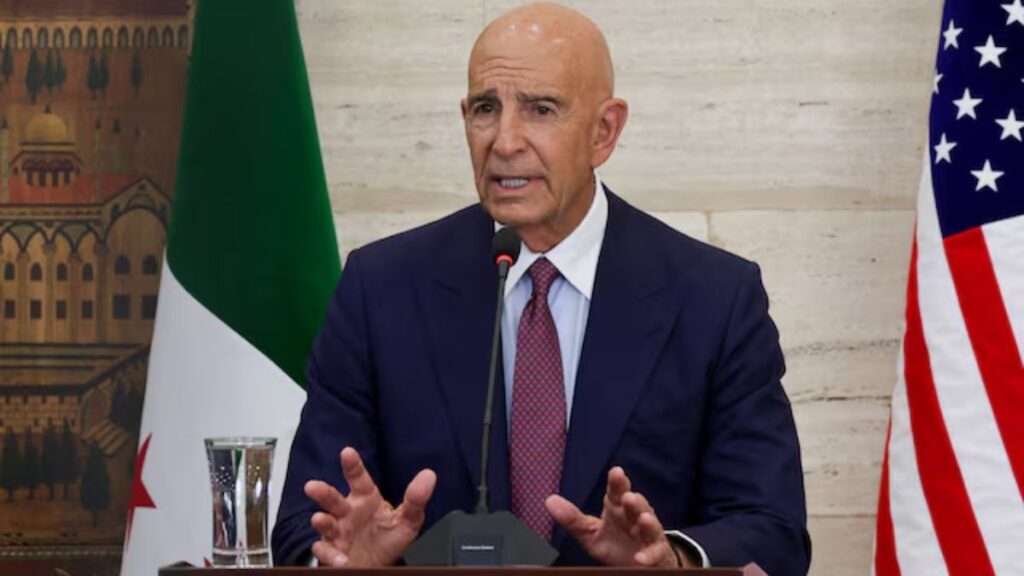
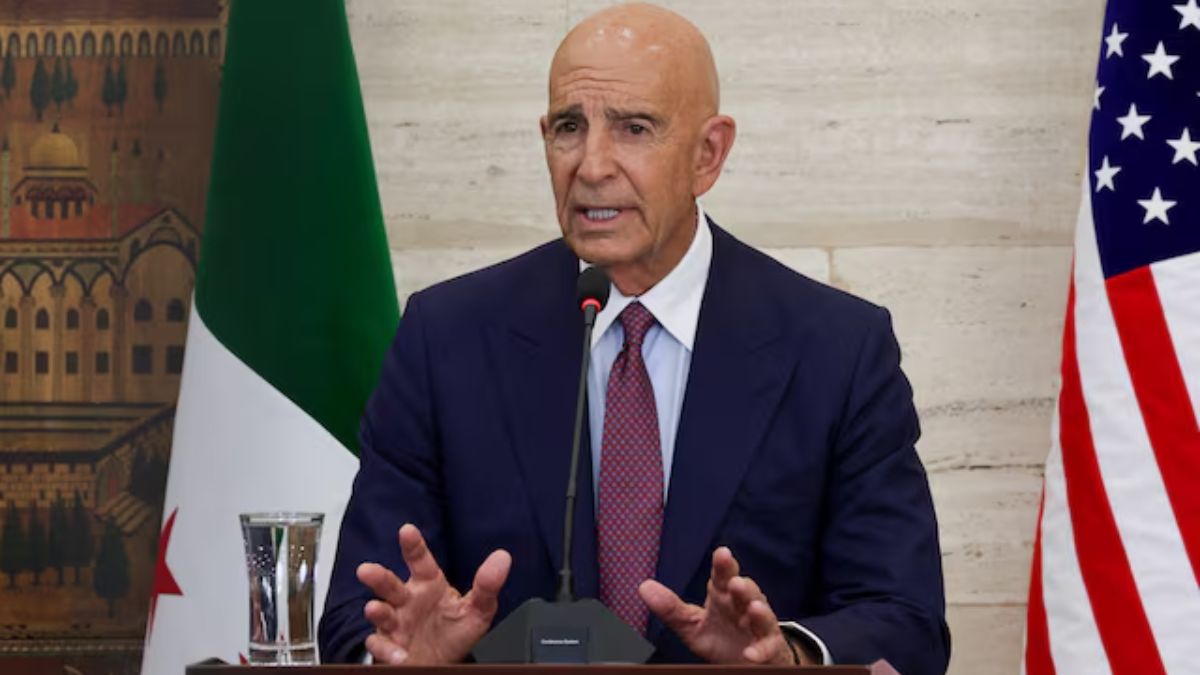
 U.S. Special Envoy to Syria Tom Barrack at a press conference with the Syrian and Jordanian foreign ministers in Damascus on September 16, 2025 (Reuters/Khalil Ashawi).
U.S. Special Envoy to Syria Tom Barrack at a press conference with the Syrian and Jordanian foreign ministers in Damascus on September 16, 2025 (Reuters/Khalil Ashawi).
U.S. Special Envoy to Syria Thomas Barrack said Syria remains the “missing piece of peace” in the Middle East, even though the Gaza agreement marks a turning point in modern regional diplomacy, with world leaders gathering in Egypt to halt the fighting in Gaza and launch peace talks.
In a post on X on Monday, October 20, 2025, Barrack wrote that after years of a “shredding, exhausting war,” Syria stands as a symbol and a test of how resilient the new regional order can be.
“Despite the progress made, Syria lacks peace,” he said, adding that “no fabric of peace can be complete while one of the world’s oldest civilizations is submerged in destruction.”
Barrack argued that the Gaza Peace Summit was not a symbolic spectacle but “an overture to a new symphony of cooperation based on energy integration, economic interconnection, and shared human ambition.” He said the rhythm of dialogue must now extend north to Syria and, ultimately, to Lebanon.
He believes Syria’s “courageous steps” toward a border arrangement with Israel and hoped-for future cooperation are the first steps to securing Israel’s northern frontier, and that disarming Hezbollah should be the second. “As Damascus stabilizes, Hezbollah’s isolation grows,” Barrack said, stressing that Syria and Lebanon are the next pillars of a Levantine peace.
Barrack highlighted the importance of lifting U.S. sanctions to jump-start reconstruction. “President Trump and the Senate have already shown courage, and the House must now complete the statesman’s work by repealing the sanctions,” he wrote, arguing that ending the Caesar Act is not “forgetting history” but “rewriting it,” replacing the “dictionary of retribution” with “the language of renewal.”
Ending sanctions is not an endorsement but a “strategy,” he said. It would unlock allied and private-sector capacity to rebuild Syria’s power grid, water systems, schools, and hospitals. He added that Trump’s announcement easing sanctions and the decision to lift most measures on Syria as of July 1 redirected U.S. policy “from punishment to partnership,” signaling to investors and allies that America now stands for rebuilding rather than constraining.
Barrack justified sanctions relief by saying that since December 8, 2024, with the inauguration of a new Syrian government, Syria is no longer “Syria 2019” when the law was issued. He said the leadership has embarked on reconciliation, restored ties with Turkey, Saudi Arabia, the UAE, Egypt, and Europe, and even engaged in boundary discussions with Israel. Continuing sanctions, he argued, no longer punish tyrants but teachers, farmers, and shopkeepers who must power Syria’s recovery. Lifting sanctions, therefore, aligns policy with facts on the ground and the region’s readiness to turn the page.
Barrack noted that 26 senior Christian clerics from Syria have appealed to Congress to end sanctions, warning they have become a principal reason for the shrinking Christian presence in their homeland. He framed their plea as a moral echo of shifting regional tides.
Separately, the UN Security Council has considered a U.S.-drafted resolution that would ease sanctions on Syria, including on President Ahmed al-Sharaa and Interior Minister Anas Khattab, with China reportedly comfortable with the proposal.
According to The National, the draft was circulated to the Council’s 15 members on October 9 and, if adopted, would allow financial assets, funds, and economic resources to flow to the Syrian central government.
The text, the paper reported on October 13, underscores the “latent tension” at the heart of international policy toward Syria: how to re-engage a government long shunned for brutality while keeping pressure on armed groups still designated as terrorist organizations.
In a September 26 interview with Rudaw, Barrack said the current Syrian government recognizes each minority’s desire to preserve its religious rites and cultural character, but that this requires “political engineering.” The question, he said, is how to design a central government that does not become a federation while still granting communities their rights and opportunities. “I believe that is already happening,” he added.
Barrack spoke of shaping a structure to safely and properly integrate different factions and minorities. He said Damascus is working hard to achieve this and that he is optimistic it can be accomplished with some assistance.
He did not directly promise a new government by year’s end, but rather “a kind of political structure” that integrates all factions and minorities in a “safe and sound” manner.
He also voiced optimism about integrating the Syrian Democratic Forces (SDF) into Syria’s new defense architecture and about Kurdish aspirations for greater self-administration.
Barrack said the new Syrian government recognizes minorities’ desire for their own education and language systems and for respect for religious practice, stressing that no one wants these communities to be seen as “second-class.” He added that Damascus understands and values this.
Regarding the events in Suwayda (southern Syria), Barrack said what happened was “premature and unfortunate,” while emphasizing ongoing joint efforts to resolve the crisis.
if you think the article contain wrong information or you have additional details Send Correction


 A
A
A
A
A
A


 More Politics