


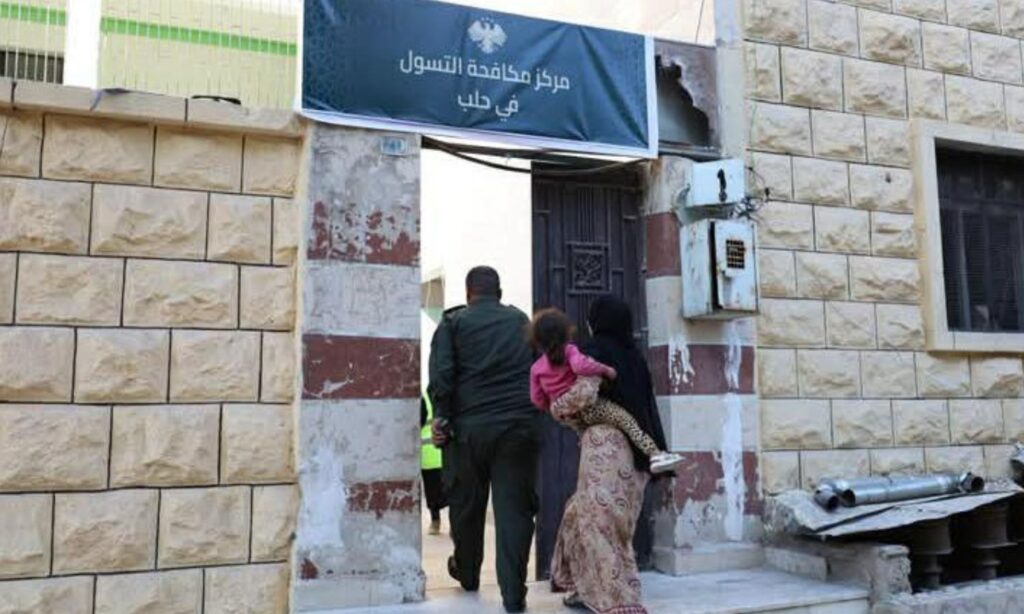
 Several Syrian provinces recently launched campaigns to combat the phenomenon of begging – August 19, 2025 (Aleppo Governorate)
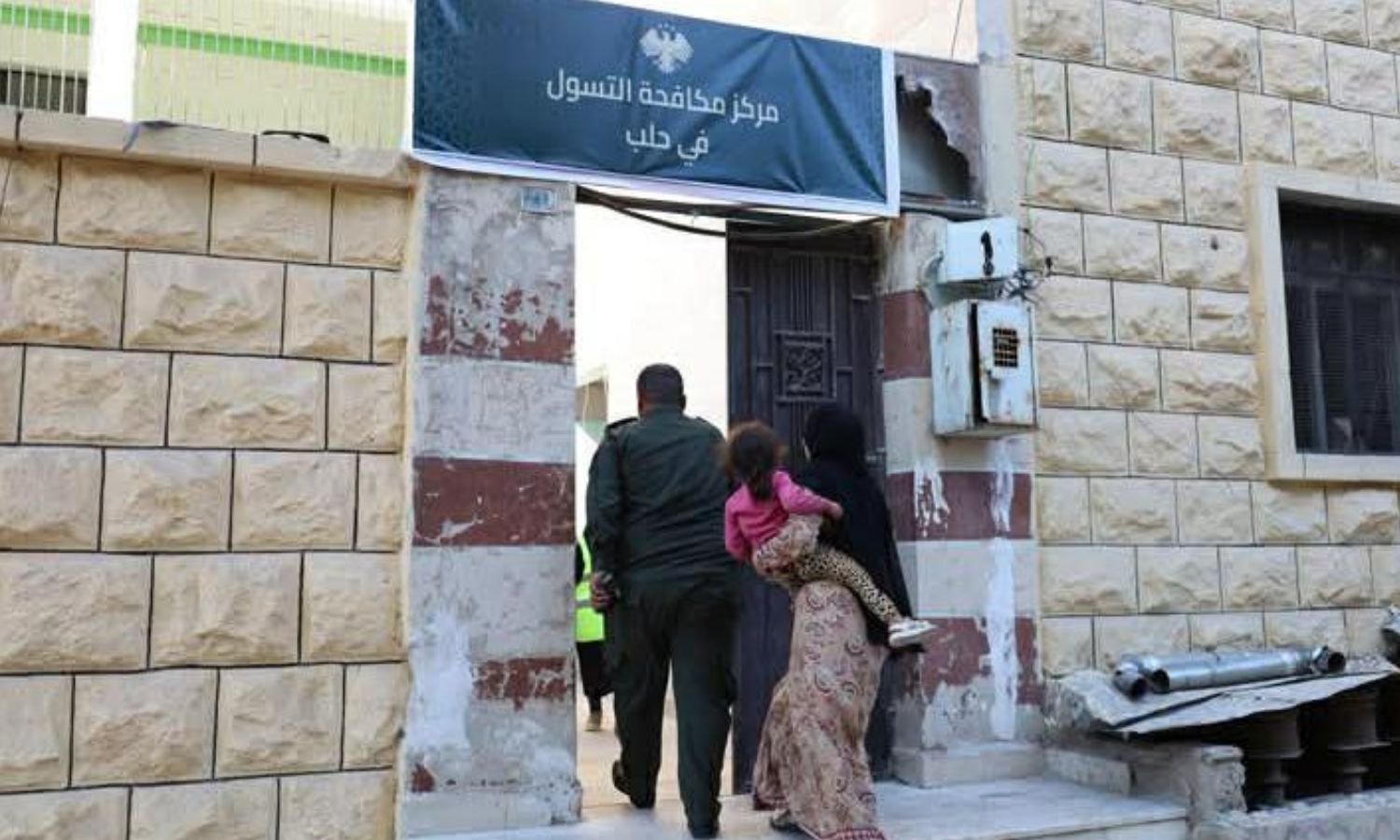
Several Syrian provinces recently launched campaigns to combat the phenomenon of begging – August 19, 2025 (Aleppo Governorate)
Damascus – Raghad Othman
On a street corner in the Fahhama district of Damascus, 11-year-old Samar Ibrahim sits quietly, selling biscuits to passersby. With a frail appearance and shy voice, she explains to Enab Baladi that she spends her summer vacation helping provide for her sisters, leaving no time for play.
Her father is dead, her mother remarried and left her daughters with their grandfather in the working-class Nahr Aisha neighborhood, and what little comes from charities is not enough. Samar is one of many Syrian children forced by poverty to work, though others fall prey to organized gangs that exploit children for profit.
Residents describe how beggars, often children or women, appear to be in genuine need but are in fact managed by gangs. These groups distribute beggars to busy streets and traffic lights, monitor them from a distance, and collect the money at the end of the day.
Samir al-Halabi, a resident of the Baramkeh area, told Enab Baladi he often watches from his window as children no older than 10 are directed by an overseer. When their pockets fill with coins, they run back to hand over the day’s “take.” He said the cycle repeats daily, turning what many see as an act of compassion into fuel for a black market of exploitation.
Begging in Syria is a complex social issue, fluctuating between genuine need and organized exploitation. The law imposes penalties, but the challenge lies in balancing humanitarian considerations with legal enforcement.
Educational psychologist Yasar Droubi explained that begging often stems from feelings of helplessness, loss of confidence in one’s ability to work, or a habit of relying on handouts, which fosters a sense of dependency.
“Some individuals find comfort in playing the role of ‘victim’ to elicit sympathy, which keeps them begging even when other opportunities exist.”
_Yasar Droubi, Educational Psychologist
Family breakdown, lack of support, and childhood neglect also increase vulnerability. Culturally, some communities view begging with tolerance or even legitimacy, especially where education is absent, pushing people toward unhealthy survival strategies.
Begging leaves deep scars on society’s image, signaling widespread poverty and the inability to protect vulnerable groups (children, women, the elderly).
According to psychologist Yasar Droubi, begging fuels feelings of tension and insecurity among individuals, especially when accompanied by insistence or child exploitation. It can open dangerous doors to negative practices such as sexual harassment, petty crime like theft, and the erosion of social cohesion through the loss of mutual trust.
For her part, psychologist Alaa Rankousi believes that “random compassion” toward beggars only perpetuates the cycle. She stresses that addressing the phenomenon is a shared responsibility of the state, associations, and individuals.
Awareness campaigns play an important role in raising public consciousness but remain insufficient without tangible alternatives, since deep psychological change requires long-term strategies based on rehabilitation, rebuilding trust, and restoring the values of work and dignity.
Alaa Rankousi
Psychologist
“The state must provide real alternatives such as job opportunities, psychosocial support, and child protection,” she explained. Associations should focus on offering social support programs, employment opportunities, and vocational training for marginalized groups, while individuals must understand that giving money on the street is not a solution but rather deepens a state of dependency.
Rankousi added that begging is not merely an outstretched hand for money but a “double psychological and social wound,” requiring comprehensive educational, psychological, and cultural responses that go beyond material poverty.
Several Syrian provinces have recently launched plans to combat begging. In Aleppo, a campaign was officially launched on August 17–18 under the supervision of a 30-member committee from government institutions and civil society organizations.
Committee member Futoun Kharboutli told Enab Baladi that the campaign works along three main tracks:
She added that a shelter center has been established in the city to accommodate about 60 cases and that Aleppo’s Anti-Begging Office was reactivated after 14 years of closure, alongside vocational and educational programs with specialized staff.
Nashmi al-Ahmad, head of the Anti-Begging and Vagrancy Office in Hama’s Directorate of Social Affairs and Labor, told Enab Baladi that the office conducts near-daily rounds across Hama city neighborhoods to document beggars and build a database of cases, which are then divided into two categories:
Addressing begging has become a priority, especially as the phenomenon has surged since 2011 due to difficult living conditions, according to Jamila Abu al-Khair, a member of the Executive Office for Social Affairs and Labor in Homs.
She said efforts now focus on rehabilitating children and youth in shelters by teaching them trades or returning them to school. Those insisting on professional begging are referred to court, while orphans and widows receive support from charities that cover their needs and secure education for widows’ children. This takes place in cooperation with the ministries of Education and Awqaf (Religious Endowments) to spread social awareness discouraging handouts to beggars.
Abu al-Khair added that field campaigns with local associations and provincial authorities continue in areas where beggars gather, aiming to address the phenomenon within a comprehensive humanitarian and social framework. She noted ongoing coordination between the Social Affairs Directorate and local authorities, in partnership with charities like the al-Birr and Social Services Association, which has extensive experience in this field.
Lilian al-Maghous, head of the Begging and Juveniles file at the Ministry of Social Affairs and Labor, told Enab Baladi that the number of beggars is large and that there is no full statistic on the phenomenon in Syria.
She revealed that only two centers in Damascus and one in Aleppo are currently operational, but the ministry’s new plan includes expanding the number of centers in cooperation with various entities and rehabilitating existing ones to increase efficiency and capacity.
The number of beggars is large, and there is still no comprehensive statistic on the scale of the phenomenon in Syria.
Lilian al-Maghous
Head of the Begging and Juveniles Fileat the Ministry of Social Affairs and Labor
She highlighted key challenges: unregistered children (a separate file with its own centers), limited shelter capacity, widespread school dropouts (a significant percentage of beggar children are out of school), and cases of families pushing children to beg as a source of income. Organized networks exploiting children for begging also complicate law enforcement.
A national committee has been formed in coordination with the General Secretariat of the Presidency, including representatives from the ministries of Social Affairs, Awqaf, Interior, Justice, Emergency Management, Local Administration, Environment, Tourism, Health, and Information. According to al-Maghous, there is active coordination with governors across provinces and partnerships with civil society organizations and activists to propose parallel solutions.
According to lawyer Amira Afghani, Syrian law devotes a special section to begging under Chapter Ten of the Penal Code (Law No. 148 of 1949, Articles 596–599), titled “Crimes committed by dangerous persons due to their lifestyle.”
Legal scholars define begging as the rejection of work in favor of soliciting others’ charity, either directly or under the guise of trivial services or acts.
Law No. 16 of 1975 also supports anti-begging efforts by establishing workhouses and offices to track cases of beggars and the homeless, requiring social reports before sentencing detainees.
Penalties range from one to six months’ imprisonment with compulsory labor, or commitment to a workhouse in case of repetition. Harsher penalties apply when begging involves threats, feigned injuries, use of children, or organized group begging, ranging from six months to two years’ imprisonment with labor. Beggars with disabilities may receive a lighter custodial sentence, and courts may also impose probation.
However, social realities, poverty, unemployment, and weak social safety nets, make begging a survival strategy, reducing the effectiveness of punitive measures alone.
Afghani noted the weakness of alternative institutions, such as workhouses, which fail to provide effective rehabilitation, leaving imprisonment as the default punitive response.
Organized begging networks exploiting women and children complicate individual prosecutions, as it is difficult to prove criminal responsibility of ringleaders. Shortages of trained staff to produce social reports also slow procedures, leading authorities to rely on traditional punitive measures.
Finally, Afghani explained the contradiction in perceptions: while the law criminalizes begging as a social threat, in today’s context it reflects an economic and social crisis, exposing a gap between legal texts and lived reality.
if you think the article contain wrong information or you have additional details Send Correction


 A
A
A
A
A
A







 More Society