


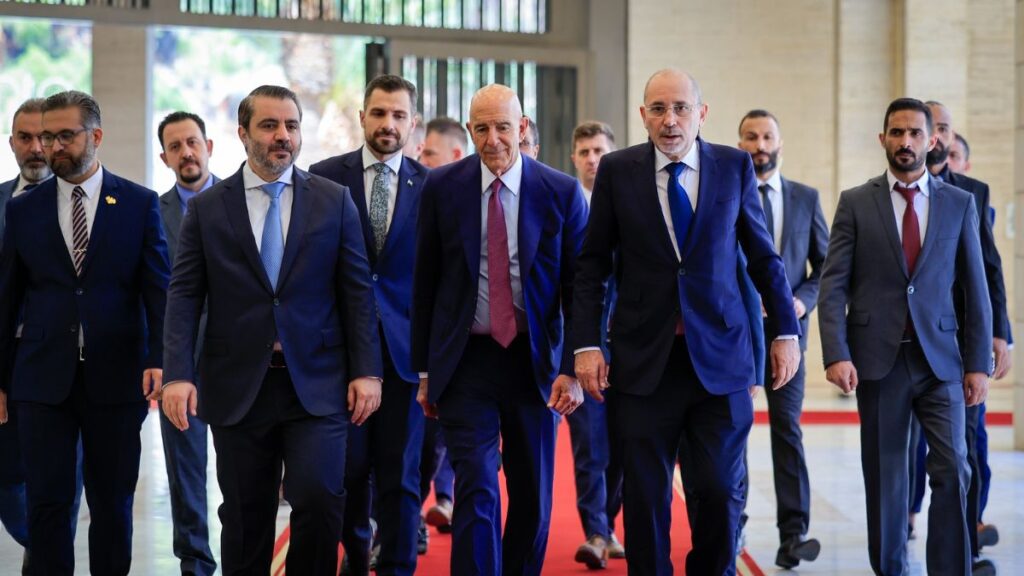
 Syrian Foreign Minister Asaad al-Shibani meets with his Jordanian counterpart Ayman Safadi and US Special Envoy to Syria Thomas Barrack – September 16, 2025 (Syrian Foreign Ministry/X)
Syrian Foreign Minister Asaad al-Shibani meets with his Jordanian counterpart Ayman Safadi and US Special Envoy to Syria Thomas Barrack – September 16, 2025 (Syrian Foreign Ministry/X)
Syrian Foreign Minister Asaad al-Shibani announced the adoption of a roadmap to resolve the crisis in Suwayda (southern Syria), following a meeting with his Jordanian counterpart Ayman Safadi and US Special Envoy to Syria Thomas Barrack at the Tishreen Palace in Damascus on Tuesday, September 16.
At a joint press conference, al-Shibani said the roadmap aims to “guarantee rights, uphold justice, strengthen social reconciliation, and pave the way toward healing wounds,” according to the state-run Syrian Arab News Agency (SANA).
He explained that the plan, backed by Jordan and the United States, includes practical steps:
Holding accountable all those involved in attacks on civilians and property, in full coordination with UN investigation mechanisms.
Ensuring the uninterrupted flow of humanitarian and medical aid.
Compensating victims, rebuilding villages and towns, and facilitating the return of displaced families.
Restoring basic services and creating conditions for a return to normal life.
Deploying Interior Ministry local security forces to protect roads and secure civilian and commercial movement.
Clarifying the fate of missing persons and returning detainees and abductees to their families from all parties.
Launching a reconciliation process that engages all communities in Suwayda.
“Suwayda belongs to all its people, and efforts are underway to restore normal life away from divisions and sectarian tensions,” al-Shibani stressed.
Jordanian Foreign Minister Ayman Safadi said Amman wants Syria to “stabilize, recover, and rebuild after years of destruction and suffering endured by the Syrian people, starting with practical steps toward a brighter future for all Syrians.”
He described the recent events in Suwayda as “tragic and must be overcome,” underscoring the need to hold perpetrators accountable and deliver humanitarian aid.
Safadi stressed that the security of southern Syria is directly linked to Jordan’s own security. “Its stability is essential for ours,” he said, condemning Israeli attacks on Syrian territory and calling for their halt.
He added that Israel is “the only party seeking Syria’s partition, because it does not want Syria to stabilize,” emphasizing that Jordan rejects partition, a stance he said is shared by the Arab world and the international community.
Safadi concluded that “a stable Syria is a guarantee for the security and stability of the region.”
US envoy Thomas Barrack reaffirmed Washington’s commitment to assist the Syrian government and support efforts to achieve security and stability.
“We cooperated with Syria and Jordan to reach this roadmap for Suwayda, as the Syrian government has taken practical steps to ensure civil peace,” Barrack said.
From his perspective, stability in Syria can only be achieved through “cooperation and coordination among Syrians themselves, by building trust, hope, and tolerance.”
According to the Jordanian Foreign Ministry, the meeting followed earlier rounds of consultations hosted in Amman on July 19 and August 12, aimed at consolidating a ceasefire in Suwayda.
Since the outbreak of violence in the province on July 12, Jordan has played a key mediating role. The “Amman Talks” of July 19 resulted in a ceasefire agreement between the Syrian government and local factions in Suwayda.
On August 12, a tripartite working group was formed, including Damascus, Amman, and Washington, to support Syrian government efforts to enforce the ceasefire and end the crisis in the province.
Syrian–Jordanian–American Working Group to Consolidate the Suwayda Agreement
The unrest began on July 12 with reciprocal kidnappings between residents of the al-Maqous neighborhood, mostly Bedouins, and members of the Druze community. The next day, clashes broke out.
The Syrian government intervened on July 14 to stop the violence, but its intervention was accompanied by violations against Druze civilians, prompting local factions, including some allied with the Defense and Interior ministries, to respond.
On July 16, government forces withdrew from Suwayda after Israeli strikes targeted their positions. This was followed by retaliatory attacks against Bedouin residents, leading to mobilization of armed tribal convoys in their defense.
Subsequently, the Syrian government and Israel, with US mediation, reached an agreement to halt military operations.
if you think the article contain wrong information or you have additional details Send Correction





 A
A
A
A
A
A


 More Politics