


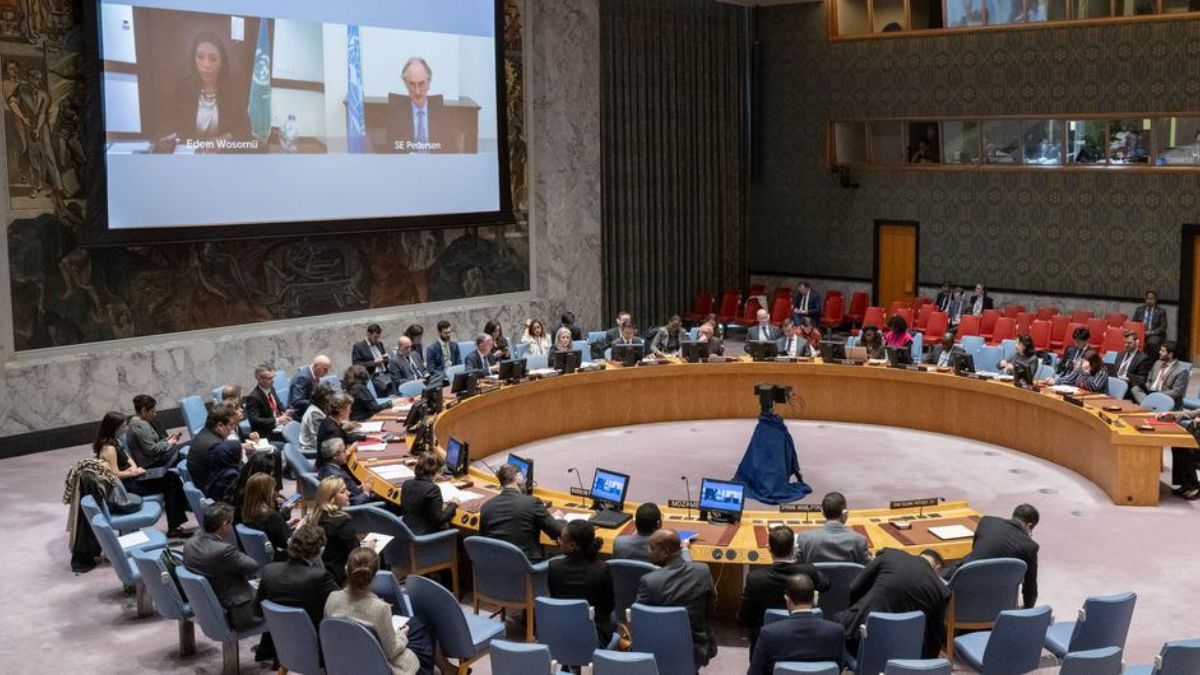
 UN Special Envoy to Syria Geir Pedersen and Edem Wosornu, Director of Operations and Advocacy at the UN Office for the Coordination of Humanitarian Affairs (OCHA), brief the UN Security Council on Syria – June 30, 2025 (UN).
UN Special Envoy to Syria Geir Pedersen and Edem Wosornu, Director of Operations and Advocacy at the UN Office for the Coordination of Humanitarian Affairs (OCHA), brief the UN Security Council on Syria – June 30, 2025 (UN).


 A
A
A
A
A
A
Envoys of Syria, Jordan, and the United States at the United Nations have sent a joint letter to Secretary-General António Guterres and the President of the Security Council, requesting that the Suwayda (southern Syria) roadmap be adopted as an official UN document to help resolve the province’s crisis and stabilize southern Syria.
According to the letter, published Thursday, September 18, by the Syrian Arab News Agency (SANA), the envoys wrote: “On the instructions of our governments, we are honored to enclose herewith identical letters dated 17 September 2025 regarding the roadmap for resolving the Suwayda crisis and stabilizing southern Syria, addressed to the President of the Security Council and the Secretary-General.”
The letter further requested that the attached documents be circulated as an official record of both the Security Council and the 80th session of the UN General Assembly under agenda item (34), “The situation in the Middle East.”

Nawras al-Abdullah, a researcher at the Syrian Dialogue Center, told Enab Baladi that granting the agreement UN recognition gives it international sponsorship and a tracking number in the UN’s official records, opening the door for it to be translated into practical measures issued by the Security Council.
If the document is adopted inside the Security Council, it would be put to a vote and approved as a binding resolution, obligating all UN member states to comply under the UN Charter. This process requires a formal session and a majority vote, subject to the veto power of permanent members.
Al-Abdullah added that because the request came from the Syrian Foreign Ministry, it reflects a deliberate effort to give the Suwayda roadmap international legitimacy, elevating the crisis into a formalized global concern. This also demonstrates Damascus’ seriousness in implementing the agreement and places political and moral pressure on local opponents in Suwayda, as well as on Israel if it rejects the deal.
During a Thursday session of the Security Council, UN Special Envoy to Syria Geir Pedersen stressed that Syria “needs international support, the lifting of sanctions, and an end to interference in its internal affairs.” He noted that the roadmap includes “accountability and justice, the release of detainees, and delivery of humanitarian aid,” emphasizing that transitional justice is essential for a successful political process.
UN Under-Secretary-General for Humanitarian Affairs Tom Fletcher said maintaining international momentum is “critical to supporting Syrians,” reiterating calls for lifting sanctions and highlighting UN cooperation with the Syrian Arab Red Crescent to deliver aid to Suwayda.
Denmark’s envoy Kristina Markus Lassen underlined the priority of an inclusive political process and welcomed the expected participation of transitional president Ahmad al-Sharaa in the UN General Assembly.
Russian envoy Vasily Nebenzya called for sanctions to be lifted immediately and denounced Israeli actions in Syria. US envoy Dorothy Shea described the Suwayda agreement as “an opportunity for unity and peace,” reaffirming Washington’s support for reconstruction.
Envoys from Panama and Algeria likewise stressed the need to support the Syrian people, uphold sovereignty, advance political dialogue, and ensure weapons remain under state control.
On September 16, the Syrian Ministry of Foreign Affairs announced that Damascus, Amman, and Washington had reached a roadmap for resolving the Suwayda crisis following a trilateral meeting between Syrian Foreign Minister Asaad al-Shibani, Jordanian Foreign Minister Ayman Safadi, and US Special Envoy to Syria Thomas Barrack.
The talks built on earlier meetings in Amman on July 19 and August 12 aimed at consolidating the ceasefire in Suwayda and addressing months of unrest.
According to the Syrian Foreign Ministry, the roadmap reaffirms that Suwayda is an integral part of Syria, its residents are equal citizens in rights and duties, and stresses gradual steps to rebuild trust and reintegrate the province into state institutions.
The three countries pledged to work jointly for Syria’s unity and stability, support an inclusive, Syrian-led political process reflecting the country’s pluralism, fight extremism, and end community divisions.
Inviting the Syrian government to allow the UN Independent International Commission of Inquiry on Syria to investigate Suwayda’s events and hold perpetrators accountable under Syrian law.
Continued humanitarian and medical aid deliveries, restoration of basic services with Jordanian and US support.
Deployment of trained police along the Suwayda–Damascus road, withdrawal of civilian fighters from the province’s borders, and their replacement with regular forces.
Support for the International Committee of the Red Cross to secure the release of detainees and kidnapped persons, and complete prisoner exchanges.
Jordan, in coordination with Syria, to convene reconciliation meetings between Suwayda’s Druze, Christian, and Sunni communities and local Bedouin tribes.
Launch of reconstruction projects for damaged villages and properties, financed with Jordanian and American assistance.
New legislation to criminalize hate speech and sectarian incitement, supported by Washington and Amman.
The roadmap also envisions forming a local police force inclusive of all Suwayda communities, led by a local appointee approved by the Interior Ministry, and establishing a provincial council to liaise with the government and guide reconciliation efforts.
It also stipulates the release and identification of all detainees and missing persons, management of aid flows, and reconciliation between the government and local communities.
The agreement calls for ending external interference in Suwayda, cooperation with the UN commission to ensure legal accountability, and granting investigators access to evidence, including witness testimony and surveillance footage.
The United States will coordinate with Damascus to reach security understandings with Israel regarding southern Syria that respect both sides’ legitimate concerns while safeguarding Syria’s sovereignty, with Jordan’s support.
The three parties agreed to create a joint monitoring mechanism to oversee implementation.
The Syrian Foreign Ministry concluded that the roadmap reflects a “shared will” between Damascus, Amman, and Washington to resolve the crisis in Suwayda and stabilize southern Syria based on state unity and equal citizenship.
Unrest in Suwayda began on July 12 with reciprocal kidnappings between residents of the al-Maqous neighborhood, largely Bedouin, and members of the Druze community. Fighting broke out the next day.
Government intervention on July 14 to halt the violence was accompanied by violations against Druze civilians, prompting retaliation by local factions, including groups previously cooperating with the Defense and Interior Ministries.
On July 16, government forces withdrew from Suwayda after Israeli strikes, followed by reprisal attacks on Bedouin communities. Armed tribal convoys then entered the province in response.
Subsequently, Syria and Israel reached a US-mediated ceasefire agreement, halting military operations.
if you think the article contain wrong information or you have additional details Send Correction






 More Politics