


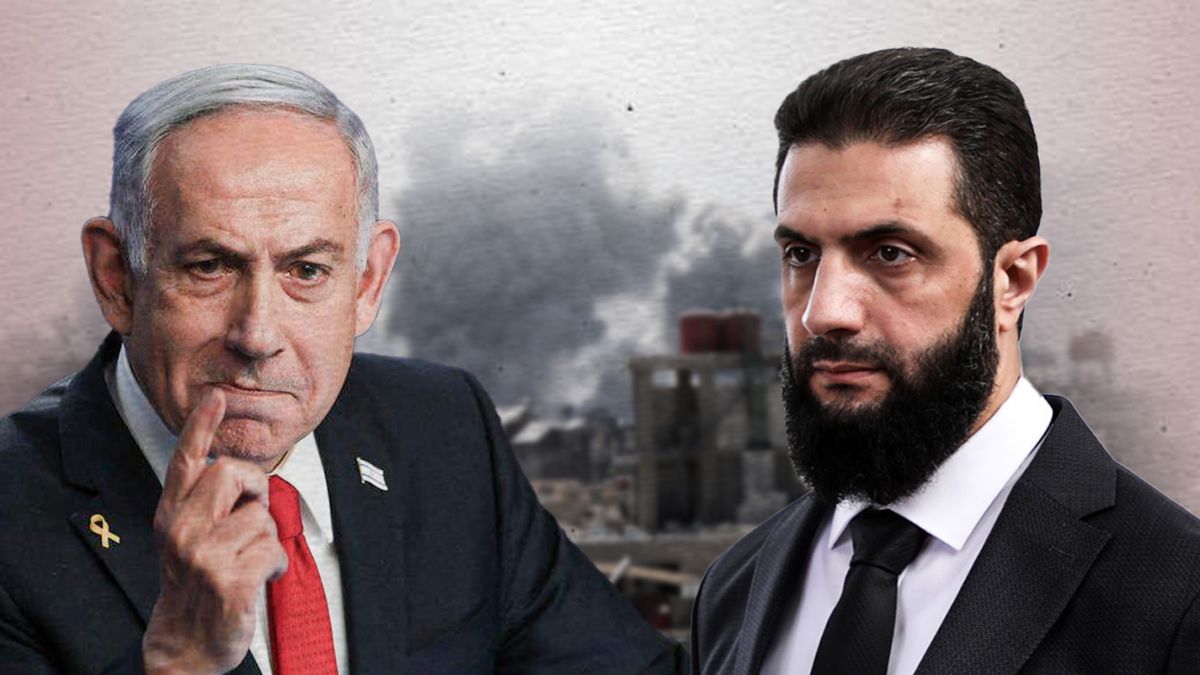
 Syrian transitional president Ahmad al-Sharaa and Israeli Prime Minister Benjamin Netanyahu (Enab Baladi edit)
Syrian transitional president Ahmad al-Sharaa and Israeli Prime Minister Benjamin Netanyahu (Enab Baladi edit)
Reuters reported on Friday, September 26, that efforts to reach a security agreement between Syria and Israel faced a last-minute “obstacle” due to Israel’s demand to open a “humanitarian corridor” into Suwayda province (southern Syria).
The agency quoted four sources familiar with the talks as saying that the agreement faltered because of Israel’s renewed request for a humanitarian corridor from Israel into Suwayda.
In earlier talks in Paris, Israel had requested to open a land corridor to Suwayda to deliver aid, but Syria rejected the request, considering it a violation of its sovereignty.
Israel reintroduced the request at a late stage of the talks, according to Israeli officials, a Syrian source, and a Washington-based source familiar with the negotiations.
The Syrian source and the Washington source said the renewed Israeli request obstructed plans to announce an agreement this week, and that this new point of contention had not been previously reported.
A Syrian official told Reuters that the talks held before the start of the UN General Assembly meetings were “positive,” but no further meetings with Israeli officials were held this week.
The US State Department, Netanyahu’s office, and the Syrian Foreign Ministry did not respond to Reuters’ questions regarding the details of the agreement or the outstanding issues.
In recent weeks, Syria and Israel came close to agreeing on the outlines of a deal after months of US-mediated talks in Baku, Paris, and London, which accelerated ahead of the UN General Assembly in New York this week
US Envoy to Syria Thomas Barrack said on September 23 that Syria and Israel were close to concluding a “de-escalation agreement,” under which Israel would halt its attacks while Syria would agree not to move heavy equipment or machinery near the Israeli border.
Speaking to reporters on the sidelines of the UN General Assembly meetings in New York, Barrack considered the agreement a first step toward the security agreement the two countries are negotiating.
Syria and Israel are holding talks to reach an agreement that Damascus hopes will ensure an end to Israeli airstrikes and the withdrawal of Israeli forces that have pushed into southern Syria, Reuters reported.
For his part, Syrian transitional president Ahmad al-Sharaa said that Israel had carried out many aggressions against Syria, still occupies the Golan Heights, and penetrates Syrian territory, but that Syria seeks to avoid war because it is in a reconstruction stage.
During his participation in the Concordia Summit in New York on September 22, Al-Sharaa added, “We are moving toward de-escalation to give Syria a chance to rebuild, and if de-escalation succeeds and there is Israeli commitment to what is agreed upon, negotiations may develop further.”
Al-Sharaa called on Israel to withdraw from Syrian territory, saying that security concerns can be addressed through negotiations.
He noted that Damascus has stages in its negotiations with Israel, with the first stage being the security agreement that returns Israel to the 1974 Disengagement Agreement.
If the security agreement succeeds, Damascus will move toward discussing further files related to the fate of the occupied Golan Heights and the long-term relationship between Syria and Israel, according to al-Sharaa.
Netanyahu’s office said in a post on X on September 24 that the negotiations with Syria aim to ensure Israel’s interests.
It pointed out that the conclusion of the negotiations depends on safeguarding Israel’s interests, including “disarmament in southwestern Syria and the protection and security of the Druze.”
Since the events in Suwayda in July, Israel has announced its direct intervention, striking government forces around Suwayda and bombing the General Staff building of the Syrian Ministry of Defense in Damascus, under the pretext of “protecting the Druze.”
Israeli Prime Minister Benjamin Netanyahu confirmed that Israel is conducting talks with the Syrian government, and that there has been some progress, but “these are still visions for the future.”
During a cabinet meeting on September 21, reported by Israel’s Channel 13, Netanyahu said that Israel’s “victories” in Lebanon against Hezbollah “opened a window for the possibility of peace with our neighbors in the north,” referring to Syria.
Several weeks ago, Israel presented Syria with a detailed proposal for a new security agreement, including a “map of demilitarized areas extending from Damascus to the border with Israel,” according to the American website Axios.
The Israeli proposal is based on the peace treaty Israel signed with Egypt in 1979 (Camp David), according to Axios sources.
That agreement divided the Sinai Peninsula into three zones (A, B, C), setting different security arrangements and levels of demilitarization depending on their distance from the Israeli border.
According to the website, the proposal stipulates:
Expanding the buffer zone on the Syrian side by 2 km.
In the strip adjacent to the buffer zone and closest to the Israeli border on the Syrian side, no military forces or heavy weapons would be allowed.
Syria would be allowed to maintain police and internal security forces.
The entire area from southwest of Damascus to the Israeli border would be designated a no-fly zone for Syrian aircraft.
if you think the article contain wrong information or you have additional details Send Correction


 A
A
A
A
A
A




 More Politics