


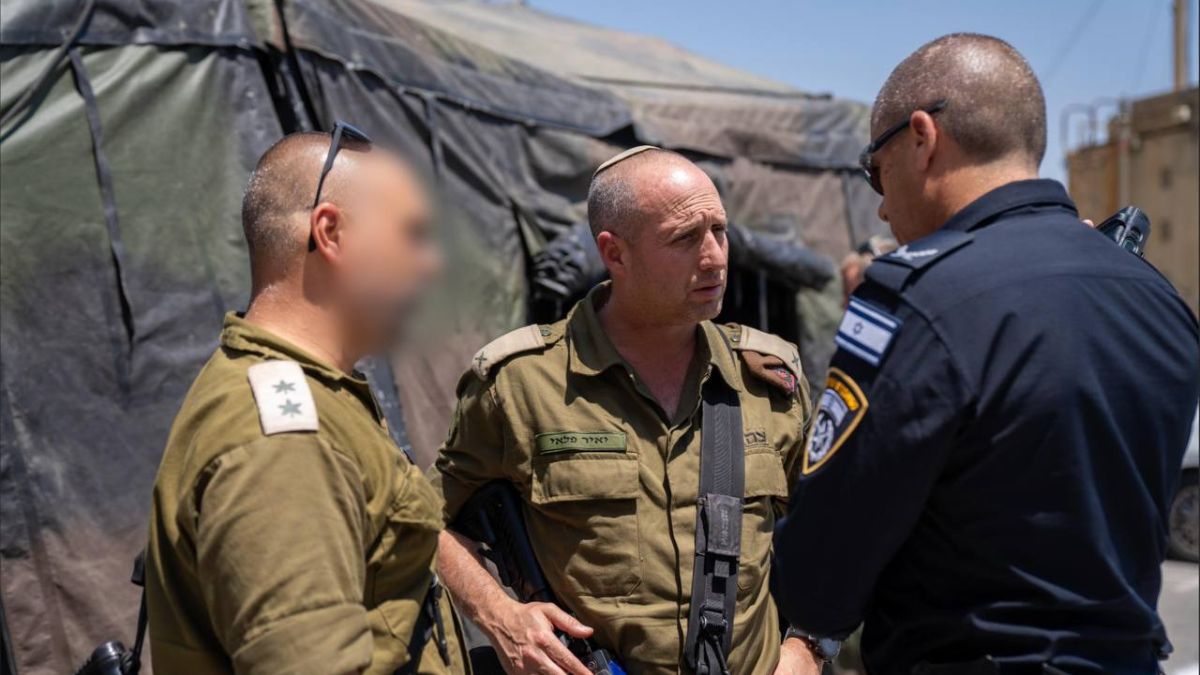
 The head of the IDF Northern Command assesses the situation in Syria from the Israeli-occupied Majdal Shams area - July 16, 2025 (Avichay Adraee)
The head of the IDF Northern Command assesses the situation in Syria from the Israeli-occupied Majdal Shams area - July 16, 2025 (Avichay Adraee)
The Israeli military announced on Wednesday, August 20, that four of its soldiers were lightly injured in an explosion involving a combat device in southern Syria.
In a statement on X, the army said the incident left the soldiers with minor injuries, without specifying the exact location or the nature of the blast. The soldiers were transferred to a hospital for treatment, and the incident remains under investigation.
According to the Israeli newspaper Yedioth Ahronoth, a military spokesperson—unnamed—said that four soldiers from Battalion 299 were wounded after an old landmine detonated on Mount Hermon (Jabal al-Sheikh, on the Syria-Israel border).
The report noted that the unit had been on an operational mission to identify weapon stockpiles in the area when it came across the device, which exploded and injured the soldiers. They were evacuated by helicopter for medical care.
Ziv Medical Center in Safed confirmed that the soldiers underwent medical examinations and scans before being discharged in stable condition.
This marks the first time the Israeli army has officially acknowledged casualties inside Syria since the fall of the previous Syrian government in December 2024.
Israeli forces have been in control of Mount Hermon since December 8, 2024, when the former Syrian regime collapsed, and says it intends to maintain control indefinitely.
The Israeli military has conducted repeated operations across southern Syria, particularly in Quneitra and Daraa provinces, searching for weapons and carrying out arrests of local residents.
On August 6, an Israeli army patrol crossed through Jubata al-Khashab into the al-Amal Farms area of Quneitra, reaching the Ain al-Nourieh region.
A media activist from Quneitra, who requested anonymity for security reasons, told Enab Baladi that the patrol consisted of around ten vehicles and armored carriers, accompanied by heavy surveillance drone activity.
The forces spread out between Tel al-Ahmar al-Gharbi and Tel al-Ahmar al-Sharqi in southern Quneitra, closing the road linking Kodneh village with al-Asbah.
The incursion was coupled with wider Israeli military movements along several axes of the Syrian-Israeli border strip.
Following the collapse of the Assad regime, Israel began constructing military bases in the areas it had entered inside Syria.
Journalist Ziad al-Fuhaili told Enab Baladi earlier that the Israeli army has established several bases in Quneitra, along with a network of strategic roads linking its positions inside the UN-demilitarized zone. This, he said, has raised concern among residents over the direct threat to their lands and resources.
Among the most significant Israeli bases set up after Assad’s fall are Mount Hermon peak and Qurs al-Nufl in the town of Hadar. Bases across southern Syria now include:
According to testimonies collected by Enab Baladi, these bases now serve as launch points for Israeli operations, with troops able to penetrate as deep as 16 kilometers into Syrian territory from the Golan Heights.
if you think the article contain wrong information or you have additional details Send Correction


 A
A
A
A
A
A





 More Politics