


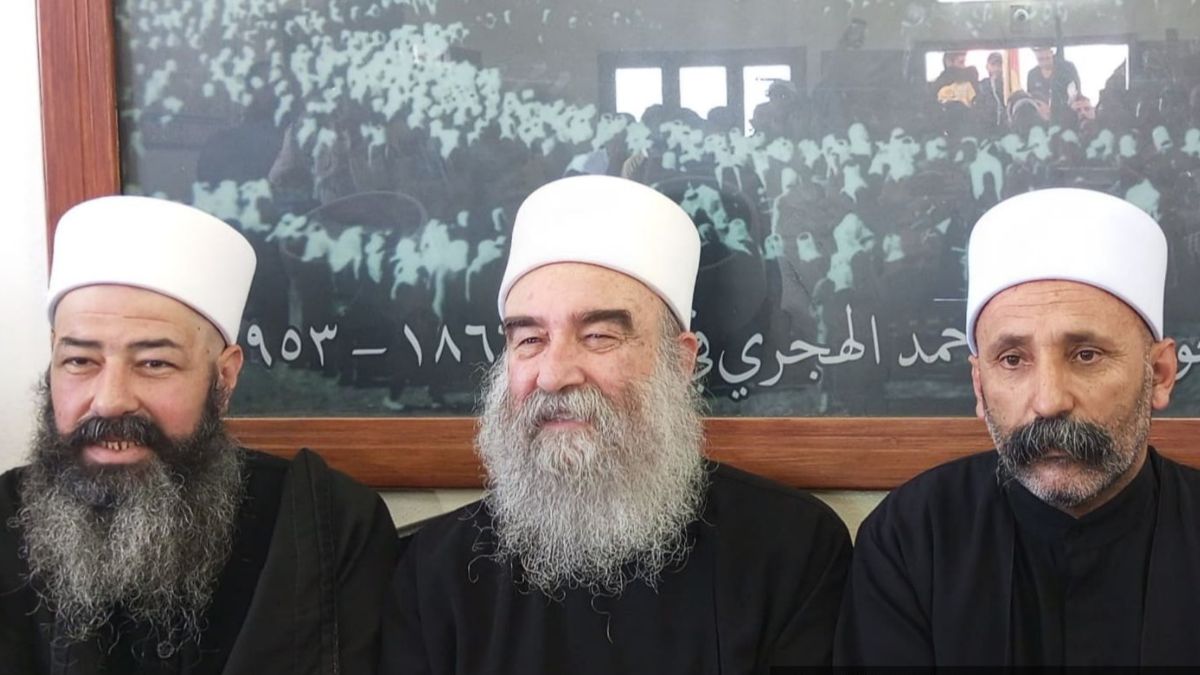
 The new leader of the Men of Dignity Movement, Mazid Khaddaj, alongside the spiritual leader of the Druze community, Sheikh Hikmat al-Hijri – August 25, 2025 (al-Rasid)
The new leader of the Men of Dignity Movement, Mazid Khaddaj, alongside the spiritual leader of the Druze community, Sheikh Hikmat al-Hijri – August 25, 2025 (al-Rasid)
The “National Guard,” the military body established by Druze spiritual leader Sheikh Hikmat al-Hijri, announced on Monday, August 25, that several local factions in Suwayda (southern Syria) had joined its ranks, most notably the “Men of Dignity Movement.”
The list of factions joining the Guard includes the Men of Dignity Movement, the “Unitarian Popular Resistance,” “Southern Shield Forces,” “Mountain Shield Forces,” “Lions of the Mountain Forces,” “Shield of Tawhid,” “Sahwat al-Khedr Shield,” “Mimas and Tal al-Lawz,” “Men of al-Lajat,” and “Men of al-Kafr.”
On Sunday, the “164th Brigade” had also announced its affiliation with the Guard.
Formed on August 23 with al-Hijri’s blessing, the National Guard includes around 40 armed factions operating in Suwayda.
In a video statement circulated by local media outlets, including al-Rasid, the new leader of the Men of Dignity, Mazid Khaddaj (Abu Diab), expressed his support for the new military structure and the “Supreme Legal Committee” established by al-Hijri, declaring loyalty to him.
The Men of Dignity Movement is the most prominent armed faction in Suwayda. On Sunday, it appointed Mazid Khaddaj (Abu Diab) as its new leader, succeeding Yahya al-Hajjar.
The movement was founded in 2013 by Sheikh Wahid al-Balous, who declared opposition to the Assad regime until he was assassinated in September 2015 in a car bombing. The perpetrators remain unknown, though the regime and Hezbollah have been accused of involvement.
Following his death, Raafat al-Balous assumed leadership, pledging to continue the same path, preserving Syria’s unity, and prohibiting aggression against Suwayda or by Suwayda against others.
In February 2017, Sheikh Yahya al-Hajjar took command due to Raafat al-Balous’s health issues, he had been injured in the bombing that killed his brother.
The faction numbers thousands of fighters, most wearing traditional local attire.
The Men of Dignity was among the most prominent factions supporting the Syrian government after the fall of the Assad regime. In a February 4 audio recording obtained by Enab Baladi, Hajjar called for ending armed manifestations to impose security in Syria and particularly in Suwayda, pledging cooperation with the civilian police to patrol jointly and lay the foundation for a lawful state in the “new and aspired Syria.”
This cooperation drew opposition from other parties in Suwayda. Threats were made against public security vehicles, but the movement maintained its stance until it broke with Damascus after the government’s July offensive.
Laith al-Balous, son of the Men of Dignity’s founder and representative of the Karama guesthouse, criticized the National Guard’s formation, calling the name a copy of Iran’s “Revolutionary Guard.”
Initially, he welcomed the Men of Dignity’s refusal to join, but the movement later issued a statement supporting the merger of local factions into an “organized military body.”
The statement described the move as essential at a time when the Druze community was “defending its existence against covetous aggressors,” pledging to work toward unity in this sensitive phase.
Commenting on the Men of Dignity’s affiliation, Sheikh al-Hijri welcomed the establishment of both the National Guard and the “Supreme Committee,” describing them as the community’s security, military, political, and legal institutions.
He said a new phase had begun after what he called a “new ordeal,” which he claimed was aimed at exterminating the Druze community.
Al-Hijri appealed to the “honorable of the world” and “free nations and peoples” to stand with the Druze and support them in declaring a separate autonomous region.
He also urged local factions to commit to what he described as the “Druze military arm,” supervised by specialized officers and backed internationally.
Al-Hijri thanked countries he said had supported them, singling out the United States and Israel.
On August 16, Suwayda witnessed mass protests in Karama Square, where demonstrators demanded “self-determination” and raised Israeli flags.
It was the first time such large crowds in Suwayda called for independence and separation from Syria.
The city remains tense after bloody events since July 13, triggered by mutual kidnappings between Bedouin tribes and Druze locals.
Government forces entered the city but faced resistance, even from factions that had previously supported Damascus, after abuses committed by members of the Interior and Defense ministries.
Syrian forces eventually withdrew on July 16 under Israeli strikes in support of local factions. Their departure was followed by retaliatory acts against Bedouins who remained in the city.
if you think the article contain wrong information or you have additional details Send Correction


 A
A
A
A
A
A



 More Politics