
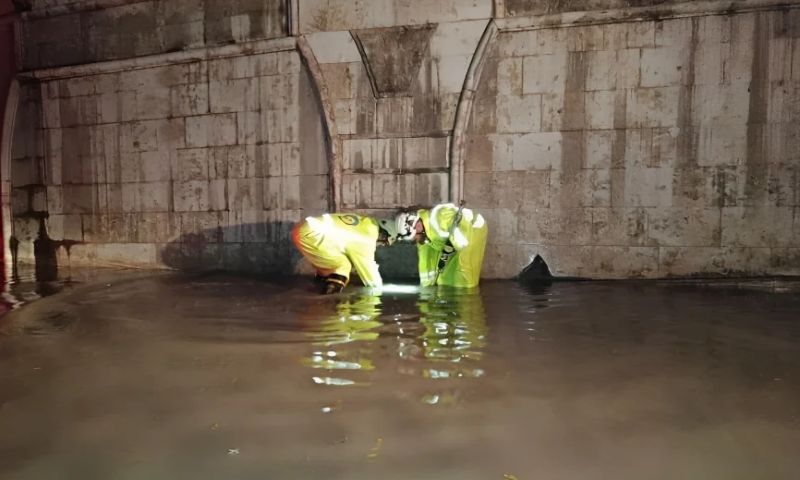

As rain returned to Aleppo (northern Syria) in late October, water once again flooded the city’s streets, leaving cars stranded and forcing pedestrians to wade through water covering large stretches of road.
The latest storm brought flooding back to several of the same locations affected in early October, raising questions about why water keeps accumulating and whether earlier interventions addressed the underlying faults, or whether the problem goes beyond cleaning drains and preparing emergency teams.
Whenever heavy rain falls, some of Aleppo’s streets are transformed. Roads normally used by cars and pedestrians become flooded areas that obstruct movement and force everyone to find a way through.
The effects of the latest rainfall were not limited to water accumulating in the streets. Civil Defense teams across Aleppo governorate and its countryside responded to a series of calls involving flash floods and flooding.
According to the Civil Defense, teams pulled out 66 vehicles and machines stranded in the water and pumped water from 23 homes, two basements and two factories. They also cleared 72 culverts and water channels, reopened five main roads, removed 10 trees and cleared four earth embankments.
On October 31, Aleppo governorate announced that work was continuing to clear storm drains, scrape sediment from streets, clean them and remove debris, through cooperation between central services teams, the city council, the public sewerage company and the Civil Defense.
The governorate said the work aimed to improve rainwater drainage, reduce water accumulation in the streets and prepare drainage networks for further rainfall.
High Water Levels Obstruct Drainage
In al-Fayd neighborhood, which lies on a main route toward the city center, accumulated water made driving difficult.
Rainwater rose in the streets until it submerged the main road and brought traffic to a halt.
While some drivers tried to make their way through the standing water, pedestrians were forced to wade through it after it flooded the roads and blocked their passage.
The neighborhood’s recurring flooding has again raised questions about its drainage capacity, particularly after Aleppo’s public water and sewerage company linked the latest flooding to rising water levels in the Queiq River.
According to the company, the river rose above the storm drain outlets during the storm, preventing water from draining into it and causing it to accumulate in the neighborhood.
The company told Enab Baladi that al-Fayd lies in the lowest part of Aleppo and that rising river levels limit the drains’ ability to carry water away during storms, even when they have been cleaned.
The company said all storm drains in the city had been cleaned, with none left out of the work.
It also said emergency teams worked around the clock in shifts during the rainfall and that the water receded after the storm ended, allowing drainage to return to normal.
The company attributed damage in some markets and other areas to the lack of proper drainage systems within premises, resulting from unplanned construction that did not account for drainage requirements during severe weather.
Measures After the First Rainfall
The flooding of Aleppo’s streets in late October was not the first that month. Earlier in October, rainwater accumulated in al-Fayd, al-Firdous, al-Mashhad, al-Masharqa and al-Saliheen neighborhoods, as well as areas around al-Fayd roundabout, al-Hajj Bridge, October 16 Bridge and Franciscan Street.
In some locations, water spread beyond the streets into homes and shops, also disrupting traffic and public transport.
The volume of rain during that episode exceeded what the network could drain in a short period.
Farhad Khorto, the official overseeing sewerage matters in the governorate, said more than 30 millimeters of rain fell in about 20 to 22 minutes, putting pressure on the drainage network.
Following that rainfall, the governorate announced that repairs and maintenance had been carried out at more than 50 locations within the sewerage network.
The public water and sewerage company also reported cleaning and clearing drain inlets and inspection chambers, while preparing its teams for subsequent rainfall.
An Aging Network in Need of Rehabilitation
Aleppo’s rainwater drainage problems stem from the condition of the sewerage network itself. Its main design dates back to 1970, according to Khorto, who explained that about 80% consists of enclosed channels built from concrete blocks, an aging structure requiring extensive rehabilitation.
According to figures provided by Khorto, the problem involves about 127 kilometers of deteriorated sewer lines. Around 42 kilometers have been rehabilitated, while roughly 85 kilometers still need rehabilitation.
The problems extend beyond aging sewer lines. Khorto also cited engineering flaws in some locations, including al-Fayd, alongside the accumulation of soil, silt and waste inside the channels, all of which affect the network’s drainage capacity.
Maintenance work also faces staff shortages. According to Khorto, the number of employees at the sewerage directorate has fallen from about 950 in 2010 to around 320 currently.