


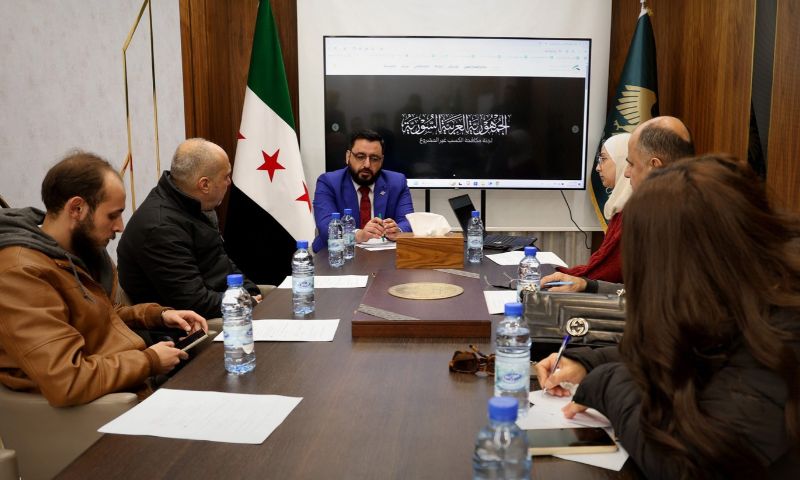
 Launch of the Voluntary Disclosure Program for Illicit Gain, December 28, 2025 (SANA)


 A
A
A
Syria’s Illicit Gain Committee conducts financial investigations, tracks suspicious financial flows at home and abroad, and examines how wealth and property were acquired. Its responsibilities extend to recovering illicitly obtained funds and assets.
The scope of these powers raises questions about their legal basis and limits, the extent to which the committee’s decisions are subject to judicial review, and the safeguards available to individuals and other affected parties. Other countries’ experiences offer possible models for regulating the committee’s work and defining its powers.
Presidential Decision No. 13 of 2025, issued on May 4, 2025, established the Illicit Gain Committee to protect public funds, combat all forms of illicit gain, recover illicitly obtained funds, and promote integrity and transparency in state institutions and across the business sector.
Alaa Younes, a researcher at the Syrian Legal Development Programme, told Enab Baladi that a presidential decision cannot serve as an independent source of legislation.
She explained that Article 36 of the Constitutional Declaration requires the president to issue regulations, orders, and presidential decisions in accordance with the law. The declaration vests legislative authority in the People’s Assembly, Syria’s parliament. Article 51 keeps existing laws in force unless they are amended or repealed.
The legal question therefore concerns both the validity of establishing the committee and the extent to which existing legislation authorizes the powers it exercises. The decision can establish the committee and regulate its work within the limits of the law. In principle, amending existing legislation or creating powers that conflict with it would exceed the authority of a presidential decision.
This is particularly important for asset freezes, confiscations, ownership transfers, the management of companies, and settlements that affect individuals’ rights. Younes said these measures require a clear legal basis and appropriate judicial safeguards.
Financial settlements can be lawful, Younes said. Establishing the legality of all the consequences of a settlement requires more than a general grant of authority or a presidential decision establishing the committee.
Younes said existing law must specify who can conclude a settlement, how assets are valued, what rights third parties have, and how settlements can be challenged or reviewed by a court. This is especially important when a settlement permanently transfers ownership of companies or real estate.
Settlements can raise legal questions unless clear legal provisions define their basis, procedures, and safeguards and make them subject to judicial review.
Younes said a financial settlement must leave open the possibility of prosecution for other crimes, a point the committee itself has acknowledged in its statements.
The legal questions also concern the committee’s relationship with the judiciary and the government bodies that manage recovered assets, as well as the scope of oversight over its decisions and actions.
Younes said the committee’s role should complement the work of the judiciary. The committee can gather information, conduct financial analysis and audits, take administrative or precautionary measures permitted by law, and refer cases. Judicial authorities retain responsibility for prosecution, determinations of criminal liability, judgments, penalties, and court-ordered confiscation, as provided by law.
The committee says that judicial authorities retain their role and that it refers cases involving suspected crimes to the public prosecutor’s office, Younes said. The published text of Decision No. 13 gives few details about the procedural boundaries between the committee, prosecutors, and the courts.
Defining those boundaries is particularly important because the Constitutional Declaration affirms judicial independence and prohibits shielding administrative decisions from judicial review, she said.
Younes said the published provisions she was able to verify leave two aspects of oversight undefined. They identify no independent external body with a detailed mandate to oversee the committee’s work, and they establish no dedicated, comprehensive procedure for challenging its decisions.
The Constitutional Declaration prohibits shielding any administrative act or decision from judicial review. The committee’s actions and decisions affecting property or other rights must therefore remain open to review by the courts in accordance with the law.
Younes said the published provisions have yet to set out a comprehensive framework for independent institutional and financial oversight of the committee’s work, its settlements, and the assets it recovers. Such a framework would identify the oversight body and define its powers and procedures.
Younes said the Illicit Gain Committee and the Syrian Sovereign Fund have separate legal foundations. Presidential Decision No. 13 of 2025 established the committee, while Presidential Decree No. 113, dated June 24, 2025, established the fund to manage and invest state assets.
The committee has announced that recovered assets, including some linked to settlements, were transferred to state entities through the Syrian Sovereign Fund for management and investment, Younes said.
The fund’s authority to manage state assets leaves open an earlier legal question about how an asset under investigation or covered by a settlement becomes state property.
Younes said the published provisions leave several procedures unclear, including how assets pass from the committee to the fund, how legal title is verified and assets are valued, and how the rights of business partners, creditors, and other third parties are protected.
The committee and the fund already work together in practice, Younes said. The published framework needs to define their legal and procedural relationship more clearly.
International experience in combating corruption and recovering assets, especially in countries that have undergone armed conflict or political transitions, offers ways to assess the Syrian committee’s legal framework. The comparisons cover the laws establishing such bodies, the powers they exercise, and how their work is overseen.
Younes pointed to Liberia, Sierra Leone, and Tunisia as useful comparisons, each shaped by a different context.
Liberia established the Liberia Anti-Corruption Commission as part of efforts to rebuild anti-corruption institutions after the civil war. Sierra Leone established its Anti-Corruption Commission in 2000, during the final phase of the war and amid changes that followed the Lomé Peace Agreement. Sierra Leone developed the commission’s legal framework further after the conflict ended.
Tunisia offers an example from a political transition outside a post-conflict setting. Its experience after the fall of the Ben Ali regime is relevant to the confiscation and recovery of a former regime’s assets.
Younes said some of these bodies are anti-corruption agencies with investigative and prosecutorial powers. Others are commissions that specialize in confiscation and asset recovery.
Their procedures offer models for conducting financial investigations, freezing and confiscating assets, recovering funds, and defining how these bodies work with the courts.
Sierra Leone established its Anti-Corruption Commission under the Anti-Corruption Act of 2000, Younes said. A 2008 law set out its mandate and powers in greater detail and was later amended.
Liberia established its commission under a 2008 law and reorganized it under a 2022 law. The latter gave the commission broader powers, including the authority to prosecute cases directly in court under certain circumstances.
In Tunisia, Decree-Law No. 13 of March 14, 2011, established the Confiscation Commission. It specified which assets and people were subject to confiscation proceedings, set out how the commission would operate and seek judicial assistance, and provided certain safeguards for rights holders.
Younes said the main lesson from these cases is that powers affecting property rights or potentially leading to prosecution and confiscation were governed by detailed legislation. Those laws defined each body’s authority, the procedures it had to follow, and its relationship with the courts.
Across the three cases, Younes said, the courts retain responsibility for deciding matters within their jurisdiction.
In Sierra Leone, the Anti-Corruption Commission investigates and prosecutes within the limits set by law. The courts decide cases and impose penalties.
Liberia’s law authorizes the commission to prosecute corruption cases in court. The commission brings cases into the judicial process, and the courts determine criminal liability.
Tunisia draws a clearer line between the work of the Confiscation Commission and procedures that require judicial intervention. The commission gathers information and takes measures authorized by the decree-law. It turns to the courts for proceedings, expert assessments, and measures that fall within judicial jurisdiction.
For Syria, Younes said the most relevant lesson is the need for a law that clearly defines each stage of the process and the powers of the bodies involved, from investigations and asset freezes to final confiscation and financial settlements. The law should also specify how decisions can be challenged, how third-party rights are protected, and who manages recovered assets.
She also stressed the importance of maintaining institutional separation, wherever possible, between investigations, asset valuation, settlement decisions, and the management of property transferred to the state. She called for a clear register of recovered assets, independent audits, and effective judicial oversight.
Younes concluded that recovering illicitly obtained funds is a legitimate and necessary goal. The central legal question is whether existing legislation provides a sufficiently clear basis for the breadth of the committee’s powers.
She said the Constitutional Declaration requires presidential decisions to operate within existing law. The more the committee’s actions affect property rights, particularly when they result in confiscation or a permanent transfer of ownership, the greater the need for explicit legislation, defined procedures, judicial review, and an effective right to challenge decisions.
if you think the article contain wrong information or you have additional details Send Correction







 More Economic Reports