

Wasim al-Adawi | Shaaban Chamieh | Ghena Jabr
Syrian families are bracing for an unusually difficult winter as heating costs rise across the country. In an Enab Baladi poll, 36.9% of respondents said they relied on diesel or gas from the black market to heat their homes.
Families struggling to stay warm have been forced to improvise, turning to rudimentary and sometimes hazardous substitutes for conventional fuels. In some governorates, residents have cut down productive olive trees around their homes for firewood or turned to pellets made from olive pomace and to walnut shells. Elsewhere, dried animal dung, known as (jilla), has returned as a heating fuel.
The crisis extends beyond supply shortages and record firewood prices. Solar power, a longer-term option, costs more than 90% of Syrians cannot afford solar power systems, which also operate less efficiently in winter.. A lack of data and inequitable distribution of fuel allocations compound the problem, leaving Syrians facing long hours of electricity rationing and scarce fuel supplies.
Economists trace the crisis from government policies that created three diesel price tiers to households’ inability to afford even the cheapest grade when it is available. On November 14, the government scrapped the highest price of 175 Syrian pounds per liter and retained the 150-pound tier as the new ceiling.
High Prices and Alternatives That Offer Little Warmth
Poll Results Show the Depth of the Crisis
Many Syrian families are bracing for a harsh winter as declining purchasing power and the suspension of subsidized fuel distribution make heating increasingly difficult to afford.
An Enab Baladi poll showed a split in how people cope with the cold. Many families buy diesel at high prices on the black market, while roughly a third of respondents rely entirely on blankets and winter clothing because they cannot afford to spend anything on heating.
Interviews conducted by Enab Baladi in several governorates echoed the findings. Some residents said they resorted to burning cardboard, plastic or animal dung to get through freezing weather.
The poll drew 804 responses and offered a snapshot of the pressures on household budgets and public services in Syria, particularly the heating options people are using this winter.
Diesel and gas ranked first at 36.9%. The result reflects how some households continue to seek out these fuels despite shortages and turn to the black market, where prices are high.
Reliance entirely on blankets and heavy clothing followed closely at 36.4%. Roughly a third of respondents could afford no form of home heating and had to make do with basic ways to keep warm.
Another 16.7% of respondents opted for firewood and agricultural waste, such as olive pomace and shells, which are locally available and cheaper in rural areas.
Electric heating ranked last at 10%. A deteriorating power sector, long hours of rationing and steep increases in electricity charges make it impractical for most Syrians.
In the Damascus countryside (southwestern Syria), Enab Baladi’s correspondent found diesel heaters starting at $100, with typical prices reaching $250 and few models available. The governorate was once the main supplier of diesel heaters to the rest of Syria.
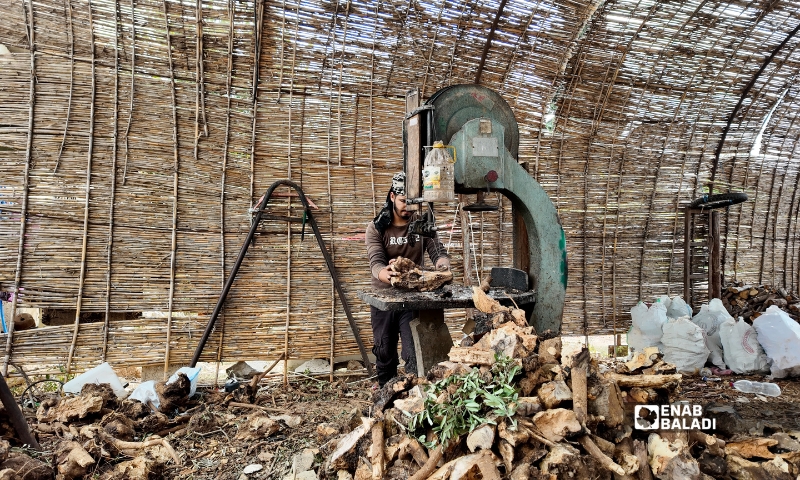
A worker at a sawmill that sells firewood in al-Ajami, western Daraa countryside, September 23, 2026 (Enab Baladi/Mahjoub al-Hashish)
How Are Syrians Keeping Warm This Winter?
- 36.9% use diesel and gas from the black market
- 36.4% rely on blankets and heavy clothing
- 16.7% use firewood and agricultural waste
- 10% use electric heating
Source: Enab Baladi poll
Daraa Families Face Tough Choices
“Leave it to God. Every option is hard.” The remark sums up what most Daraa residents interviewed by Enab Baladi said when asked how they planned to heat their homes this winter. Diesel is out of reach, firewood is scarce and prices are high.
In Tal Shihab, in the western Daraa countryside, Murad al-Beik, 45, plans to cut down some of the olive trees around his home for firewood because he can no longer afford current prices.
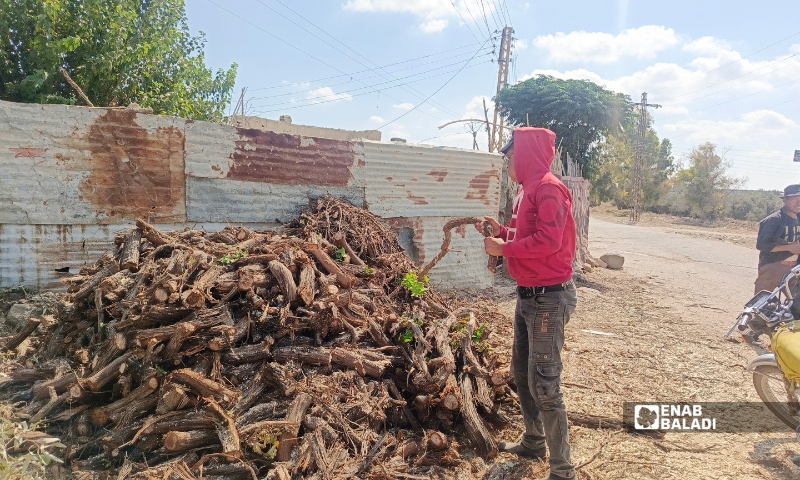
Olive wood, the most sought-after variety because it catches quickly and produces less smoke, reached 35,000 Syrian pounds per metric ton. Wood from almond and other stone-fruit trees reached 20,000 Syrian pounds per ton, and grapevine wood reached 15,000.
Murad told Enab Baladi that his elderly mother and children live with him and that he needs to keep the heater running.
Last winter, he bought diesel a day at a time because he was short on cash. This season, the price nearly doubled from 95 to 175 Syrian pounds per liter before it was adjusted to 150. Diesel heaters have also become more expensive, selling for 10,000 to 20,000 Syrian pounds in Daraa, depending on the model.
In the eastern Daraa countryside, firewood merchant Mahmoud Kasabra said residents were turning to alternatives such as olive pomace pellets and walnut shells. A metric ton of these fuels costs about $300, or roughly 45,000 Syrian pounds, and could last a household through winter if used only during the coldest periods.
Al-Hasakah Residents Turn to Wood Stoves
Some residents of al-Hasakah city (northeastern Syria) are switching from diesel heaters to wood stoves this winter as fuel prices strain household budgets. Demand for stoves and firewood has risen in local markets.
Jassem al-Abd, an al-Hasakah resident, told Enab Baladi that expensive diesel had pushed many families to look for alternatives, with wood stoves their leading choice.
Ready-to-burn firewood costs $200 to $300 per metric ton in al-Hasakah. That is still cheaper than relying on diesel throughout the winter.
Al-Abd said a family needs between one and a half and two metric tons of firewood to run one stove through the winter, a substantial expense before the cold sets in.
Mahmoud al-Khalaf, a stove seller in al-Hasakah, said demand for wood stoves had risen sharply compared with previous winters, prompting merchants to bring more into the market.
Al-Khalaf told Enab Baladi that prices vary with size and workmanship. Large stoves made of high-quality metal can cost about $100, with prices depending on the stove’s specifications, durability and expected lifespan.
After the al-Hasakah governorate’s executive office announced the start of heating diesel distribution, Nawar Mahmoud Sabri, the office’s member responsible for energy, said what she called the “relevant committees” were continuing to distribute fuel across the governorate according to set schedules. She did not specify whether the announcement was part of a Syrian Petroleum Company plan, which committees were involved, when deliveries would take place or which areas would receive them first.
Suwayda Families Buy Fuel a Little at a Time
Families in Suwayda (southern Syria) face a harsh winter and severe financial hardship that has put heating beyond their means. Residents are choosing between makeshift fuels that pose health risks and buying small amounts of diesel to get through cold spells.
In the governorate, known for its bitter winters, particularly in the southern countryside, a household needs at least five liters of diesel a day to run a heater. At black-market diesel prices and local exchange rates, that puts the monthly cost of heating at about $210.
Sidra Nassar told Enab Baladi that her family started stocking up in advance to keep their infant daughter warm. Over the past few months, her husband bought small quantities of diesel whenever he had cash to spare.
The Suwayda City Council announced that it was drawing up lists of households seeking diesel, including residents, displaced people and those most in need. Distribution still depends on whether the fuel directorate has supplies available.
Long power cuts and rising electricity bills have put electric heaters out of reach for residents.
Dried Animal Dung Returns as a Heating Fuel
Firewood offered little relief in Suwayda, where a metric ton of olive wood cost about $300.
Abu Omar Ballan, who heads a household, told Enab Baladi that the prices were “astronomical.” He worried about his children and said he did not know how he would keep them warm this winter.
With few options available, residents have returned to traditional fuels such as *jilla*, or dried animal dung. A local project has begun selling compressed dung briquettes as a substitute for firewood at $185 per metric ton.
Olive pomace has also emerged as an alternative after being a major component of last year’s aid. Meanwhile, people are increasingly burning fabric scraps, cardboard and plastic despite the serious health risks.
Umm Kami, 50, was displaced from the western Suwayda countryside and lives in a shelter. She told Enab Baladi she got through last winter with wool blankets alone because her health kept her from burning old clothes or plastic and being exposed to the toxic smoke.
These choices show the financial pressure on Suwayda households. Fuel and firewood prices increasingly determine how much heat families can afford or whether they resort to hazardous substitutes to keep from freezing.
Raqqa and Deir Ezzor Residents Face Market Prices
Raqqa and Deir Ezzor (eastern Syria) are also facing an acute fuel crisis after subsidized heating diesel distribution stopped. Families, particularly those on low incomes, are left facing high black-market prices or looking for alternatives as their purchasing power falls sharply.
Khalil al-Mabrouk, a Raqqa resident, told Enab Baladi that household heating fuel allocations had gradually dwindled over the past several years. The annual allotment fell from 440 liters to 300 liters, with the full allotment costing $25, before it was scrapped entirely.
He said the allotment could last families that used fuel sparingly through the winter. Other households bought small amounts to make up the shortfall.
In Deir Ezzor city’s al-Jubaila neighborhood, Marwan al-Mohammad, 40, collects cardboard outside shops every day to burn on winter nights. The price of diesel rose from 50 Syrian pounds per liter last winter to 110 this year.
Residents said they could not afford to buy fuel at market prices. They called for direct support through smart cards or assistance programs for the neediest families.
City Residents Have Few Heating Options
Heating options differ between rural and urban areas. Rural residents can turn to firewood or locally available substitutes, while city residents have far fewer options.
Raqqa resident Mohammad al-Hamada told Enab Baladi he wanted the government to act urgently to ease the burden before the coldest months.
As diesel grows scarce, demand for firewood in Raqqa has risen while supplies have fallen short. Enab Baladi found that the price of a metric ton of cut firewood rose from $140 two months earlier to about $200.
Adnan al-Jassem, a firewood merchant, expects current prices in Raqqa to double if demand keeps rising and supplies remain tight.
For low-income residents across the governorates, garbage bins and market waste have become a last resort for collecting cardboard and plastic to burn, despite the serious health risks posed by the emissions.
Khalaf al-Mahmoud, 45, who sells fur coats in Deir Ezzor, said the lack of heating options had led residents to rely on the traditional farwa coat for warmth. Synthetic versions sell for 2,000 to 5,000 Syrian pounds.
Al-Mahmoud told Enab Baladi that the coat, once worn only by men, now comes in a range of designs and colors for women. He said local production sets it apart from ready-made jackets. The coat reflects the region’s heritage and identity, he said, and offers good quality at a competitive price.
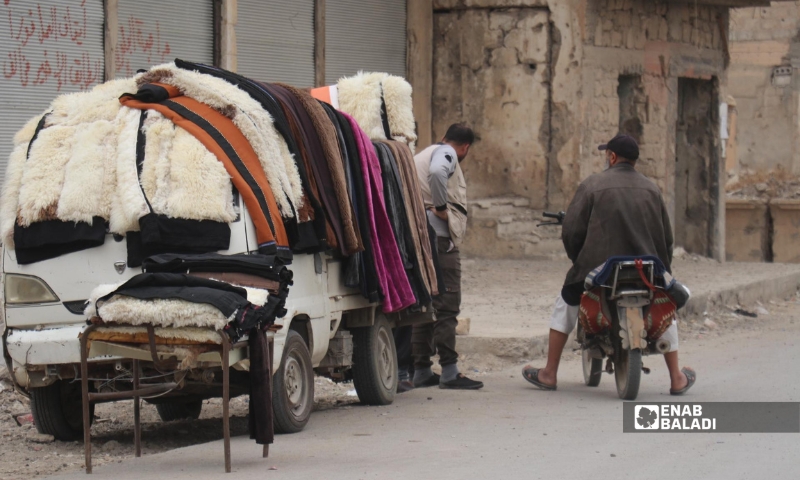
A street vendor displays fur coats to passersby in Deir Ezzor’s al-Hawiqa neighborhood, October 27, 2026 (Enab Baladi/Shaimaa al-Saleh)
Energy Ministry Deflects Responsibility as Subsidized Diesel Plan Lacks Details
Who Manages Fuel Distribution?
In correspondence with Enab Baladi, Syria’s Ministry of Energy disclaimed direct responsibility for organizing and distributing heating diesel allocations, saying the matter rested entirely with local authorities in the governorates.
In response to Enab Baladi’s questions, the ministry’s media office said the role of the authorities involved ended once the Syrian Petroleum Company delivered the diesel to the governorates.
According to the ministry’s response, the governorates’ executive offices are fully responsible for deciding how to distribute the fuel and who qualifies, in coordination with local social affairs and labor directorates.
Enab Baladi asked the ministry about the availability of fuel and other heating supplies on the domestic market, expected winter demand, and whether current supplies could meet residents’ needs.
Enab Baladi also asked what plan the ministry had adopted to secure fuel and distribute it across the governorates, and what steps it had taken to regulate the market, curb monopolistic practices and price manipulation, and enforce official prices. The questions also covered whether the ministry had a contingency plan for possible supply shortages and what alternatives it would pursue if it could not meet demand.
With winter already underway, most governorate executive offices in Syria had yet to announce clear plans for diesel distribution. The executive office in al-Hasakah governorate (northeastern Syria) was an exception. Days earlier, it announced the start of the first phase of distribution in the al-Hol area and the southern neighborhoods, with each household allocated 200 liters at 115 Syrian pounds per liter.
The lack of transparency also extended to heating diesel allocations for public schools. As of publication, the Ministry of Education had released no plan for these allocations. In an August letter to local education directorates on preparations for the 2027 school year, the ministry addressed heating in a single sentence: “Ensure heating equipment is ready and safe to use, secure the fuel or supplies needed to operate it, and carry out the necessary maintenance before use.”
Distribution Details for Subsidized Diesel Remain Unclear
On September 17, Energy Minister Mohammad al-Bashir announced new grades of diesel as part of government measures to support heating. They included a subsidized grade priced at 115 Syrian pounds per liter for heating, agriculture and eligible consumers. The governorates and the Ministry of Social Affairs and Labor would coordinate its distribution.
At a joint press conference with Youssef Qablawi, the former CEO of the Syrian Petroleum Company, al-Bashir said another grade would be supplied in cooperation with several Arab countries and priced at 150 Syrian pounds per liter. At the time, the government continued to offer standard-grade diesel at 175 Syrian pounds per liter. It scrapped that price tier on November 14, making 150 Syrian pounds per liter the new ceiling.
Al-Bashir also announced that several refineries would resume operations under the supervision of the Syrian Petroleum Company, with a production capacity of 35,000 barrels per day. The aim was to supply subsidized diesel and coordinate its distribution across the governorates.
Qablawi said the company would oversee production at the refineries, take delivery of the diesel after refining and distribute it exclusively through designated filling stations in each city. The stations would be selected based on population density and equipped with dedicated storage tanks.
Authorities announced the price and outlined how distribution would work. As of publication, they had yet to announce when distribution would begin, which stations would carry subsidized diesel, who would qualify or how much each household would receive.
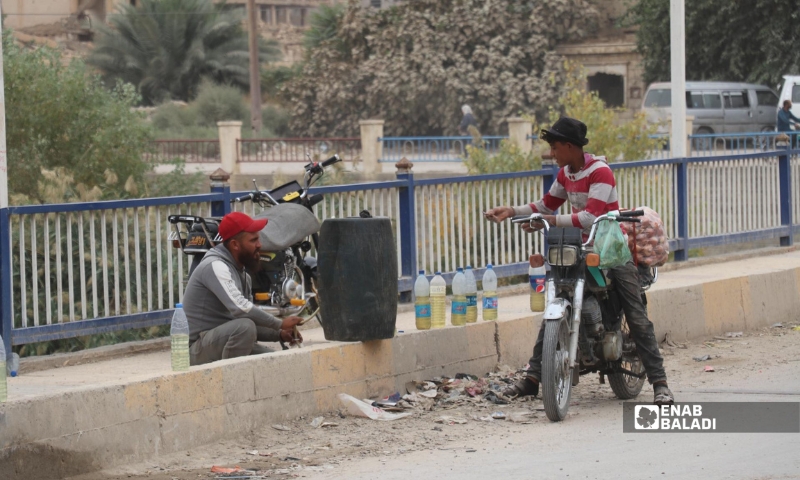
A customer buys heating fuel from a street vendor on al-Ayur Bridge in Deir Ezzor’s al-Hawiqa neighborhood, October 27, 2026 (Enab Baladi/Shaimaa al-Saleh)
Fuel Subsidies and Household Purchasing Power
Economist Majdi al-Jamous estimates that at least 75% of Syrians cannot afford heating diesel at current prices, even if it is available. He said the government subsidy on diesel does not exceed 10%, a level he considers out of step with household incomes.
Al-Jamous told Enab Baladi that, given current living conditions, the subsidy should be at least half its previous level. He warned that many Syrian households would face a harsh winter unless the government made fuel available at prices low-income families could afford.
Al-Jamous said Syria’s oil supplies had improved, citing a long-term agreement with Saudi Arabia’s Aramco for roughly 50,000 barrels of oil a day. He estimated that this covered 20% to 30% of Syria’s daily needs.
The economist said contracted supplies should reduce the risk of shortages in the coming period and make fuel more likely to remain available. He identified three challenges that would persist:
- Fuel prices
- The government’s ability to subsidize fuel for low-income households
- Access to fuel for low-income households and people most in need
High prices for firewood, gas and electricity also put alternatives to heating diesel beyond what most families can afford.
Al-Jamous said rising costs across all forms of heating left low-income families with difficult choices. He urged the government to take administrative steps before winter to identify households by income and give those most in need priority access to subsidized heating diesel.
Structural Problems in the Fuel Sector
Al-Jamous said Syria’s fuel sector faced challenges in addition to securing supplies and regulating prices:
- Structural problems stemming from low domestic production
- Limited capacity to rehabilitate and operate oil facilities
- Difficulty financing subsidies and a lack of clear data to guide government decisions
- Sharp fluctuations in global prices
Together, these factors affect market stability, fuel costs and households’ ability to meet their daily heating needs.
Al-Jamous said one of the biggest challenges was the inability to rehabilitate, operate and restructure oil wells. That keeps domestic production below the level needed to meet demand and increases reliance on imports.
He also pointed to the difficulty of subsidizing fuel and essential goods. Energy is used to produce more than 3,700 goods, he said, so higher energy prices push up heating and transport costs as well as the cost of everyday goods and services.
Al-Jamous said shortcomings in fuel management stemmed from distribution practices and the lack of data behind government decisions. That affects how authorities set prices, determine quantities and decide how to distribute fuel.
He said the government should disclose available fuel volumes, sources of supply and distribution arrangements so the public can understand its decisions and uncertainty in the market can ease. He pointed to countries that use targeted subsidies to protect people most in need when broader support is withdrawn.
Al-Jamous said deciding prices and distribution without clear, public data undermines market stability and citizens’ trust in the authorities.
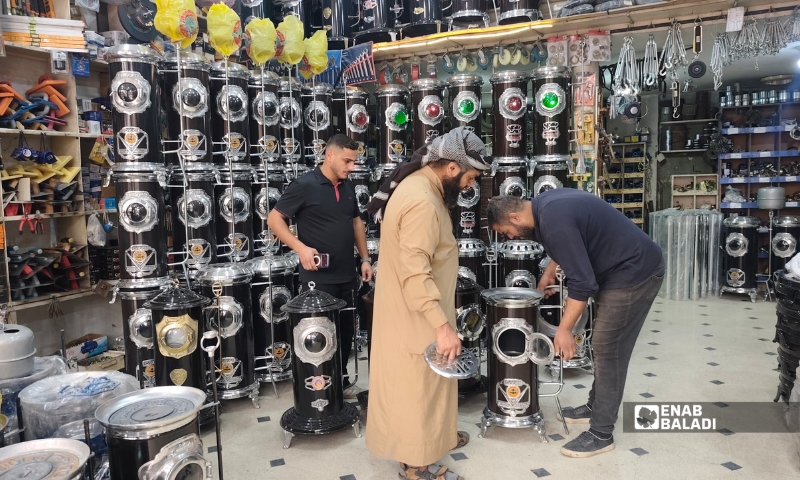
Customers inside a shop selling heaters in Raqqa’s al-Quwatli market, October 26, 2026 (Enab Baladi/Ahmad al-Hamdi)
Heating Costs Outstrip Wages as Distribution Falters
What Solutions Are Available?
Syrian economist Mohamad Bakr said the average income had fallen so far behind the cost of diesel, gas, electricity, firewood and even blankets and heavy clothing that he described the difference as a “chasm.” Under current economic conditions, he said, even narrowing it was impossible.
Bakr identified three stages in how access to heating changed over the years:
- Before the war: About 85% of Syrians had access to reliable, efficient heating.
- During the war: Rationing and shortages set in, although about 50% of the population could still use some form of heating.
- Now: Heating has become a “luxury” for the small share of households that can buy what they need without worrying about cost or how to obtain it.
Bakr said household spending priorities had shifted dramatically. Rent came first because families needed to keep a roof over their heads, followed by food. Education fell farther down the list.
Spending on health care and medical treatment had become “highly elastic,” he said, with many families forgoing care altogether to cover basic daily expenses.
In previous winters, Syria’s most vulnerable households relied on selling their subsidized diesel allocations to bring in a little money and shore up their strained budgets. That option has all but disappeared as distribution has stopped or become erratic.
Mohamad Bakr, economist
Proposals for Managing Fuel Supplies
Abdulrahman Mohammed, a professor of finance and banking at Hama University’s Faculty of Economics, said frequent changes to fuel policies, prices and distribution rules disrupt the market. The changes make it harder for producers and consumers to make decisions and plan ahead, creating opportunities for speculation and stockpiling.
He said volatile prices and unexpected changes in distribution rules also affect consumer behavior. Some people rush to buy before prices rise, while others hold off in hopes of a price cut. Either response can strain the market even when supplies are adequate.
Mohammed said distribution priorities should be based on objective, measurable criteria, including the number of people actually living in each governorate, the needs of different sectors, and local geography and logistics. He said equitable distribution required authorities to:
- Account for geographic differences between governorates.
- Allocate fuel to areas with limited access to distribution services.
- Ensure remote areas are served.
- Publish relatively stable criteria and review them regularly using documented consumption data. Estimates by local committees can be influenced by local pressures and considerations.
Mohammed said better oversight of the fuel supply chain would require digital tracking, on-the-ground inspections and institutional reform. A digital system that tracks shipments from import or domestic production to the consumer would make it easier to monitor quantities, fuel grades and delivery points.
He also called for a single electronic register of violations and penalties so regulators could share information, follow up on breaches, standardize enforcement and hold violators accountable. He said publishing regular, transparent data on the fuel sector was necessary to improve market management.
When information about the amounts imported, produced and distributed is unavailable, rumors and speculation fill the gap, increasing uncertainty for consumers and producers.
Mohammed said that without coordinated reforms, the fuel sector would remain one of the biggest constraints on the Syrian economy, affecting production costs and household living standards.
Syria’s fuel crisis also stems from problems in economic governance, frequent policy changes, a lack of published distribution criteria, and weak oversight and transparency. All of these factors affect market stability alongside supply shortages and price fluctuations.
Abdulrahman Mohammed,
Hama University Faculty of Economics
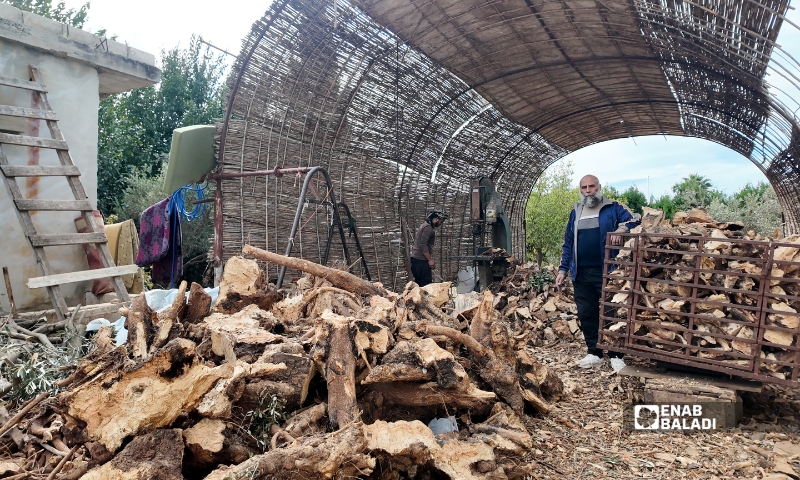
Firewood is prepared for winter at a sawmill in Muzayrib, western Daraa, November 5, 2026 (Enab Baladi/Mahjoub al-Hashish)
Gaps in Distribution Raise Corruption Concerns
Bakr said administrative confusion and a lack of clear instructions were keeping fuel from reaching eligible households under registration and distribution arrangements run by local groups and committees.
He identified several problems:
- No way to track allocations: Eligible households do not know how or when they will receive fuel. Officials have said only that registration is limited to “second-tier” diesel, priced at the current ceiling of 150 Syrian pounds per liter.
- No guarantees: Bakr said making diesel available for heating and agriculture at genuinely subsidized prices was currently close to “a fantasy.”
- Risk of diversion and adulteration: If subsidized diesel becomes available, Bakr questioned whether authorities could oversee distribution, stop allocations from being diverted and prevent suppliers from adulterating fuel with lower-quality petroleum products. Such practices could fuel corruption and disrupt the market, he said.
Obstacles to Cash Assistance and Alternative Heating
Bakr said switching from fuel allocations to direct cash assistance to protect purchasing power would face institutional and political obstacles.
Setting eligibility criteria and identifying beneficiaries would require time-consuming surveys, he said. The process could also trigger disputes and accusations of favoritism or of allocating aid based on loyalties or where people live.
Bakr said the program should have been studied and designed years ago to avoid the problems facing households now.
He also discussed longer-term options such as solar power and solar water heaters. He said they offered limited relief from the winter heating crisis for two reasons:
- Lower winter output. Cloud cover and weaker sunlight reduce the performance of solar systems in winter.
- High upfront costs. More than 90% of Syrians cannot afford the equipment. Routine maintenance is also too expensive for the most vulnerable households.
Budget Options and Imported Supplies
Bakr said official data and statements pointed to shortfalls in domestic resources and logistics capacity, making Syria reliant on imports and forward contracts to meet demand for heating fuel.
He proposed speeding up implementation of agreements to move Iraqi oil through Syrian territory and ports and requiring that a share of the oil in transit go toward bolstering Syria’s reserves and domestic supplies.
Asked about introducing a new subsidized tier or amending the budget, Bakr warned that a subsidy introduced without a funding plan would have predictable consequences. “Reintroducing subsidies without funding would widen the budget deficit, drive up inflation and weaken the national currency, further eroding people’s purchasing power,” he said.
Bakr told Enab Baladi that the projected budget deficit could not be estimated until the government disclosed the subsidy tiers and the volumes involved. Under current conditions, he said, funding any in-kind subsidy would add to inflation, leaving consumers to bear the cost.