

Rkkan al-Khder | Mohammed Jaffal | Yazan Kur
Israel’s upcoming elections, scheduled for October 27, are unfolding under circumstances unlike those of previous elections, amid the military and security changes the region has witnessed since Hamas launched its “Al-Aqsa Flood” operation in October 2023.
The operation marked a turning point in Israeli domestic politics, prompting the government led by Benjamin Netanyahu to launch a war on the Gaza Strip that continues to this day. The escalation did not remain confined to Gaza. The Israeli army expanded its operations into Syrian and Lebanese territory and launched a military campaign against Iran in alliance with the United States.
Netanyahu’s statements continue to signal escalation, accompanied by repeated pledges not to reverse previous military measures, including Israel’s presence inside Syrian territory.
Enab Baladi examines the Israeli elections by looking at the governing coalition and opposition parties, their main areas of agreement and disagreement, and the changes that could emerge in Israeli policy after the vote, whether the current government remains in power or opposition parties prevail.
The report also explores the options available to the Syrian government in dealing with Israel, whether the next Israeli government pursues further escalation or moves toward de-escalation, and the potential US role in mediating between the two sides after the election results and the formation of a new Israeli government.
The Governing Right-Wing Coalition: Continued Escalation or De-escalation?
Israel’s current government is a coalition led by Likud and headed by Prime Minister Benjamin Netanyahu. Its main partners include the Religious Zionism party, led by Bezalel Smotrich, and the Jewish Power (Otzma Yehudit) party, headed by Itamar Ben-Gvir.
These parties, all part of the Israeli right, share positions that include opposition to a two-state solution, continued settlement expansion in the West Bank, and reliance on military options across the region. Their main differences concern certain domestic policies, including the conscription of ultra-Orthodox Jews (Haredim) and granting Jews greater freedom to practice their religious beliefs in Jerusalem. Netanyahu, meanwhile, seeks to preserve greater flexibility on these issues to avoid provoking angry reactions regionally and internationally.
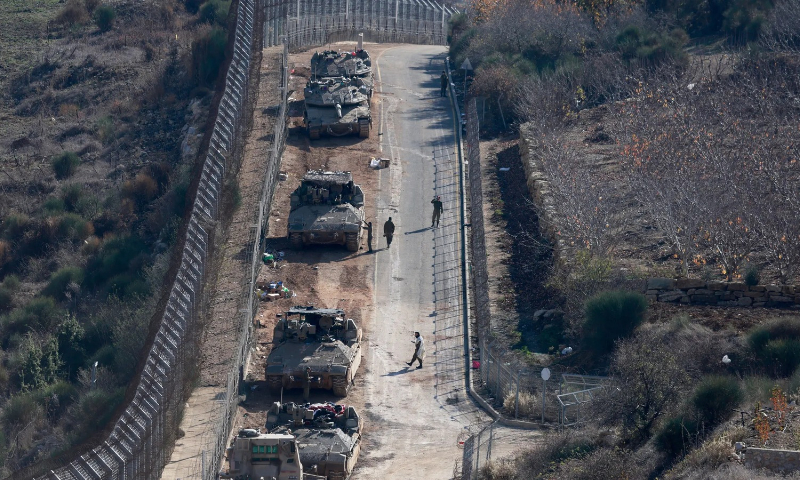
Israeli military vehicles at the border near Majdal Shams in the Golan Heights on the day Assad fell, December 8, 2024 (AFP).
Escalation Ahead of the Elections
Israel has intensified its activities in southern Syria in recent weeks. Israeli forces killed a young man near the al-Hamidiyah military base in Quneitra countryside (southwestern Syria) on October 4, before opening fire on two other young men on October 6, wounding one of them.
Israeli forces also killed a man with a disability during an incursion into Jamlah (western Daraa governorate, southern Syria) on October 22.
These operations have taken place alongside continued daily incursions, arrest campaigns, searches, and harassment of residents affecting their work and livelihoods. According to figures released by the Sijil Center on October 1, Israel committed 280 violations in September, the second-highest monthly total recorded in Syria since the beginning of 2026.
The recent intensification of Israeli military activity raises questions about its connection to the government’s election campaign, particularly as it has coincided with repeated statements reaffirming Israel’s determination to retain control of the occupied Syrian Golan Heights and its refusal to withdraw from areas entered after the fall of the Assad regime.
International relations researcher Dr. Mohammed al-Yemeni believes there may be a political connection between Israel’s escalation in Syria and Netanyahu’s electoral calculations. However, he cautions against attributing Israeli military activity solely to the elections, arguing that developments along the Syrian front are also linked to broader security and strategic calculations dating back to the fall of Bashar al-Assad’s regime in December 2024, as Israel seeks to reshape the security environment surrounding the Golan Heights and its northern border.
Al-Yemeni added that security issues become increasingly important in Israel as elections approach, particularly as Netanyahu seeks to present himself as the leader capable of protecting Israel and managing multiple regional threats.
He believes the elections may influence the timing, intensity, and political presentation of the escalation, but they are not its only cause. The deeper objective, he said, is to establish a new security arrangement along the Syrian border, while the election campaign provides a political environment in which the results of military operations can be used to electoral advantage.
Al-Yemeni summarized the objectives of Israeli intervention in Syria in five main areas, combining military considerations with political and negotiating calculations:
- Establishing a security buffer zone and imposing a long-term military reality on the ground.
- Preventing Syria from independently rebuilding its military capabilities without meeting Israeli conditions.
- Using military force to strengthen Israel’s negotiating position.
- Exploiting minority issues and local unrest to justify intervention.
- Sending messages to regional and international powers.
Israeli elections may influence the timing, intensity, and political presentation of the escalation, but they are not its only cause.
Dr. Mohammed al-Yemeni
International relations researcher
If Netanyahu Wins: What Scenarios Are Possible?
Ahead of the Israeli elections, questions are emerging about the approach Netanyahu might adopt if reelected and the factors that could influence changes in his security policy toward the region, including Syria.
Al-Yemeni stressed the importance of distinguishing between Netanyahu’s personal electoral victory and his ability to form a stable government. The election results alone do not determine foreign policy, which is also shaped by the composition of the governing coalition, the positions of participating parties, US pressure, and developments on the ground in Syria.
He identified three possible scenarios if Netanyahu remains in power, without suggesting that any is inevitable:
- Continued military pressure while keeping negotiations open.
- Greater escalation if negotiations stall or domestic pressure increases.
- A limited security understanding under US sponsorship.
Al-Yemeni linked any change in Israel’s approach more closely to the terms of a potential settlement than to the identity of the prime minister alone. Netanyahu could combine hardline rhetoric with practical negotiations if he believed an agreement would provide Israel with security guarantees without requiring withdrawal from positions it considers strategic. Conversely, continued escalation does not necessarily mean Israel rejects political understandings in principle, as the objective may be to negotiate from a position of strength. The problem, however, is that excessive use of force could make an agreement more difficult, since Damascus would be unwilling to legitimize arrangements imposed under sustained military pressure.
Al-Yemeni believes the most significant concession the Israeli government could offer would not necessarily be a comprehensive peace agreement or an immediate settlement concerning the Golan Heights. Rather, it could involve accepting a reciprocal security agreement that includes Israeli withdrawal from some positions seized after the fall of the Assad regime, limiting incursions and strikes inside Syrian territory, and establishing clear arrangements for border monitoring and preventing military threats.
Reaching that stage, however, would require addressing disagreements over withdrawal, the buffer zone, and the Syrian military presence in the south. Al-Yemeni considers it unlikely that the Israeli government would easily make a major concession concerning the final status of the Golan Heights.
He therefore emphasized the need to distinguish between the possibility of limited territorial or security concessions and reaching a comprehensive regional settlement.
The US Role: Between Support and Mediation
US President Donald Trump announced his support for Benjamin Netanyahu in the Israeli election race on October 18, describing him as “a Great Warrior Prime Minister” and an even greater partner in confronting Iran.
Trump also addressed Israeli voters, suggesting that choosing any candidate other than Netanyahu would mean selecting the “wrong leader.”
Dr. Zaki Lababidi, head of the Syrian office at the Syrian American Council, considers Trump’s public endorsement of Netanyahu an unusual and extraordinary position in American political circles. He claimed that no US president had previously intervened in Israeli elections, or elections in any other country, to the extent of openly endorsing one candidate over another.
Lababidi added that many American political figures and analysts believe Netanyahu requested the endorsement and exerted pressure on Trump to make his support public.
Regarding the potential impact on the election results, Lababidi said opinion polls continued to indicate that Netanyahu would lose, and he considered a significant change in the coming days unlikely. He suggested Trump’s endorsement could even backfire if the Israeli opposition used it to portray Netanyahu as a puppet controlled by Trump, an argument some opposition candidates have already made in statements to the media.
Lababidi said his greatest concern was that Trump’s public endorsement came shortly before a meeting between US Defense Secretary Pete Hegseth and Netanyahu. In his assessment, this raised the possibility of a strike against Iran before the elections, although he did not consider such an attack certain. He suggested it could be intended to cancel or at least postpone the elections in pursuit of a foreign military victory that might improve Netanyahu’s chances of winning another term.
According to Lababidi, this scenario is reinforced by what he described as Netanyahu’s determination not to leave office before achieving his vision of “Greater Israel,” which Lababidi said Netanyahu had openly expressed at the United Nations. He argued that this vision was being pursued through the destruction of Gaza, attacks in the West Bank, the seizure of Syrian territory, and the occupation of areas in southern Lebanon.
Lababidi also argued that Syria forms part of Netanyahu’s vision of Greater Israel, which he described as an attempt to pressure residents into abandoning their homes and communities. He said Netanyahu seeks to advance this vision while presenting himself as a strong leader, thereby improving his electoral prospects.
Lababidi expects Netanyahu to continue what he described as an aggressive policy toward Syria, particularly the government of Ahmed al-Sharaa, by portraying it as “Islamist” and a threat to Israel. He argued that such accusations could be used to justify Israel’s continued presence in Syria and obstruct Damascus’s efforts to strengthen its capabilities and maintain stability.
As for the United States’ role in mediating between Syria and Israel to reach an understanding or agreement, Lababidi considered meaningful US involvement unlikely at present, given continued discussion of military escalation and the possibility of renewed warfare against Iran.
US-mediated Syrian-Israeli negotiations are unlikely amid continued discussion of military escalation involving Iran.
Dr. Zaki Lababidi
Head of the Syrian office at the Syrian American Council
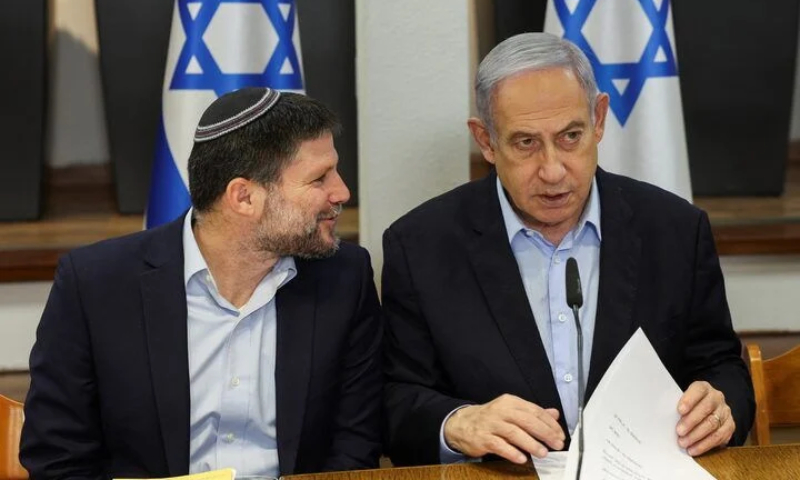
Israeli Prime Minister Benjamin Netanyahu alongside his ally, Finance Minister Bezalel Smotrich, during the Israeli government’s weekly cabinet meeting, November 25, 2025 (Reuters).
Israeli Opposition and Syria: Could the Current Approach Change?
On the other side of Netanyahu’s governing alliance stands a group of opposition parties seeking to offer an alternative to his government. Their criticism focuses on the management of the war, the security failures preceding the October 7, 2023 attack, the performance of government institutions, and foreign relations.
However, this political competition does not necessarily reflect fundamental disagreements over Israel’s security and military objectives, particularly in Syria.
The positions of leading opposition figures suggest that their differences partly concern how military power should be managed and how gains on the ground can be translated into political results, rather than whether Israel should retain positions inside Syrian territory.
Agreement on Challenging Netanyahu, Disagreement Over the Alternative
Israel’s opposition is neither a single party nor a homogeneous political movement. It includes centrist, right-wing, and left-wing forces that disagree on domestic and foreign policy issues but share the goal of preventing Netanyahu from securing another term.
On September 26, five prominent opposition leaders signed a declaration of principles pledging to cooperate during the election campaign, refrain from attacking one another, and work toward forming what they described as a “Zionist and responsible” government focused on reform and reconstruction.
The meeting brought together Gadi Eisenkot, leader of the Yashar party; Naftali Bennett and Yair Lapid, who are running on a joint list called Beyachad (Together); Yair Golan, leader of the Democrats party; and Avigdor Liberman, head of the Yisrael Beiteinu party.
This understanding does not mean the five leaders have merged their parties into a single electoral list or agreed on a unified foreign and security policy platform. Rather, it represents an effort to reduce public disagreements and improve their chances of forming an alternative government.
Gadi Eisenkot: A Candidate With a Military Background
Gadi Eisenkot, a former Israeli military chief of staff and leader of the Yashar party, has emerged as one of Netanyahu’s leading challengers. His platform emphasizes reforming state institutions, improving military effectiveness, investigating the “failures of October 7, 2023,” and ending military service exemptions for ultra-Orthodox Jews.
Eisenkot also differs with Netanyahu over the administration of the West Bank. He has pledged to return responsibility for the issue to the military rather than allow Finance Minister Bezalel Smotrich to continue overseeing aspects of its civil administration.
In Syria, Eisenkot is in no hurry to withdraw from the buffer zone.
According to a report published by The Jerusalem Post on September 3, Eisenkot, unlike Netanyahu, does not view the permanent retention of territory inside another country as an objective in itself. Instead, he sees it as leverage for securing more favorable strategic and diplomatic arrangements for Israel, despite his skepticism toward Syrian President Ahmed al-Sharaa’s political direction.
Bennett and Lapid: A Joint List Bringing Together the Right and Center
Former Israeli prime ministers Naftali Bennett and Yair Lapid announced in April that they would contest the elections on a joint list called Beyachad, led by Bennett.
The alliance brings together Bennett’s right-wing positions, including support for settlements and a hardline security approach, with Lapid’s centrist political platform.
The two previously served together in the same government between 2021 and 2022.
Their alliance reflects an effort to offer a different approach to governing without a fundamental ideological break from the right.
Regarding Syria, Bennett remains skeptical of President Ahmed al-Sharaa but has expressed a willingness to consider American assessments suggesting that al-Sharaa’s position may have changed.
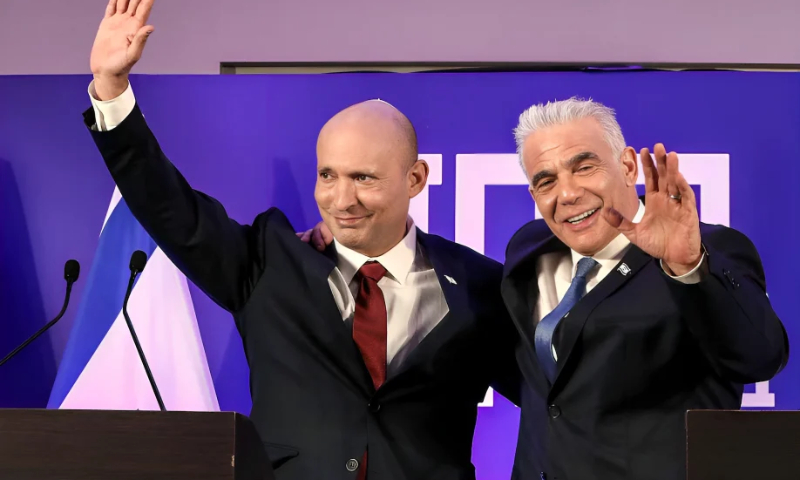
Former Israeli prime ministers Naftali Bennett and Yair Lapid are running in the election on a joint list called Beyachad (Together), April 26, 2026 (Reuters).
Yair Golan: The Left-Wing Component of a Diverse Opposition
Yair Golan, leader of the Democratic Party, represents the left-wing current within the opposition and supports including Arab parties in a governing coalition, unlike the publicly stated positions of other opposition leaders.
However, his participation in the joint understanding does not mean the opposition has reached a unified vision on regional issues or relations with Syria.
Avigdor Liberman: Opposition From the Nationalist Right
Avigdor Liberman, leader of Yisrael Beiteinu, is part of the political camp seeking to end Netanyahu’s rule, despite holding right-wing positions on security, foreign policy, and economic issues.
His disagreements with Netanyahu concern government management and domestic issues, particularly military service and relations with ultra-Orthodox religious parties.
Israeli Opposition Unites to Remove Netanyahu
Ali Fawzi, a researcher specializing in Arab and African affairs, believes the current Israeli opposition represents a broad political bloc primarily seeking to end Benjamin Netanyahu’s rule rather than a unified ideological project capable of presenting a comprehensive vision for Israel’s future and the region.
Speaking to Enab Baladi, Fawzi said the preliminary agreements between several opposition leaders, including Gadi Eisenkot, Naftali Bennett, Yair Lapid, Yair Golan, and Avigdor Liberman, reflect an awareness of the importance of avoiding internal conflicts and broadening their electoral base. However, he said these agreements do not necessarily mean the leaders have overcome disagreements over the distribution of power or the formation of a sustainable governing coalition.
Fawzi added that the opposition’s main challenge extends beyond weakening Netanyahu’s electoral prospects to securing a stable parliamentary majority, particularly given disagreements over reliance on Arab parties and the hardline positions of some leaders concerning acceptable political partnerships within a government.
The opposition encompasses different political currents, bringing together the security-focused right, the center, and the Zionist left. Removing Netanyahu is their main point of agreement, while disagreements persist over the relationship between religion and the state, engagement with Arab parties, the future of a settlement with the Palestinians, and relations with the United States and European countries.
Ali Fawzi
Researcher in Arab and African affairs
Eisenkot and Netanyahu: Different Approaches to Military Power in Syria
Regarding Syria, Fawzi stressed that the disagreement between Netanyahu and some of his rivals, particularly Eisenkot, is not about abandoning Israel’s security considerations or immediately withdrawing from areas entered by the Israeli military in southern Syria. Instead, it centers on how to use the military presence to achieve tangible political and security outcomes.
He explained that Netanyahu tends to maintain military pressure and retain strategic positions without establishing a clear political path toward withdrawal. Eisenkot, by contrast, favors avoiding a hasty withdrawal while opposing an open-ended military presence that drains resources and increases Israel’s political and diplomatic burdens.
Fawzi added that Eisenkot’s approach essentially involves using territorial control as negotiating leverage to secure more favorable security arrangements for Israel, rather than simply holding on to military gains without translating them into agreements or long-term guarantees.
Elections Could Encourage Hardline Positions Before Negotiations
Fawzi warned that electoral competition could push opposition leaders to adopt hardline security positions to avoid accusations of being too lenient toward threats cited by Israel.
Consequently, competition for the premiership may not necessarily lead to softer positions toward Syria. Instead, it could prompt some candidates to emphasize their commitment to Israeli security considerations before the elections, even if they later show greater willingness to use negotiations in managing relations with Damascus.
No Fundamental Differences on Security Issues
Political writer and researcher Darwish Khalifa told Enab Baladi that the current Israeli opposition does not fundamentally differ from Benjamin Netanyahu in its security policies beyond Israel’s borders. He explained that most opposition forces belong to the Israeli right, although some figures are closer to the center-right, with Yair Golan being the exception.
Khalifa described the agreement between the five opposition leaders as an electoral understanding aimed at removing Netanyahu from office and preventing his bloc from securing a parliamentary majority, rather than a consensus on changing the substance of Israeli security policy.
He stressed that this convergence of positions also extends to issues involving Syria, Iran, and Lebanon, making it necessary to exercise caution when expecting a fundamental change in Israeli foreign policy simply because the opposition reaches power.
Khalifa added that Israeli political forces regard the situation in Syria as fragile and unstable and believe steps are necessary to protect Israel’s northern border and prevent threats from emerging nearby.
He noted that Israeli statements describing the government in Damascus as having a Salafi-jihadist background and comparing it to armed movements and factions in the region recur in Israeli media. In his assessment, this reflects a continuing security-based suspicion toward Syria’s new authorities.
Relations With Russia and Turkey and the Disengagement Agreement
Khalifa called for monitoring the next Israeli government’s relations with Russia and Turkey in Syria, as well as its position on Syrian weapons in the south, as indicators that could reveal its actual policy direction after the elections.
He also raised the question of whether Eisenkot, if he became prime minister, would seek a return to the arrangements established under the 1974 Disengagement Agreement and what conditions Israel might impose on the Syrian government in any potential negotiations.
Khalifa believes these issues will be central to assessing whether the new government is prepared to change how it manages Israel’s military presence or open a negotiating process with Damascus.
He concluded that any assessment of the next government’s direction must be based on its actual decisions after the elections, rather than relying solely on opposition leaders’ positions and campaign statements.
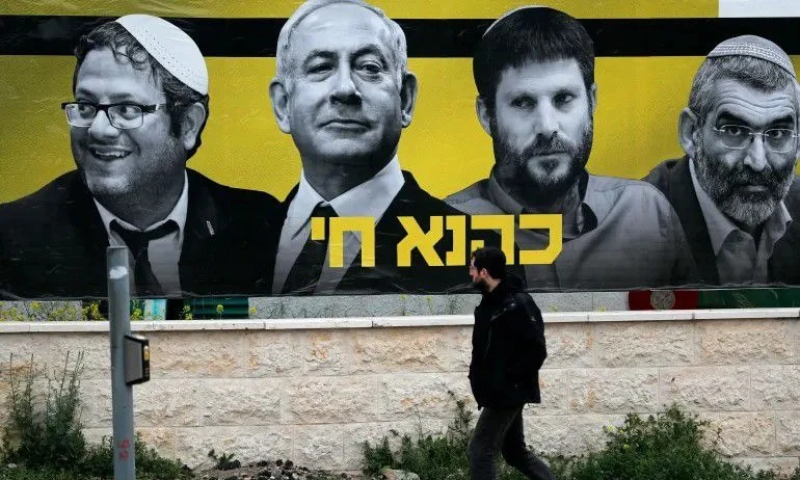
A mural depicting Israeli Prime Minister Benjamin Netanyahu and his government allies, November 17, 2024 (AFP).
The Syrian Government Confronts Israeli Escalation
Reliance on Diplomacy and the Limits of Its Influence
Since the fall of the former regime in December 2024, the Syrian government has responded to Israel’s expanding military activities in the south through two parallel approaches: rejecting the military presence and incursions, while seeking to contain escalation through political contacts and calls to reactivate the 1974 Disengagement Agreement.
As Israeli operations continued, this position moved beyond official statements toward attempts to negotiate security arrangements under US mediation, aimed at ending attacks and securing Israeli withdrawal from the territories its forces had entered.
Over the following months, Damascus maintained its commitment to the existing agreement and called for withdrawal to the lines held before December 8, 2024. Israel, meanwhile, continued conducting operations inside Syrian territory and justifying its presence on security grounds.
In August, Syrian Foreign Minister Asaad al-Shaibani said Damascus expected negotiations on a security agreement to resume and that ending attacks was a priority. However, he pointed to what he described as insufficient Israeli willingness to finalize an agreement. His remarks followed the breakdown of talks addressing the cessation of military operations and Israeli withdrawal.
In September, Syrian President Ahmed al-Sharaa raised the issue again before the United Nations General Assembly, demanding that Israeli forces withdraw to the lines of December 8, 2024, and reaffirming that the Golan Heights are part of Syrian territory.
During October, the UN Security Council renewed its call for full respect and implementation of the 1974 agreement. However, continued Israeli incursions and operations in Quneitra and Daraa countryside demonstrated that political efforts had not yet ended the military activities on the ground opposed by Damascus.
Against this backdrop, questions remain about the effectiveness of the Syrian government’s reliance on diplomacy and whether the upcoming Israeli elections could change how Tel Aviv deals with Damascus, or whether Israeli security calculations will remain decisive regardless of who becomes prime minister.
Syrian Diplomacy: Between the Balance of Power and Results on the Ground
Dr. Samir al-Abdullah, a senior researcher at the Arab Center for Contemporary Syrian Studies, believes the Syrian government’s reliance on a political approach reflects its understanding of the balance of power and the constraints facing the country as it rebuilds its institutions and military and security capabilities.
Al-Abdullah considers avoiding confrontation a choice imposed by current circumstances, one that also aligns with a broader trend toward reducing regional tensions.
However, he distinguishes between choosing diplomacy as a means of responding to escalation and its ability to deliver tangible results. Continued Israeli incursions and strikes, he argues, put this approach to the test, particularly regarding its ability to stop violations and compel Israel to withdraw from newly established positions.
Al-Abdullah noted that Damascus’s expanding relations with the United States, Arab countries, and Turkey could provide tools to influence Israel’s position. However, this would require moving beyond declared political support toward clear commitments. He identified Washington as the actor most capable of influencing Israeli calculations and maintaining pressure that could lead to an end to military operations and withdrawal.
Damascus’s success depends on a willingness to maintain sustained pressure that ends violations and leads to withdrawal from newly established positions.
Dr. Samir al-Abdullah
Senior researcher at the Arab Center for Contemporary Syrian Studies
For his part, political thought researcher Amer Darwish believes the Syrian government is using official statements, diplomatic contacts, and demands for respect for its sovereignty amid a clear imbalance in military power, while it needs to rebuild its institutions and address domestic priorities.
Darwish said entering into a conventional military confrontation with Israel could pose serious risks to domestic stability. At the same time, he warned that the continuation of the current military situation without change could weaken the effectiveness of Syria’s position.
He explained that political objections and reliance on international law alone are insufficient to change Israeli behavior unless accompanied by pressure that raises the cost of continued violations. Israeli decision-making, he added, is influenced by security calculations, international relations, and domestic and electoral considerations, rather than Syria’s positions alone.
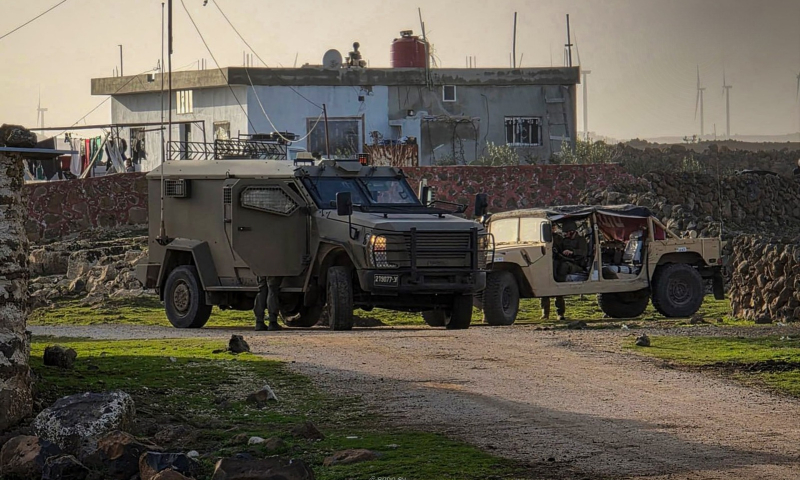
Israeli military vehicles during a ground incursion into Quneitra countryside, southern Syria, February 1, 2026 (SANA).
The 1974 Agreement: A Basis for Negotiations or Crisis Management?
Darwish believes the 1974 Disengagement Agreement provides a legal and political framework on which Damascus can build by demanding its implementation and reactivating the associated channels, while documenting violations and presenting them to the United Nations.
He stressed the need to move beyond general diplomatic contacts toward negotiations addressing clear demands, including ending incursions and strikes, withdrawing from areas entered by Israeli forces, activating monitoring mechanisms, and establishing guarantees to prevent violations from recurring.
Darwish warned that any understanding lacking verification mechanisms and a timetable could become a means of managing the crisis rather than addressing its underlying causes.
Without a timetable and monitoring mechanisms, an agreement could become a tool for managing the crisis rather than resolving it.
Amer Darwish
Political thought researcher
Al-Abdullah agrees with Darwish that any security understanding should not become a cover for consolidating Israel’s military presence. He proposed basing such an agreement on implementing the 1974 accord within its existing framework, through phased and reciprocal arrangements that include a withdrawal timetable, UN verification mechanisms, and clear commitments to halt military operations, without imposing open-ended restrictions on Syrian sovereignty.
Al-Abdullah warned that continuing negotiations while new military realities become entrenched could undermine the fundamental purpose of the political process. Its success, therefore, should not be measured simply by the continuation of talks, but by its ability to stop violations and bring about an actual change in Israeli military deployments.
Could the Approach Change?
Al-Abdullah does not believe the future of negotiations depends solely on whether Benjamin Netanyahu remains Israel’s prime minister or is replaced. Netanyahu’s continued leadership could mean maintaining a hardline security approach, while a change of leadership might create greater opportunities for understandings on ending attacks, withdrawal, and border arrangements. However, a change in prime minister would not necessarily mean a change in Israel’s security doctrine or its position on the Golan Heights.
According to al-Abdullah, any political change in Israel should be assessed by its willingness to stop violations and withdraw, rather than by changes in rhetoric alone. A successor to Netanyahu might open a window for negotiations, but would not guarantee de-escalation. Similarly, Netanyahu’s continued leadership would not necessarily close the door to an understanding if effective mediation could transform Syrian demands into enforceable commitments.
Darwish, for his part, noted that Netanyahu’s continued leadership could preserve an Israeli policy based on imposing conditions on the ground and using the military presence as leverage in negotiations. This could involve keeping troops in positions they have entered and continuing incursions and operations, while maintaining open negotiating channels.
Darwish did not rule out broader escalation or more stringent conditions if the Israeli government believed circumstances allowed it. However, he does not consider escalation an inevitable consequence of Netanyahu remaining in power, as American and regional calculations and developments on the ground would also remain influential.
A successor to Netanyahu, meanwhile, might change how the issue is managed or the degree of openness to mediation, but this would not guarantee a change in Israel’s security objectives.
Darwish believes any new Israeli leadership should be evaluated based on its actual positions toward Syria, its coalition partners, and its willingness to withdraw from territories entered by Israeli forces, rather than simply on its opposition to Netanyahu.
Damascus’s Options Between De-escalation and Confrontation
Al-Abdullah outlined three potential paths for Syria: reaching a balanced, interim security understanding; continuing to manage the crisis without settling; or sliding into a larger military escalation.
He considers the continuation of the unresolved crisis a likely scenario in the near term, given the gap between Syrian demands and Israeli actions.
In response to these possibilities, al-Abdullah called for keeping communication channels open, intensifying diplomatic pressure, and documenting violations, alongside strengthening the state’s ability to maintain security in the south and protect residents. He stressed the importance of avoiding a large-scale military confrontation that would be incompatible with current circumstances, while ensuring that negotiations do not provide cover for Israel’s continued military presence.
Darwish, meanwhile, called for a strategy combining diplomacy, legal documentation, and coordination of regional and international positions, with measurable objectives. If diplomatic contacts help stop military operations, reduce deployments, or establish an effective monitoring mechanism, that could be considered progress. However, if violations continue unchanged, the available tools should be reassessed, and international and legal efforts expanded, rather than simply repeating official positions.
Darwish stressed that the failure of diplomacy does not automatically make military escalation the alternative. Instead, it requires identifying more effective ways to increase the cost of continued violations while keeping negotiations open for serious understandings.
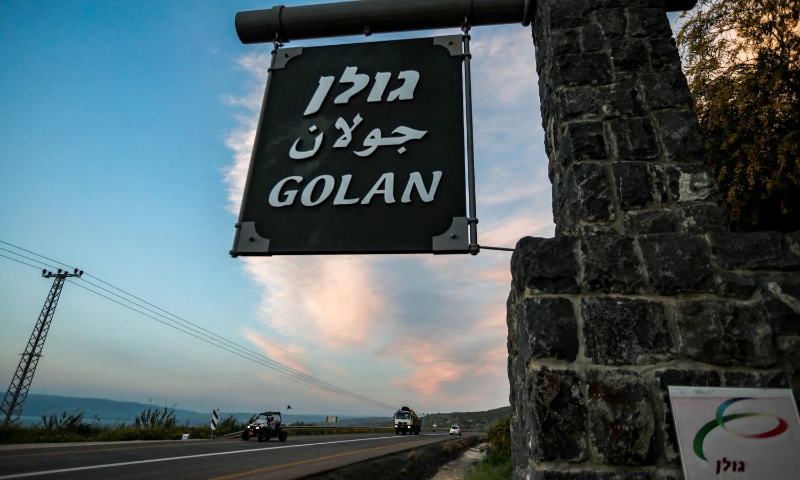
A road sign displaying the word “Golan” in Arabic, English, and Hebrew near the Sea of Galilee, March 24, 2019 (AFP).