


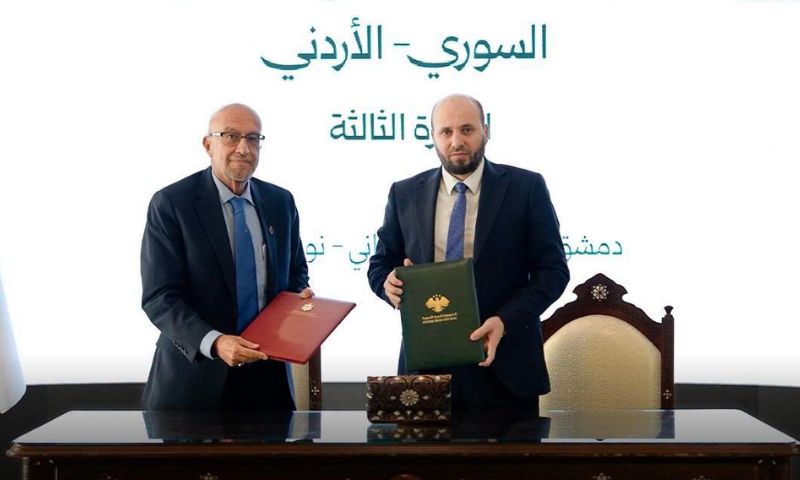
 Signing of the memorandum of understanding on a cloud seeding project between Syria and Jordan, November 9, 2026 (Ministry of Energy/Facebook)
Syria and Jordan are moving to expand cooperation in managing shared water resources through a cloud seeding project in the Yarmouk River basin, aimed at increasing rainfall and developing water resources.
As part of this effort, Syrian Minister of Energy Mohammed al-Bashir and Jordanian Minister of Water and Irrigation Raed Abu al-Soud signed a memorandum of understanding on Monday, November 9, to cooperate on a cloud seeding project in the Yarmouk River basin. The signing took place during the third session of the Syrian-Jordanian Higher Coordination Council, held in Damascus.
According to information published by the Syrian Ministry of Energy on its official platforms, the memorandum aims to establish a framework for technical and institutional cooperation between the two countries to develop a joint cloud seeding project, assess its feasibility, implement it, and evaluate its results.
The Ministry of Energy said the memorandum would contribute to developing water resources, strengthening water security and advancing shared interests.
Areas of cooperation include studying climatic characteristics, cloud types and weather conditions suitable for cloud seeding, as well as exchanging data and expertise and developing a joint system for monitoring rainfall and water-related indicators.
The memorandum also provides for conducting pilot operations, training technical personnel and assessing the project’s environmental and economic feasibility. It calls for establishing a joint technical committee responsible for preparing an implementation program, overseeing its execution and coordinating data exchanges.
The project will proceed in stages, beginning with suitability and feasibility studies and the establishment of baseline measurements. These will be followed by a pilot phase during suitable seasons and weather conditions, before the results are evaluated and a joint decision is made on whether to continue, modify or expand the project, according to the memorandum.
The memorandum was signed as part of a package of 11 cooperation documents between the two countries. These included a memorandum on railway connectivity, a protocol on food security and supplies, memorandums on investment and civil aviation, and an executive program for scholarships and academic exchanges.
The Syrian-Jordanian Higher Coordination Council serves as an institutional framework for cooperation between the two countries. It was established in May 2025 to coordinate policies and strengthen integration across various sectors.
The council’s first session resulted in an agreement on a roadmap aimed at achieving short-term and long-term objectives serving the shared interests of both countries.
In the water sector, the roadmap included reviewing the 1987 agreement on the utilization of Yarmouk River waters and amending certain provisions to account for both countries’ water rights, alongside reactivating joint committees.
The Yarmouk River basin is a strategic water source for Jordan, which is entitled to an annual allocation of between 180 million and 200 million cubic meters under the 1987 agreement.
In this context, Syrian Deputy Minister of Energy for Water Resources Affairs Osama Abu Zaid said in press statements that Syria had released quantities of water to Jordan during the first quarter of 2026.
Abu Zaid added that the release of additional quantities was currently being studied in accordance with specified water allocations.
He pointed to technical challenges related to the length of water conveyance channels and high rates of water loss, making it necessary to select shorter routes that minimize water wastage.
Regarding the 1987 agreement and calls for its revision, Abu Zaid explained that the agreement remains in effect but needs to address emerging issues, particularly years of drought.
He added that agreements reached by the Syrian-Jordanian technical committee had led to the adoption of an annual assessment of water reserves, with each country’s share determined accordingly. He described this approach as the most effective solution for managing available resources.
In April 2026, Syrian Foreign Minister Asaad al-Shibani conveyed a message from President Ahmed al-Sharaa to Jordan’s King Abdullah II stating, “We will share Syria’s water with Jordan.”
During the same month, the two sides announced understandings on managing water resources in the Yarmouk basin and launching a joint digital platform for exchanging water data.
According to a report published in April by the London-based newspaper Al-Arab, Syrian-Jordanian relations had long been an example of “hostile water policies.” The report said the 1953 Yarmouk water-sharing agreement and the 1987 bilateral agreement had largely remained on paper because of the absence of effective monitoring mechanisms and sustained political will.
The report highlighted repeated accusations by Amman that Damascus had built small reservoirs along the upper tributaries of the Yarmouk River and diverted water before it reached Jordanian territory.
Conversely, Syria accused Jordan of excessive well drilling in shared groundwater recharge basins, according to media reports.
The cloud seeding memorandum reflects this shift toward expanding technical cooperation between the two countries. Under its provisions, cloud seeding is presented as a means of developing water resources rather than replacing existing water-sharing agreements.
The signing comes as water reserves at Jordan’s al-Wehda Dam, which depends on the Yarmouk River, remain at low levels. Storage fell to approximately one million cubic meters in 2026, compared with 19 million cubic meters in 2021, according to figures reported by CNN Arabic.
if you think the article contain wrong information or you have additional details Send Correction


 A
A
A







 More Society