

Enab Baladi, Wasim al-Adawi
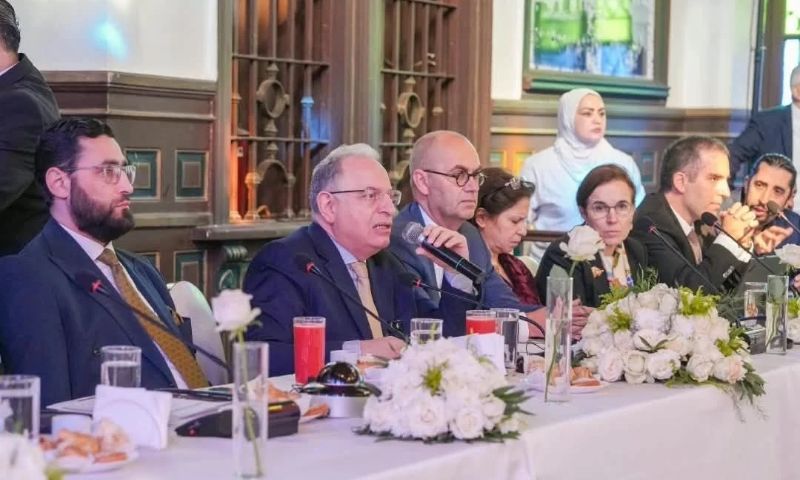
Syria’s Ministry of Finance has raised its forecast for economic growth by the end of 2026 to 12.8%. Finance Minister Mohammed Yisr Barnieh announced the revised forecast at the Syria Partnership Coordination Forum in Damascus on November 17.
The ministry’s forecast exceeds the World Bank’s projection of 8% to 10%, published in its October economic and poverty outlook, as well as the International Monetary Fund’s (IMF) estimate.
The gap reflects the Syrian government’s greater optimism about the economy. It also raises questions about what underpins the government’s forecast and whether growth will translate into tangible improvements in Syrians’ lives.
The forecast comes as Syria renews its engagement with the IMF. On November 20, the Finance Ministry announced that an IMF expert mission had concluded its visit to Damascus and that the two sides had agreed to hold Article IV consultations in March 2027.
The agreement marks a step toward restoring economic and institutional ties between Syria and the IMF after years of interruption. It paves the way for regular reviews of fiscal and monetary policy and economic performance, alongside grants and technical advice on economic reforms.
The World Bank estimates that rebuilding Syria will cost about $216 billion. Poverty remains widespread, and the country faces shortages of financing, investment, and jobs.
As economic activity picks up, the question is whether Syria is entering a period of sustained growth or seeing a rebound in economic indicators since the fall of the regime, with gains that have yet to reach most Syrians.
Economist and banking expert Mahmoud Abdul Karim said answering that question starts with distinguishing growth in gross domestic product (GDP) from improvements in living standards. It also requires examining what drives growth, who benefits, and whether it can be sustained.
12.8% Growth Forecast Raises Questions About the Recovery
The gap between the government’s growth forecast and international estimates raises questions about Syria’s economic outlook. The government’s projection remains plausible, though it is more optimistic than the international estimates. The IMF itself has pointed to limited economic data as an obstacle to assessing Syria’s economic performance in detail.
Abdul Karim told Enab Baladi that rising economic output can coexist with widespread poverty. The growth rate measures changes in real output after adjusting for prices, while the poverty rate measures the share of people who cannot meet their basic needs.
He said Syria’s economy had shrunk by more than half since 2010 and grew by no more than 3.6% in 2025. The projected rise in 2026 is therefore partly attributable to what economists call a low base effect.
When an economy starts from a low level of output, even a partial recovery in activity can produce a high growth rate while leaving much of the earlier loss unrecovered.
“The growth is real. It reflects a recovery in economic activity. Gains in living standards are another matter,” Abdul Karim said. “The economy is regaining activity it lost, and Syrian households will feel the difference only when their incomes rise faster than the prices of what they buy.”
Some World Bank figures support that assessment. The bank estimates that Syria’s GDP reached about $30.6 billion in 2025, with GDP per capita of $1,179.
Abdul Karim said GDP per capita is calculated by dividing total output by the population. It includes economic activity and revenues that do not reach households directly, making it distinct from average income or wages.
The World Bank’s updated estimates project that 45.8% of Syrians will remain below the $4.20-a-day poverty line in 2026, while 20.6% will remain below the international poverty line.
Abdul Karim said those figures show why faster GDP growth does not automatically yield comparable gains in purchasing power.
Growth in Oil and Agriculture
The International Monetary Fund (IMF) attributed the improvement in Syria’s economic activity to several factors in a press release. It highlighted the following.
– Oil and gas production increased after the government regained control of key producing areas.
– Agricultural output improved following better rainfall in 2026.
– Electricity supplies increased, and trade and transport services improved.
– Refugees returned, and consumer and investor confidence improved.
– Visitor numbers rose, and activity picked up in commerce and services.
Available data show improvements in several sectors. Cement production reached 4.1 million metric tons in the first half of 2026, while crude oil production reached 14.8 million barrels over the same period. Syria also achieved self-sufficiency in wheat after years of relying on imports.
The continued return of refugees is increasing demand for goods and services. It is also adding millions of people to the labor market and increasing the number of people who need housing and services.
The World Bank expects job creation to lag behind workforce growth as Syria absorbs 1.75 million refugees and about 1.97 million internally displaced people who returned to their home areas between December 2024 and the end of July 2026. The IMF says the recovery has been uneven across regions and poverty remains widespread despite improvements in some indicators.
The gap between wages and living costs shows the scale of the problem. Expressed in new Syrian pounds, the minimum wage rose from 7,500 SYP (about $50) in July 2025 to about 12,560 SYP (about $83) in May 2026. Both dollar equivalents use the November 22, 2026, parallel-market exchange rate in Damascus of 150.75 SYP per dollar. Over a year, the cost of the minimum expenditure basket rose by more than 30%. The minimum wage covered only about 47% of the full basket and about 75% of its food component.
Unemployment estimates vary widely. The International Labour Organization (ILO) puts the rate at 13.6% based on its statistical models.
The challenges extend beyond the labor market. In its August 2026 assessment, the IMF warned that inflation in Syria would rise again in 2026 after slowing to the low double digits in 2025.
The IMF attributed the expected increase to higher prices for fuel and imported food, stronger domestic demand, and rising costs for services and housing.
Mahmoud Abdul Karim said current growth still largely reflects the restoration of existing production capacity. Syria has made less progress toward building a new production base.
Oil output, for example, is still about 79% below prewar levels. The improvement in agriculture also depends partly on weather conditions, and there is no guarantee that future growing seasons will see the same gains.
Abdul Karim cited a United Nations Development Programme (UNDP) estimate that Syria would need 55 years to regain its prewar output if its economy continued to grow by 1.3% a year. A lasting recovery, he said, would require high growth rates sustained over several years. A single year of rapid growth from a low base would fall short.
IMF Reengages With Syria as Financing Remains Uncertain
The agreement to hold Article IV consultations in March 2027 marks a significant step in Syria’s relationship with the IMF. Any financing or loan from the fund would require a separate decision.
Article IV consultations are regular reviews of an IMF member country’s economic and financial conditions. They cover monetary and fiscal policy, the exchange rate, the banking sector, and growth prospects. They conclude with an assessment and recommendations to help identify and address economic imbalances.
In a press release, the IMF mission that visited Damascus from July 19 to 23, 2026, reported improvements in economic activity and public finances. It also identified obstacles to more stable growth.
The main obstacles include the following.
1. A weak banking sector with limited capacity for financial intermediation and investment financing.
2. A shortage of monetary policy tools and constraints on the central bank’s ability to stabilize prices.
3. A need to reform the tax system and improve the management of public spending.
4. Persistent gaps in economic data and statistics that limit the accuracy of planning and assessments.
5. A need to address public debt and rebuild trust with international financial institutions.
Abdul Karim said Syria’s growth needs to shift from restarting idle sectors toward new investment, higher productivity, and more stable jobs for the recovery to be sustained.
He identified five priorities for that shift.
– Energy: Make electricity supplies more reliable to lower production costs for factories, workshops, and small businesses.
– Financing: Direct bank financing and investment toward labor-intensive sectors such as agriculture, food processing, textiles, and construction.
– Monetary policy: Contain inflation so wage increases retain their purchasing power.
– Social protection: Develop targeted support programs for the most vulnerable groups, particularly as humanitarian aid declines.
– Public revenue: Improve the efficiency of tax collection and broaden the revenue base while avoiding additional burdens on people with limited incomes.
The fiscal targets presented by Syria’s finance minister include raising public revenue from about 17% of gross domestic product (GDP) to more than 25% by 2030. Meeting that target would require extensive tax and administrative reforms.
Completing the labor force survey launched by Syria’s Planning and Statistics Authority in cooperation with the ILO is also essential to measuring unemployment, income, and employment and using reliable data to guide economic policy.
Abdul Karim sees 2027 and 2028 as a test of Syria’s economic trajectory. Once the low base effect fades, he said, continued growth, investment projects that materialize, new jobs, and wages with greater purchasing power will show whether the economy has entered a sustained recovery.
“2027 and 2028 will determine whether Syria is building a new economy or simply recovering part of its old one,” he said.
Achieving a high growth rate is only part of Syria’s economic challenge. The country also faces questions about the kind of growth it can achieve, how it will finance it, and who will benefit.
With projected growth approaching 13% and reconstruction estimated to cost $216 billion, the clearest test of Syria’s recovery will be whether the economy can provide more jobs, higher incomes, and better services.
Has Syria’s Economy Fallen Into a Neoliberal Trap?
In an earlier interview with Enab Baladi, Syrian researcher and economist Joseph Daher examined the government’s approach, describing it as a sharp change in direction built around the following policies.
– Unrestricted free-market principles.
– Trade liberalization.
– Cuts in government spending.
– Near-total reliance on attracting foreign direct investment by any means and at any cost.
Daher said the approach has fundamental flaws because it ultimately diverts scarce capital away from vital productive sectors such as industry and agriculture.
He said the approach has deepened Syria’s economic dependence on foreign actors and external forces, making it harder to build a durable economy rooted in Syrian society’s own capacities. He described the result as a neoliberal economic trap.