


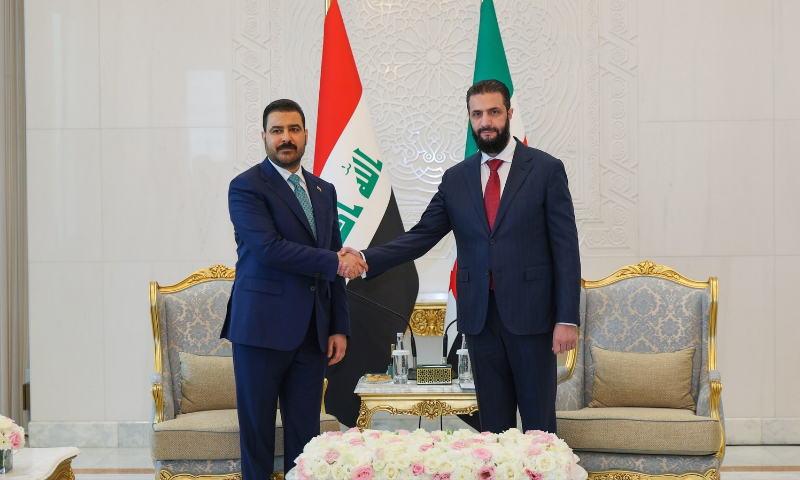
 Syrian President Ahmed al-Sharaa receives Iraqi Prime Minister Ali al-Zaidi at the People’s Palace in Damascus, October 28, 2026 (Syrian Presidency)
Enab Baladi, Amir Hakouk
Relations between Damascus and Baghdad are no longer defined by the political differences that marked earlier periods. Shared security and economic interests are pushing the two countries to expand coordination, as regional shifts pose challenges to border security and energy and trade routes.
Iraqi Prime Minister Ali al-Zaidi’s visit to Damascus on October 28 and his meeting with Syrian President Ahmed al-Sharaa opened the way for discussions about the future of the relationship, following a period of Iraqi caution toward Syria’s new leadership.
The visit coincided with al- Sharaa’s remarks about the need to build relations based on shared interests and his support for Baghdad’s efforts to bring all weapons under state control. He also addressed oil, water, agriculture and trade in an interview with Iraq’s Dijlah TV.
Baghdad’s dealings with Syria’s new leadership have involved reservations, given Iraq’s complex political landscape and the history of relations between the two countries. However, continued tensions no longer serve either country’s interests, according to political experts.
Amer Fakhoury, a professor of public international law and researcher in international affairs, told Enab Baladi that the fundamental shift was that both sides had begun viewing the relationship in terms of shared interests rather than past political differences. Iraq cannot ignore Syria, or vice versa, because of their shared border and security and economic issues that are difficult to address separately.
Fakhoury attributed the accelerating rapprochement to changing Iraqi calculations, Damascus’s efforts to end its isolation and rebuild its Arab relations, and regional developments that have pushed Baghdad to seek broader options for oil exports and the development of trade and energy.
He said Zaidi’s regional tour, which included Saudi Arabia and Jordan before Syria, reflected an Iraqi drive to diversify its Arab relations.
Meanwhile, Ammar Jello, a researcher at the Washington-based Dialogue Institute for Research and Studies, linked the development of relations to the restoration of trust through security coordination, which has begun to open the way for cooperation on other issues.
Jello told Enab Baladi that Iraqi concerns about the border, weapons and drug smuggling, and the activities of the Islamic State group had prompted contacts with Damascus, before discussions expanded to energy and economic projects.
He said regional developments, particularly disruptions to oil export routes, had reinforced both sides’ recognition that they needed one another. Rapprochement is therefore no longer simply an exchange of visits, but a process tied to the two governments’ ability to turn overlapping interests into agreements that can be implemented.
Economic cooperation is one of the main drivers of closer Syrian-Iraqi relations, with energy, transport and trade projects under discussion.
Fakhoury said Damascus sought to restore its economic and geographic role as a potential corridor for trade and energy between Iraq and the Mediterranean, while Iraq represented an important market for the Syrian economy. The proposed Iraqi-Syrian pipeline to the port of Baniyas (western Syria) is one of Baghdad’s principal strategic interests as it seeks to diversify its oil export outlets and reduce reliance on a limited number of routes.
Jello said cooperation extended beyond oil to trade routes and connections with the Mediterranean and Turkey, as well as water and agriculture.
He said implementing these projects could strengthen stability in both countries, but remained dependent on financing, security and the ability to turn agreements into actual projects.
Speaking about Iraq, al-Sharaa supported the government’s efforts to bring all weapons under state control. He said the existence of multiple military forces weakened state institutions, and that decisions on war and peace must remain in the state’s hands.
This position gives the security dimension of bilateral relations significance beyond conventional border coordination.
Fakhoury interpreted the statement as a message of support for the Iraqi government and its official institutions, and an affirmation of Damascus’s desire to deal with the Iraqi state rather than armed groups making decisions outside its authority.
He linked this to a shared interest in managing the border and conducting security and military coordination through official institutions.
However, Fakhoury cautioned against reading too much into the position. Supporting state control of weapons does not mean there is a Syrian-Iraqi agreement to confront Iran or any other regional actor. The issue also concerns Iraq’s independent decision-making and the government’s ability to manage security matters.
Jello said security coordination had helped build the trust that paved the way for economic and political cooperation. However, he pointed to continuing challenges, including Islamic State cells, smuggling, the length of the border, and the presence of multiple armed groups and centers of decision-making.
According to this assessment, sustaining closer relations requires practical cooperation on intelligence sharing, border control and preventing either country’s territory from being used to threaten the other, alongside addressing shared security and judicial issues.
Al-Sharaa raised the idea of Syria and Iraq regaining control over their decisions in the region, away from international and regional rivalries. Achieving this goal, however, depends on the two countries’ ability to manage their foreign relations without new partnerships becoming a source of dependence or further conflict.
Fakhoury distinguished between independent national decision-making and complete freedom from external influence. He said the former was possible by broadening the two countries’ options, while the latter was difficult in a region where the interests of Iran, Turkey, the United States and other countries overlap. Political divisions within Iraq, the challenges of rebuilding state institutions in Syria, and continuing security threats could obstruct the implementation of agreements, according to Fakhoury.
Economic projects also require financing, stability and institutional capacity, making the transition from announcements to implementation a central test of the relationship.
Jello agreed on the importance of building joint political coordination, saying the two countries’ complementary geography and economies gave them reasons to deepen relations over the medium and long term.
He also noted that Turkish and US interests could influence the course of rapprochement, without necessarily aligning with the priorities of Damascus and Baghdad.
Al-Sharaa and al-Zaidi Discuss Strengthening Syrian-Iraqi Relations
Syrian President Ahmed al-Sharaa received Iraqi Prime Minister Ali Falih al-Zaidi at the People’s Palace in Damascus on October 28, in the first visit by an Iraqi prime minister to Syria since the fall of Bashar al-Assad’s regime in late 2024.
During an expanded meeting attended by delegations from both countries, the two sides discussed ways to strengthen bilateral relations and develop security, economic and trade cooperation, alongside regional and international developments and issues of shared concern.
Border Security and Intelligence Coordination
Security featured prominently in the talks, with a focus on controlling the shared border, intelligence cooperation, and combating terrorism and smuggling.
Oil and Trade
The talks also addressed economic cooperation, particularly exporting Iraqi oil through Syria to the port of Baniyas, expanding bilateral trade, and developing energy and transport projects.
These issues form part of Baghdad’s efforts to diversify its oil export outlets, while Damascus seeks to benefit from its geographic location and revive its economy.What Did al-Sharaa Say?
Before the visit, al-Sharaa gave an interview to Iraq’s Dijlah TV in which he said there was an opportunity to strengthen cooperation between the two countries, based on shared interests in security, energy, trade, water and agriculture.
He also supported the Iraqi government’s efforts to bring all weapons under state control, saying the existence of multiple military forces weakened state institutions and that decisions on war and peace should remain in the state’s hands.
Al- Sharaa also addressed Syrian detainees in Iraq and the possibility of facilitating the return of some of them under legal arrangements between the two sides. He also discussed social ties and allowing Iraqis to visit the Sayyida Zaynab shrine in Damascus.
The visit was part of Zaidi’s regional tour, which included Saudi Arabia and Jordan, as Baghdad seeks to broaden its Arab relations and strengthen political and economic cooperation with countries in the region.
if you think the article contain wrong information or you have additional details Send Correction


 A
A
A




 More Politics