


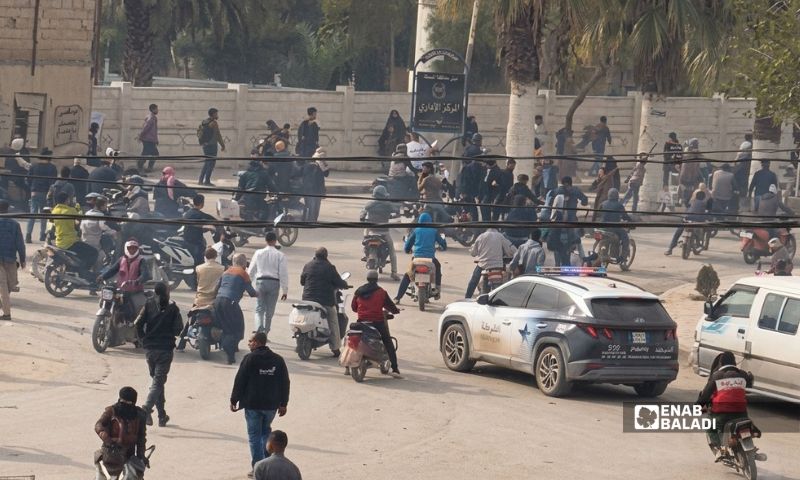
 Protesters near the governorate headquarters in al-Hasakah city, November 4, 2026 (Enab Baladi)
Rival protests over Kurdish language instruction and disruptions to schooling heightened security tensions in al-Hasakah city (northeastern Syria) on Wednesday, November 4. Internal Security Forces intervened to prevent a wider confrontation between the two sides.
Supporters of the dissolved Syrian Democratic Forces (SDF) gathered outside the al-Hasakah governorate headquarters, demanding more Kurdish language lessons in school curricula and raising Kurdish flags. The protest came a day after demonstrators stormed the city’s Education Directorate building to protest the approved curricula.
Counterprotesters from several city neighborhoods took to the streets to oppose disruptions to education and the removal of students from schools. They called for security to be enforced and educational institutions to be kept out of political protests.
The two sides threw stones at each other near the governorate headquarters before Internal Security Forces intervened, dispersed both protests and prevented the confrontation from escalating. One member of the security forces was injured by the stone throwing, according to information obtained by Enab Baladi.
The developments come amid disagreements over school curricula and the Kurdish language, as the integration of government, public service and security institutions in al-Hasakah governorate continues following the agreement reached between the Syrian government and the SDF in January.
Activist Ahmad Zaher said members of Revolutionary Youth had been carrying out activities for several days at schools in al-Hasakah, Qamishli, al-Darbasiyah and Maabada (all in al-Hasakah governorate). These included forcibly removing students from classrooms and organizing protests, which he said had disrupted education in several areas.
Zaher told Enab Baladi that Revolutionary Youth members stormed the Education Directorate building in al-Hasakah on Tuesday, November 3, halting work and the processing of visitors’ paperwork for several hours. He said they attempted to do the same at the governorate headquarters on Wednesday.
He said members of the group stormed schools in al-Darbasiyah while carrying weapons, preventing teaching staff from objecting to the removal of students for fear of being assaulted.
Zaher said the actions in al-Darbasiyah included rioting, with Arabic language textbooks torn up, trampled on and treated with contempt, as he described it.
In Maabada, Zaher accused Revolutionary Youth members of blocking the main road toward al-Malikiyah (northeastern al-Hasakah governorate), attacking several shops and engaging in rioting in the area.
The activist criticized what he described as the failure of Asayish forces, now integrated into the Internal Security Forces, to stop students from being forcibly removed from schools, despite the repeated incidents over recent days.
The information available to Enab Baladi did not include a response from SDF-affiliated bodies to the allegations concerning the removal of students from schools, attacks on property and the tearing up of textbooks.
Abdul Rahman al-Hassan, a resident of al-Hasakah city, said opposing disruptions to education did not mean rejecting demands concerning Kurdish language instruction. He added that he had no objection to peaceful demands that did not interfere with institutions’ work or interrupt schooling.
He told Enab Baladi that his objection concerned attempts to disrupt schools, halt institutions’ work and force students to participate in protests. Involving students in these actions, he said, undermined the stability of their education.
Al-Hassan described events near the governorate headquarters as provocative and a warning of rising tensions among residents. He cautioned that the protests could turn into street confrontations or provoke reactions that deepen divisions.
He called on the Syrian government to assert control throughout the governorate, ensure government offices are functioning and prevent any party from disrupting their work, stressing that institutions must continue providing services to residents.
Another city resident, Jumaa al-Obeid, said platforms and activists he described as affiliated with the SDF had been conducting incitement campaigns for several weeks and attempting to put students at the forefront of demands concerning school curricula.
Al-Obeid told Enab Baladi that Revolutionary Youth members were forcibly removing students from schools daily and pushing them into the streets. He said he had observed masked people dressed in black during the protests who were managing the demonstrations and directing chants against the approved official curricula.
He said his demand was for children to be able to continue their education without threats or repeated interruptions. Using schools and students in political actions under the guise of educational demands, he said, disrupted regular schooling.
Al-Obeid called on Internal Security Forces in al-Hasakah to maintain security and stability and prevent interference with schools. He stressed the need to keep educational institutions out of political disputes and protests that disrupt their work.
The protests coincide with the start of implementation of decisions concerning Kurdish language teaching in public and private schools. On August 27, Education Minister Mohammed Abdul Rahman Turko issued a decision amending the implementing regulations for Decree No. 13 of 2026, allowing Kurdish to be taught as a national language in areas where Kurdish citizens make up a substantial proportion of the population.
According to the Education Ministry’s decision, Kurdish is to be taught at all educational levels and included in the approved curricula, with three lessons per week alongside Arabic and English. Students’ Kurdish grades will count toward their overall final marks.
The decision also provides for one weekly activity lesson in Kurdish as part of its inclusion in education at the schools covered by the decision.
To ease the transition, the decision allows students, during the first academic year after it takes effect, to study social studies, history, geography and philosophy in either Arabic or Kurdish, using the approved curricula. This option is limited to one academic year.
The decision tasked the National Center for Curriculum Development with preparing Kurdish language curricula for all educational levels “in accordance with established scientific and educational principles and in line with the national curriculum framework.” It also tasked the center with translating the activities course materials in accordance with the approved activities guide.
The decision addresses Kurdish language instruction in government educational institutions after years in which the Autonomous Administration used its own curricula in areas under its control in northeastern Syria, while government curricula continued to be used elsewhere.
Al-Hasakah governorate underwent military and administrative changes during 2026 after the Syrian army took control of its southern and eastern rural areas and parts of its western countryside. The SDF withdrew to the governorate’s main cities, particularly al-Hasakah and Qamishli.
On January 29, the Syrian government and the SDF reached an agreement to begin integrating the governorate’s military, security and public service institutions into government structures. Implementation began gradually in February.
On August 25, SDF commander Mazloum Abdi announced the dissolution of the forces and their affiliated formations. Two days later, Syrian President Ahmed al-Sharaa issued a decree appointing Abdi as an adviser to the presidency.
The latest protests come as administration, education and security in al-Hasakah governorate continue to face challenges associated with the transition and integration process, amid differing demands over curricula, language and the role of government institutions in running the governorate’s affairs.
if you think the article contain wrong information or you have additional details Send Correction


 A
A
A


 More Politics