
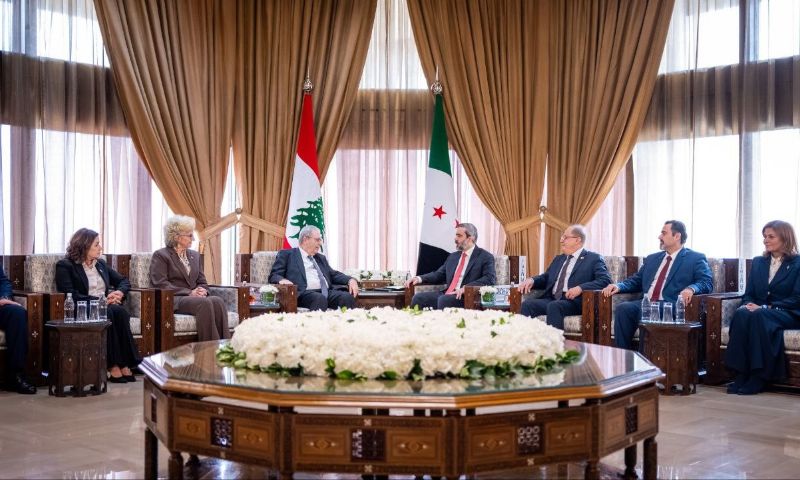

A Lebanese government delegation arrived in the Syrian capital, Damascus, on Monday, November 2, to continue previous talks, with the issue of Syrian refugees topping the agenda.
The Syrian Arab News Agency (SANA) reported that the issue of Syrian refugees and ways to facilitate their return was the main focus of the visit, alongside a range of administrative, social and educational matters related to their presence in Lebanon.
Syria’s Foreign Ministry said the meeting addressed strengthening coordination across various fields, particularly security cooperation and border control, as well as expanding partnerships in education, higher education, social affairs and labor. Discussions also covered follow-up work by joint technical committees to serve the mutual interests of both countries.
According to SANA, the visit comes within the framework of ongoing relations between the two countries, building on previous discussions and following up on the work of committees established by both sides to address various issues.
Syrian Foreign Minister Asaad al-Shaibani received the Lebanese delegation, which was headed by Lebanese Deputy Prime Minister Tarek Mitri.
Also present to receive the delegation were Syrian Minister of Higher Education and Scientific Research Marwan al-Halabi, Minister of Education Mohammed Abdul Rahman Turko, and Minister of Social Affairs and Labor Hind Qabawat.
The Lebanese delegation included Minister of Labor Mohammad Haidar, Minister of Education Rima Karami, and Minister of Social Affairs Haneen Sayed. Lebanese Interior Minister Ahmad al-Hajjar, who had been expected to attend, was absent from the meeting.
Al-Hajjar postponed his visit to Syria until a later date, citing “urgent personal reasons.”
The two sides held bilateral meetings between Syrian ministers and their Lebanese counterparts, with each meeting focusing on a specific area of cooperation.
Ahead of the visit, Lebanese Deputy Prime Minister Tarek Mitri told Lebanon’s An-Nahar newspaper that the visit was part of the ongoing relations between the two countries since Syria’s new leadership came to power.
He added that it was a continuation of previous discussions and an opportunity to follow up on the work of committees established by both sides to address outstanding issues.
The visit, therefore, was not so much about opening new channels of communication as continuing the work already initiated, assessing progress made so far and identifying the steps that still require follow-up and coordination.
Refugees Take Priority
According to An-Nahar, the central issue in the discussions is the situation of Syrian refugees and ways to facilitate their return to their country, including procedures that require direct cooperation between Damascus and Beirut.
The UN High Commissioner for Refugees (UNHCR) previously announced that approximately 1.8 million Syrian refugees had returned from abroad since the fall of the Assad government in December 2024, including 715,611 Syrians who returned from Lebanon.
Among the key issues is the registration of Syrian children born in Lebanon and the procedures for registering them with Syrian authorities to ensure that their births are officially recorded and that they are not left outside the civil registration system.
Another issue concerns Syrian students attending Lebanese schools and the need to organize and follow up on their educational records, to address their circumstances within a clear framework agreed upon by both countries.
Facilitating the movement of people through border crossings is also on the agenda, including simplifying procedures and regulating travel between Syria and Lebanon. Mitri considered this a practical issue no less important than refugee returns, given its direct impact on citizens of both countries and the need for clear, mutually agreed procedures governing cross-border movement.
Security and Judicial Issues Absent From Agenda
Ahead of the visit, Lebanese Deputy Prime Minister Tarek Mitri told An-Nahar that security and judicial matters were not included in preparations for the ministerial meetings. He said security incidents occurring within Lebanon were the responsibility of Lebanese security authorities.
Mitri added that the issue of holding perpetrators of crimes accountable, which Lebanon’s justice minister has called for addressing, was being handled separately through a special committee and was not part of the current ministerial visit’s agenda.
However, Syria’s Foreign Ministry said following the meeting that discussions had included security cooperation and border control.