


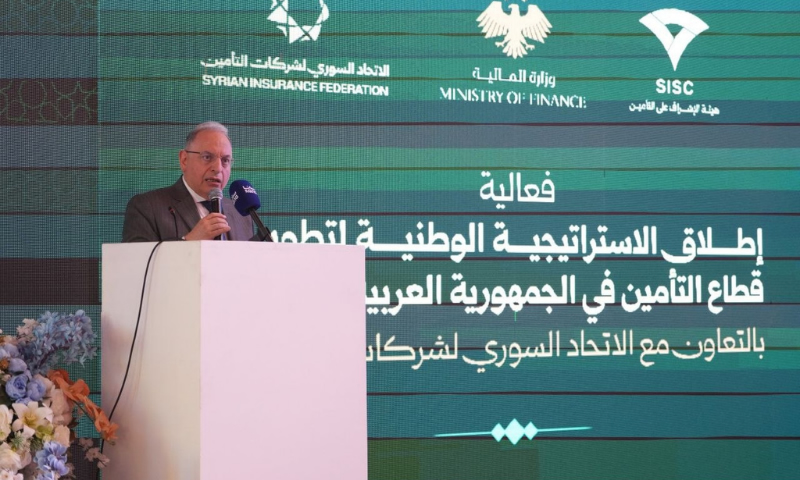
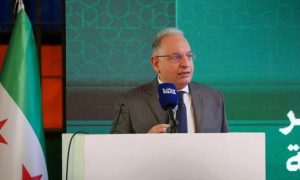
 Syria’s Ministry of Finance launches the National Strategy for the Development of the Insurance Sector at a ceremony at the Hejaz Institution hall in Damascus, November 23, 2026 (Syrian Ministry of Finance)
Attention is turning to Syria’s insurance sector after Finance Minister Mohammed Yisr Barnieh recently revealed that global reinsurance companies and insurance brokers are interested in entering the local market. The move could reshape Syrian insurers’ ability to cover risks associated with major projects and allow them to transfer some of those risks to international markets after years of limited engagement with global insurance institutions.
Barnieh said on his personal Facebook page that international companies, including Swiss Re, Munich Re, and Hannover Re, had expressed interest in the Syrian market, alongside international insurance brokers such as Marsh, Guy Carpenter, Aon, and Nasco. Their interest comes as the domestic insurance sector needs to rebuild its financial and technical capabilities and develop its tools to meet the requirements of anticipated investments.
This interest comes in a market that remains small relative to the financing and insurance requirements of infrastructure, energy, and industrial projects. The sector’s 2025 indicators reflect this limitation, with total insurance claims paid reaching 1.53 billion new Syrian pounds (SYP). Private insurance companies accounted for 58% of these payments, while the state-owned Syrian Insurance Corporation accounted for 42%.
The companies interested in the Syrian market include major international reinsurers, notably Switzerland’s Swiss Re, whose shareholders’ equity reached $25.1 billion in 2025, Germany’s Munich Re, with shareholders’ equity of 33.4 billion euros, and Hannover Re, with equity of 12.9 billion euros.
The list also includes insurance brokerage and risk management companies such as Marsh, whose group revenue reached approximately $27 billion; Aon, with shareholders’ equity of $9.35 billion; and Nasco, which operates regionally and internationally.
These institutions perform different roles, ranging from assuming and redistributing risks to arranging insurance coverage. Their expressed interest does not mean they have actually entered the Syrian market.
The significant gap between the financial capabilities of global reinsurance and brokerage companies and the size of the Syrian market presents an opportunity to expand insurance coverage and attract expertise. However, it also raises concerns about competitive balance. The entry of institutions with substantial financial resources and extensive international networks could give them an advantage in insuring major projects, leaving Syrian companies facing competition they may struggle to match, particularly given their limited capital, inadequate technical tools, and low insurance penetration.
The combined capital of the Syrian Insurance Corporation and private insurance companies in the first half of 2022 amounted to approximately 199.6 million new Syrian pounds, according to the latest report published on the Insurance Supervisory Commission’s website. Of this amount, 20 million pounds belonged to the state-owned corporation, while 179.6 million pounds were distributed among 12 private companies.
Based on the exchange rate prevailing in the Syrian market at the time, approximately 513 old Syrian pounds per US dollar, the combined capital of the state-owned corporation and private insurance companies was equivalent to approximately $38.9 million. This figure reflects the limited domestic capital base compared with the potential risks associated with insuring major projects.
However, according to preliminary and non-final statistical indicators issued by the Insurance Supervisory Commission on the performance of Syria’s insurance sector in 2025, total written insurance premiums reached 3.88 billion new Syrian pounds. The figure falls to 3.35 billion pounds when compulsory insurance is excluded. Private insurance companies accounted for 60.5% of written premiums, compared with 39.5% for the Syrian Insurance Corporation.
Total insurance claims paid also reached 1.53 billion new Syrian pounds, with private insurance companies accounting for 58% and the Syrian Insurance Corporation accounting for 42%.
The total number of insurance policies issued reached 978,009. The Syrian Insurance Corporation led this category with a share of 90.6%, while private insurance companies accounted for 9.4%.
The figures reveal a clear disparity between activity measured by the number of policies and activity measured by the value of premiums and claims. Private insurance companies lead in the value of written premiums and claims paid, while the overwhelming majority of insurance policies are issued by the Syrian Insurance Corporation.
Health insurance was absent from the 2025 statistics published by the Insurance Supervisory Commission. However, it accounted for the largest share of claims in the first half of 2022, with payments reaching approximately 335 million new Syrian pounds, compared with premiums of around 306.5 million pounds. This means claims exceeded written premiums, indicating the financial pressure insurance companies may face when managing certain types of coverage.
Economist Joseph Daher told Enab Baladi that the interest of global reinsurance companies in the Syrian market could represent a positive step toward reintegrating the insurance sector into the international financial system. However, it would not independently address the sector’s structural problems or automatically create the conditions necessary for investment expansion.
Daher said Syria’s private insurance sector is operating far below its prewar capacity. It faces obstacles related to reintegration into the global financial system, a weak domestic banking sector, outdated legislation, and a shortage of reinsurance, alongside the need to reassess insurance companies’ assets and recapitalize the market.
These obstacles overlap with restrictions that companies previously faced when investing outside Syria, prompting some to direct their funds toward real estate rather than diversify their investments across different financial instruments and markets.
According to Daher, international money transfers remain one of the most significant obstacles facing the insurance sector. Reinsurance companies rely on formal banking channels to settle financial transactions, whether transferring reinsurance premiums abroad or receiving claims payments when losses occur. Rebuilding international banking relationships is therefore a practical prerequisite for expanding cooperation.
Reinsurance allows local insurance companies to transfer some of the risks they assume to larger companies in exchange for premiums, so they do not have to bear the full value of potential losses alone. This mechanism is particularly important when insuring energy projects, factories, infrastructure, and other high-value projects.
Daher said international reinsurance coverage could help investors protect their investments and strengthen their ability to manage risks. However, it does not provide a sufficient guarantee of attracting investment unless a stable business environment is in place.
Beyond insurance, the economist identified several major factors that continue to influence investors’ decisions:
The return of reinsurance companies also depends on their assessment of risks in the Syrian market. It cannot be assumed that their entry would immediately reduce insurance costs for shipping or industrial projects. Pricing depends on the scale of risks, the nature of coverage, available data, claims management capabilities, and the degree of financial and legal stability.
Syria’s insurance sector continues to operate under legislation dating back to 2004, highlighting the need to update it in line with developments in the global insurance industry over the past two decades.
According to Daher, there is a need to develop regulations governing financial solvency, corporate governance, disclosure, risk management, and investment in accordance with the requirements of global reinsurance companies, which apply rigorous standards when accepting risks and determining coverage terms.
He also believes that the limited insurance coverage available for major projects, including restrictions on insurance denominated in US dollars, represents one of the shortcomings that must be addressed, alongside the need to strengthen regulatory oversight and modernize asset valuation mechanisms.
According to Daher, this process requires reassessing the sector’s structure and the ability of local insurance companies to meet international underwriting requirements. This could lead to the restructuring of some companies or an increase in their capital if they are unable to comply with the new standards.
Indicators from the insurance sector’s annual report covering the first half of 2022 show that health insurance accounted for approximately 45% of written premiums, while other insurance segments, including life and engineering insurance, remained relatively limited.
According to Daher, only about 4% to 5% of Syrians have health insurance, while health insurance accounts for approximately 80% of all insurance coverage among this group. This reflects the limited penetration of insurance in Syrian society, despite its importance in easing the financial burden on households.
He believes that the entry of global reinsurance and brokerage companies could facilitate the development of new products, improve risk management, and provide technical expertise. However, this alone would not be sufficient to increase the sector’s contribution to gross domestic product (GDP) unless accompanied by growth in productive sectors, improved purchasing power, and an expansion in the number of businesses and individuals able to purchase insurance coverage.
International interest in Syria’s insurance sector could therefore represent an opportunity to develop its structure. However, it remains dependent on the ability of the Syrian government and local companies to build a more efficient financial system, modernize legislation, and improve the economic environment, conditions that extend beyond the insurance market itself.
if you think the article contain wrong information or you have additional details Send Correction


 A
A
A




 More Economic Reports