


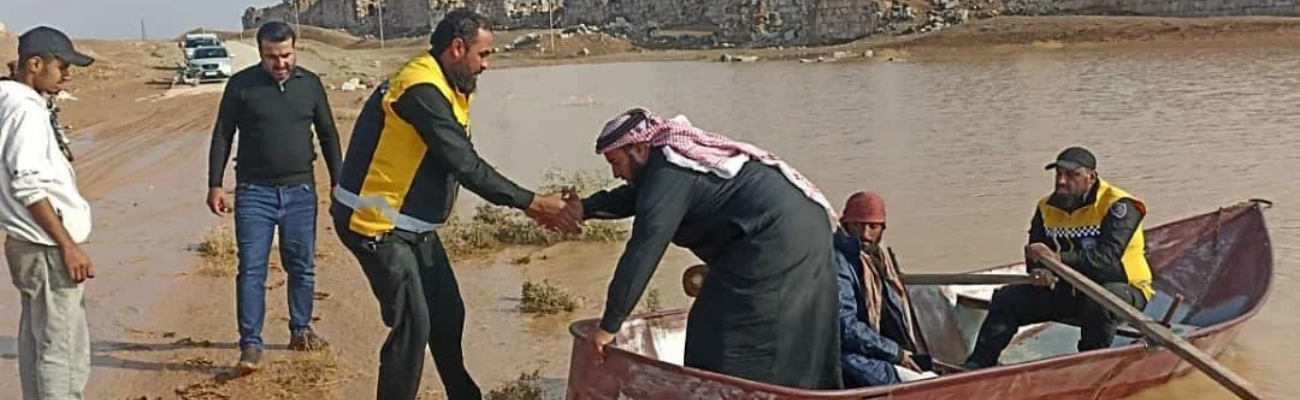
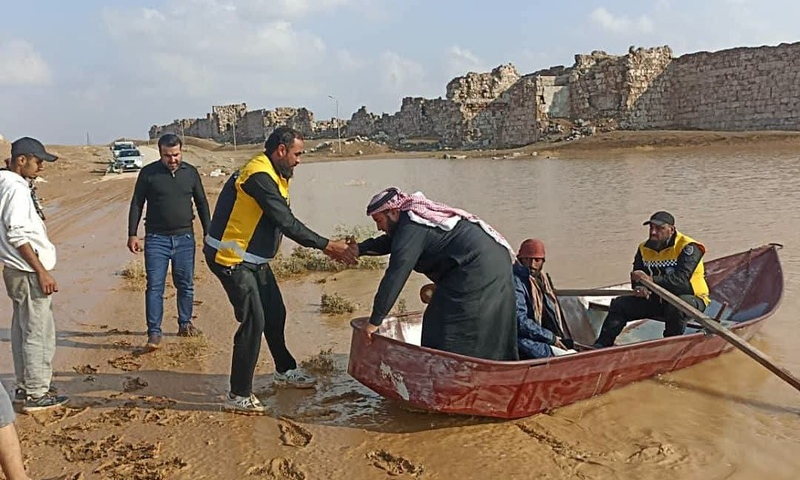
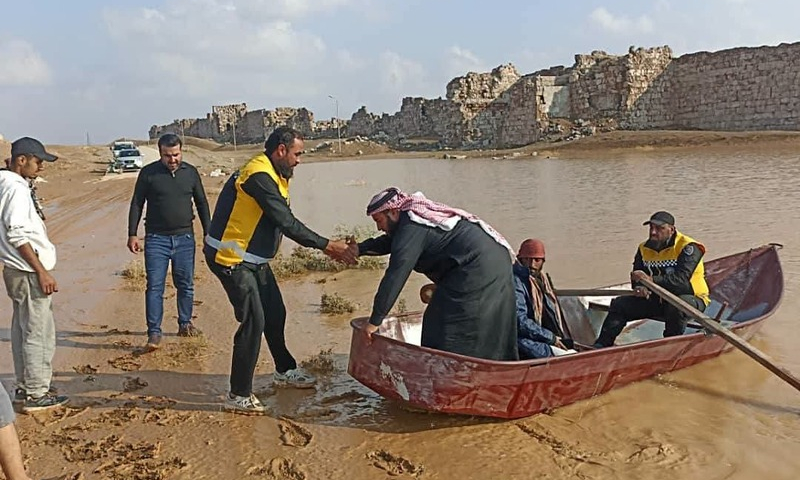
 Two people rescued after becoming trapped inside a truck surrounded by floodwaters near al-Rusafa Bridge in Raqqa (northern Syria).


 A
A
A
Shaaban Shamieh | Alaa Shaabo | Nour Kassem
Flooding in Syria has once again exposed the country’s deteriorating roads and drainage networks, as heavy rainfall inundates streets, damages infrastructure, and disrupts transportation. Officials and engineers warn that aging systems, equipment shortages, and fragmented responsibilities are preventing sustainable solutions to the recurring crisis.
Recent flooding across large areas of eastern Syria and the desert region illustrates the impact of heavy rainfall. Flash floods have caused deaths and property damage and left civilians stranded, prompting the Ministry of Defense to deploy helicopters to evacuate them.
With responsibilities divided among several institutions, equipment shortages and deteriorating infrastructure, accountability remains fragmented while residents bear the cost of a chronic crisis.
As forecasts predict above-average rainfall during the coming winter, questions are again being raised about the readiness of the relevant institutions and their ability to move beyond responding to flooding after it occurs toward addressing its underlying causes before the rainy season begins.
Preparations Fail to Prevent Flooding
Emergency Measures Remain the Main Response
Syrian governorates face similar challenges every winter, including flash floods, flooding, waterlogged streets and muddy pools.
In Aleppo (northern Syria), for example, Enab Baladi’s correspondent documented water accumulating in the al-Fayd, Salah al-Din and Saif al-Dawla neighborhoods, as well as at other major intersections, following rainfall in late September. In some areas, the water partially submerged vehicles.
In Latakia (western Syria), the problem extends beyond blocked drains, according to Enab Baladi’s correspondent. Excavation works and unfinished road projects add to the difficulties, particularly in geographically low-lying areas such as al-Raml al-Janoubi, which becomes a natural collection point for floodwaters flowing from higher neighborhoods.
In Damascus, the first rainfall of the current season exposed a gap between officially announced preparations and conditions on the ground, as water accumulated in the al-Tadamon, Daf al-Shouk, al-Kabbas and Kashkoul neighborhoods.
In Jaramana (Damascus countryside, southwestern Syria), sewage mixes with rainwater, turning side streets into muddy pools. Residents of the al-Qaryat neighborhood were forced to collect money from each household to clear blockages in the sewage network at their own expense.
These incidents are not isolated. Similar scenes recur across most governorates during every rainy season, sometimes even after limited rainfall, raising the same question year after year: Why Flooding in Syria Keeps Returning?
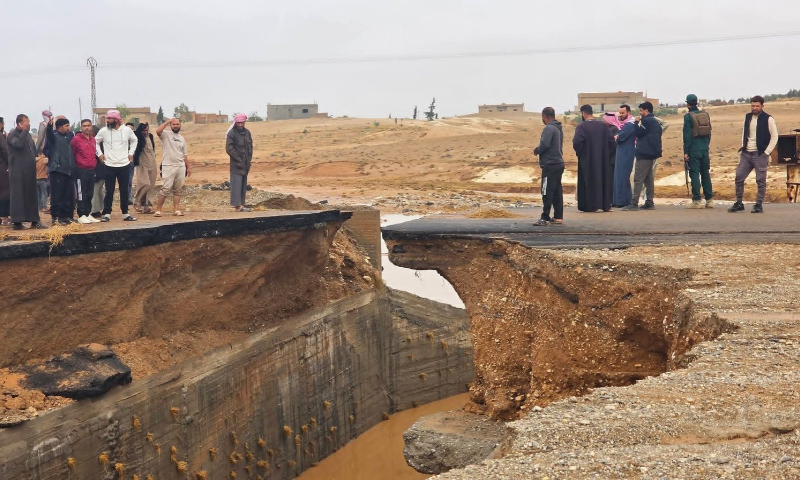
Flooding in Syria damages al-Salmani Bridge near Tabqa in Raqqa governorate, October 29, 2026. (Raqqa Governorate/Facebook)
Why Flooding in Syria Keeps Returning?
Combined Drainage Networks
The difficulties are not solely related to the amount of rainfall, according to Mohammad Bashar al-Mufti, head of the Central Committee for Water Resources, Sanitary and Environmental Engineering at the Syrian Engineers Syndicate.
Al-Mufti told Enab Baladi that Syria uses combined drainage networks that carry both sewage and rainwater. Overflow structures are installed along these networks to discharge the mixed water into nearby valleys or rivers, potentially contaminating water sources.
He added that large sections of these networks are old, while others were damaged or destroyed during the years of conflict. Pipe joints are also not watertight, allowing sewage to leak into the surrounding ground.
Al-Mufti also highlighted the impact of climate change, explaining that rainstorms have become more intense while their duration has shortened. This means large volumes of water arrive within brief periods, exceeding the networks’ designed capacity.
Taher al-Omar, director of the General Establishment for Drinking Water and Sanitation, agreed with this assessment. He told Enab Baladi that much of the infrastructure has deteriorated and requires maintenance, rehabilitation and expansion, as population pressure and aging systems have exceeded their original design capacity.
For his part, Minister of Emergency and Disaster Management Raed al-Saleh attributed the worsening problem in a statement to infrastructure that was not designed to accommodate urban expansion or meet required standards in major city centers and informal settlements. He also cited drains blocked by waste and sediment, as well as encroachments on natural floodwater channels.
Urban encroachment on riverbanks and the construction of homes along floodwater routes during repeated droughts have blocked natural waterways, causing floodwaters to spill into neighboring areas when it rains.
Mohammad Bashar al-Mufti
Head of the Central Committee for Water Resources, Sanitary and Environmental Engineering at the Syrian Engineers Syndicate
Above-Average Rainfall Expected
Infrastructure problems coincide with forecasts of above-average rainfall during the approaching winter, according to Anas al-Rahmoun, director of the Climate Change Directorate at the Ministry of Local Administration and Environment.
Al-Rahmoun told Enab Baladi that the coming winter is expected to be warm but wetter than average. He noted that four rainfall events were recorded during August and September that had not previously occurred during those months.
He added that 2025 also witnessed unusually high rainfall within short periods, at levels not seen in six decades.
Are Divided Responsibilities Hindering the Response?
Water and sanitation institutions, municipalities, city councils, governorate water resources directorates, the Ministry of Local Administration and Environment, and the Ministry of Emergency and Disaster Management share responsibility for managing stormwater drainage and flash flood risks. This division makes it difficult for residents to determine which institution is responsible when problems arise.
Taher al-Omar, director of the General Establishment for Drinking Water and Sanitation, said there is a severe shortage of machinery, equipment, and resources needed for the work, including suction trucks, excavators, and mobile pumps, as well as a shortage of specialized personnel.
Al-Omar told Enab Baladi that work had begun several weeks earlier to clean stormwater drains, identify areas and locations likely to experience blockages or water accumulation, and take whatever precautions were possible to prevent flooding.
He noted that reports received during sudden storms are handled according to priorities and available resources.
The media department at the Ministry of Emergency and Disaster Management also told Enab Baladi that it faces major shortages of engineering machinery, operational centers, personnel, equipment and training. It said the ministry is coordinating with the Ministry of Local Administration and Environment to ensure stormwater drainage networks are prepared, cleaned and maintained.
The emergency and disaster management minister had previously stressed that flood risk management must begin long before rainfall occurs, rather than when it starts.
Meanwhile, Ahmed Kawan, director of the General Authority for Water Resources, told Enab Baladi that the authority’s work focuses on flood channels, rivers and irrigation networks, while also providing machinery to support city councils within designated urban planning areas.
According to Kawan, approximately 93% of cleaning and clearance work had been completed by September, covering about 2,670 kilometers. However, the work he described concerned waterways and irrigation networks, not stormwater drains in public streets and neighborhoods.
The Ministry of Emergency and Disaster Management also said it had carried out what it described as emergency works in cooperation with technical services, agricultural and water resources authorities in the al-Sayha Dam area and the Quweiq River basin in Aleppo and Idlib, ahead of the rainy season to reduce flood risks.
These works included reinforcing and rehabilitating approximately 50 kilometers of earthen embankments in the Jazraya and al-Wasita areas, constructing and rehabilitating ten drainage culverts, and rehabilitating 12 kilometers of agricultural roads.
Despite the number of institutions involved, al-Mufti said cleaning street storm drains is the responsibility of municipalities, which lack both the necessary equipment and the authority to maintain drainage networks after those responsibilities were transferred to the sanitation company affiliated with the Ministry of Energy.
On October 18, the Ministry of Local Administration and Environment issued a circular instructing governorates and their affiliated institutions to supervise and monitor the cleaning and maintenance of stormwater drainage networks, remove obstructions and blockages, and assume responsibility for implementation and follow-up.
Enab Baladi had sent questions to the Ministry of Local Administration and Environment on October 8 about local councils’ preparations for winter and stormwater drainage.
At the time, the ministry’s media office said a committee had been formed to examine the issue and promised to provide answers once its work was completed, no later than October 22. However, no response had been received by the time this investigation was published.
Al-Mufti said available emergency measures include cleaning storm drains and inspecting sections of the networks that overflowed during previous rainy seasons.
However, he warned that it was already too late to implement fundamental measures before the season, emphasizing the need for a clear plan to rehabilitate sewage networks based on an assessment of actual conditions and to provide sustainable solutions rather than temporary repairs.
A fundamental solution requires moving toward separate networks for sewage and stormwater drainage, particularly in coastal cities and cities crossed by rivers, such as Damascus, Homs and Hama. Rainwater should be directed to rivers or the sea through the shortest possible route.
Mohammad Bashar al-Mufti
Head of the Central Committee for Water Resources, Sanitary and Environmental Engineering at the Syrian Engineers Syndicate
Residents from several governorates also told Enab Baladi that sewage networks and stormwater drains need regular cleaning and maintenance before the peak of winter. They called for solutions to recurring waterlogged areas and the rehabilitation of roads damaged by potholes and cracks.
They also emphasized the need to link road paving and maintenance projects with drainage network repairs, rather than implementing fragmented projects that repeatedly fail to prevent flooding in the same locations after every rainfall.
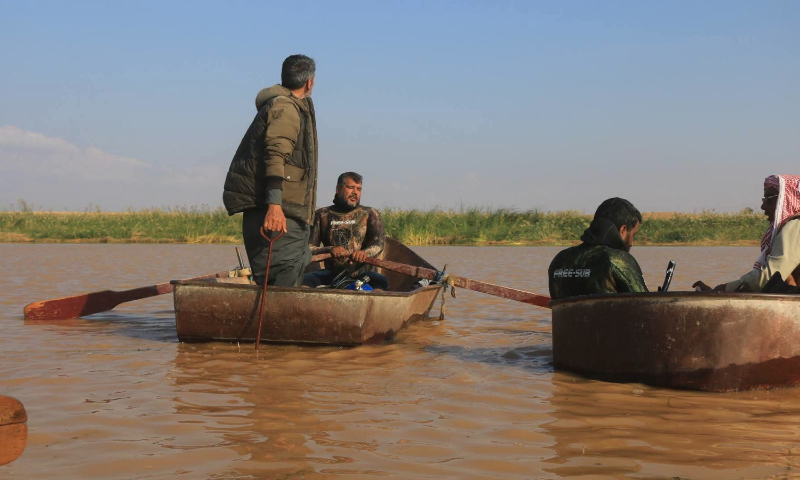
Civil Defense teams in Raqqa search for missing people swept away by floodwaters from al-Salmani Bridge toward Lake Euphrates, October 29, 2026. (Syrian Civil Defense/Facebook)
Transport Ministry’s Plan Faces Deteriorating Infrastructure
Can Syria’s Roads Withstand the Winter?
The return of rainfall in Syria has renewed scrutiny of the readiness of roads and drainage networks, recalling the damage caused during the previous rainy season, including deteriorating asphalt, road closures and washed-away bridges.
A report titled Syria Climate Profile, published in July by the Weathering Risk initiative, warned of flood risks. Against that backdrop, a central question remains: Will ongoing maintenance work withstand the coming winter, or will addressing the problem require tackling its underlying technical causes and reassessing priorities?
Beyond Cleaning Storm Drains
Preparations for the rainy season must go beyond filling surface potholes and resurfacing damaged road sections to address the broader hydraulic and structural infrastructure of the road network.
Moaz Najjar, director of the General Establishment for Road Transport at the Ministry of Transport, told Enab Baladi that inspecting stormwater drainage systems is an essential part of annual maintenance work ahead of winter.
The measures include checking the condition of drainage culverts, cleaning drains and roadside ditches, and removing sediment and obstructions to ensure water flows away from road structures. Any identified defects are addressed alongside pothole repairs.
Civil engineer Yasser Dalal, meanwhile, told Enab Baladi that the fundamental question should be: “Where will the rainwater go when it reaches the road?” He stressed that effective preparation requires examining the entire drainage system.
Cleaning storm drain grates and rainwater collection points alone is not enough if the channels downstream are blocked or damaged. Several tunnels in Damascus, for example, become completely flooded during winter. This requires checking collection openings and side channels, followed by drains and culverts beneath the road, all the way to the final discharge point.
Yasser Dalal
Civil Engineer
According to Dalal, technical standards extend beyond drainage structures themselves to engineering details that affect road safety and traffic movement, even when the road surface appears to be in good condition:
- Road gradients and pavement protection: Inspecting the cross slopes and longitudinal gradients of road surfaces and shoulders, removing soil that obstructs water runoff, and sealing cracks and openings in asphalt that allow water to penetrate underlying layers.
- Roadside safety and slopes: Inspecting road shoulders to ensure vehicles can stop safely in emergencies, particularly on international highways; checking slopes and retaining walls near earthen or rocky escarpments; monitoring signs of soil erosion around culverts and bridge supports; and inspecting drain covers, protective barriers, and traffic signs.
These measures are particularly important in major cities and on arterial roads. Dalal noted that flooding in tunnels or major transport corridors can cause serious damage, while repairs become extremely difficult once the damage occurs because such roads cannot easily be closed during working days or peak traffic hours.
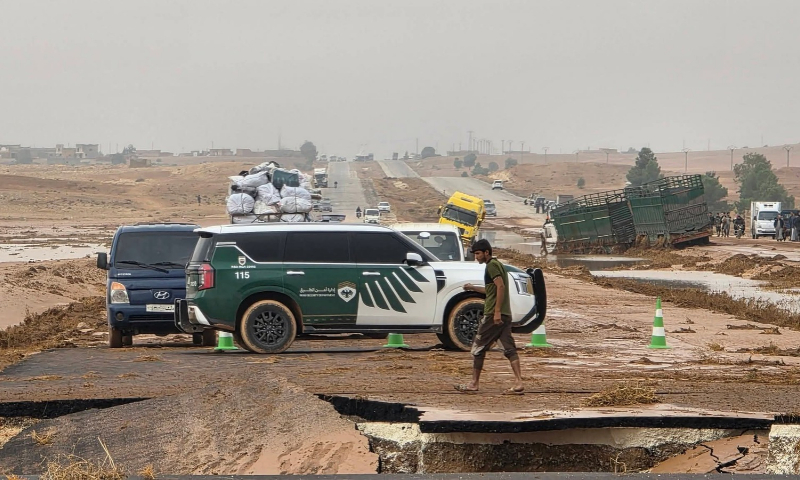
Flooding in Syria damages al-Salmani Bridge near Tabqa in Raqqa governorate, October 29, 2026. (Raqqa Governorate/Facebook)
Distinguishing Poor Maintenance from Construction Defects
The appearance of a pothole or crack in a road surface is not enough to determine the cause of the damage. According to Dalal, diagnosis requires examining the type, location, and timing of the damage, supported by the necessary technical tests.
- Poor maintenance: Often appears as drains blocked by soil. However, persistent blockages or water accumulation after cleaning may indicate defects in road gradients, elevation levels, or the distribution of drainage openings.
- Construction defects: Can be identified by comparing completed works against technical standards, checking layer thickness, material quality and compaction levels, and detecting voids beneath the asphalt.
The recurrence of potholes, depressions, cracks and rutting in the same location after every repair is a reason to investigate the problem, not a justification for repeating the same patchwork repairs.
Yasser Dalal
Civil Engineer
Dalal emphasized that several causes may overlap at the same location. Poor drainage can worsen the effects of construction defects, while delayed maintenance can increase the extent of damage. Each case therefore requires an accurate technical assessment rather than broad generalizations.
Does the Transport Ministry’s Plan Target Climate Risk Hotspots?
Against the backdrop of accumulated damage, Moaz Najjar, director of the General Establishment for Road Transport, outlined the institution’s 2026 maintenance plan to Enab Baladi. He explained that priorities are determined according to the defects identified and the allocated budgets, across several areas:
- Road safety and vital networks: Priority is given to expressways and equipping them with safety measures, alongside maintaining major road corridors and rehabilitating bridges in Idlib, Aleppo and eastern Syria. The work also includes road markings, directional and warning signs, reflective road studs, and roadside delineators, implemented by the establishment’s teams or through dedicated contracts.
- Progress on ongoing projects: Completion has reached 87% in the first phase and 60% in the third phase of the Homs-Masyaf road project, 75% on the Hama-Salamiya road, 77% on the Homs-Salamiya highway, 53% at the Tal Qartal interchange on the Homs-Hama highway, and 86% on the border road in Suwayda.
- Completed bridge projects: The Great Rastan Bridge in Homs entered service in June, followed by al-Rashid Bridge in Raqqa and the Cement Factory Bridge in Rastan in July.
- Major highway and arterial road rehabilitation projects: The plan includes launching rehabilitation projects on the Nasib-Damascus highway, with an implementation period of 400 days, the Damascus-Homs highway, with 500 days, and the Homs-Aleppo highway together with the Saraqib-Idlib link, also with 500 days.
The works also include rehabilitating and widening a second carriageway on the Damascus-Palmyra road, with an implementation period of 791 days, and the Palmyra-Deir Ezzor road, also 791 days. The road from al-Basiri junction to the al-Tanf border crossing, including the al-Saba Biyar link, is scheduled for 900 days. Other projects include widening the Idlib-Ariha-al-Mastouma road and maintaining the Latakia-Ariha highway.
– Rehabilitation of vital bridges: This phase focuses on a network of strategic bridges, including the al-Siyasiyeh, al-Mayadin and al-Bukamal bridges in Deir Ezzor, as well as the Maadan Bridge in Raqqa.
The list also includes several bridges in Idlib governorate: the southern and central al-Maarra bridges, Khan al-Subul bridges, Basanqul bridges, the Idlib-Saraqib interchange, and the al-Shughour-Ishtabraq Bridge.
Regarding the technical criteria used to select projects, Najjar explained that the establishment relies on field survey equipment and scientific indicators, particularly the Pavement Condition Index (PCI), which assesses deterioration affecting road surfaces and foundations, and the International Roughness Index (IRI), alongside truck traffic density and overall traffic volumes.
In contrast to the figures and projects announced, Dalal presented an engineering perspective suggesting that maintenance priorities should not be determined solely by visible damage or numerical indicators. Instead, they should be guided by a risk and response matrix that considers:
- Traffic volumes and the strategic importance of roads connecting hospitals, essential services and key communities.
- Immediate attention to the most dangerous locations, including repeatedly flooded areas, damaged culverts and ground subsidence.
- Clearing water flow routes and addressing damage in underlying soil layers before laying asphalt.
- Preparing rapid response teams and alternative traffic routes for locations where repairs may extend beyond winter.
Regarding quality assurance, Najjar stressed that projects undergo technical tests covering layer thickness, surface evenness and gradients, asphalt pavement quality, and completed drainage structures. Contractors are required to redo any sections that fail to meet specifications.
Dalal, however, argued that accepting completed work should not be based solely on its surface appearance. It should involve documenting conditions before and after maintenance, testing compaction and materials, and conducting field inspections following the first rainfall to ensure that water accumulation has been eliminated and ground subsidence has not recurred.
Complex Challenges
The need for road maintenance ahead of winter comes amid broader challenges facing Syria’s infrastructure, following years of declining maintenance and damage to the transport network, alongside climate-related risks threatening roads and associated structures.
According to the World Bank’s damage and needs assessment following the February 2023 earthquake in Syria, approximately 675 kilometers of primary and secondary roads were damaged across six governorates covered by the assessment: Aleppo, Idlib, Raqqa, Hama, Tartus and Latakia. This represented about 11% of the road network included in the study.
The assessment also highlighted challenges that predated the earthquake in the transport sector, including inadequate maintenance and unrepaired damage to roads and bridges during the years of war.
It recommended improving standards for road and bridge design and construction, including associated structures such as culverts and drainage channels, and strengthening measures to reduce flooding and landslide risks in vulnerable areas.
As the rainy season begins, the challenge is not merely to carry out maintenance work, but to determine whether it can address the causes of deterioration and prevent the damage from recurring.
While the General Establishment for Road Transport has outlined its projects and technical procedures, the effectiveness of its preparations will depend on directing interventions toward the areas most vulnerable to flooding, assessing drainage infrastructure and monitoring road performance after rainfall. These are the standards by which the network’s readiness for winter can be measured, rather than simply the volume of work completed.
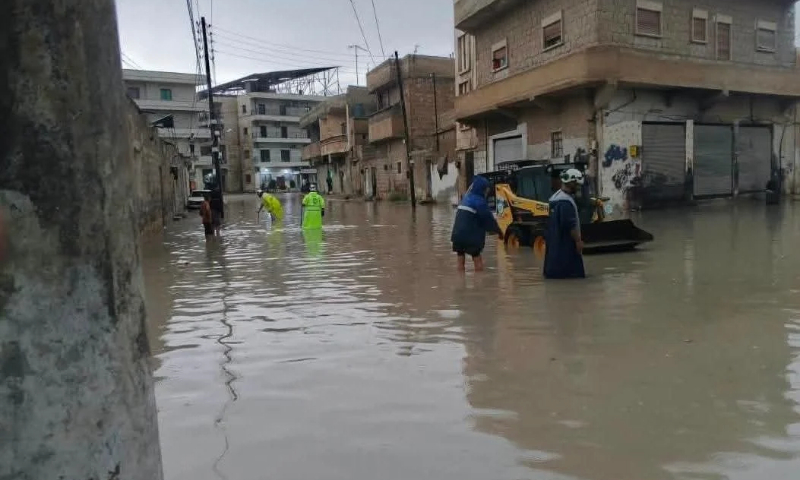
Civil Defense teams respond to flooding in Manbij, clearing blocked roads and pumping water from flooded homes following heavy rainfall, October 28, 2026. (Aleppo Emergency and Disaster Management Directorate/Facebook)
Solutions and Alternatives
Technical Approaches to Redesigning Road and Drainage Networks
Syria’s transport and drainage networks become less efficient during heavy rainfall because of inadequate regular maintenance and the combination of stormwater and sewage drainage systems.
The consequences extend beyond water accumulation and traffic disruption to structural damage, including weakening the soil layers supporting roads and eroding bridge foundations as a result of prolonged water saturation under traffic loads.
Enab Baladi spoke with three academic experts specializing in geotechnical engineering, civil engineering and water resources to examine available technical alternatives for reducing these structural and environmental risks, as well as the conditions required for their implementation in Syria.
Understanding the Soil Comes First
Dr. Ali Ahmad, an earthquake geotechnical engineering specialist and lecturer at the Higher Institute for Earthquake Studies and Research at Damascus University, explained that heavy rainfall is among the most significant challenges facing infrastructure.
Rainwater can weaken the soil layers supporting roads, reducing their load-bearing capacity under traffic and causing settlement or collapse within the road structure.
Ahmad told Enab Baladi that the impact of rainwater can also cause landslides or slope failures along roadsides, as well as settlement and structural failures beneath bridge foundations.
He explained that addressing these effects requires a proactive approach based on understanding how soil behaves when exposed to water, rather than merely repairing roads after damage occurs. Geotechnical engineering, he added, helps develop solutions suited to the nature of each problem and the conditions of each location.
Geotechnical solutions include developing surface and subsurface drainage systems that prevent water accumulation and harmful infiltration into road layers, and improving soil properties through compaction, stabilization using suitable materials, or localized replacement of weak soils based on testing and assessment results.
Dr. Ali Ahmad
Earthquake Geotechnical Engineering Specialist
Ahmad added that solutions also include protecting slopes and embankments against erosion and landslides through proper assessments and the adoption of suitable reinforcement and protection measures.
The geotechnical specialist explained that sustainability depends on selecting the most technically and economically appropriate solution that requires the least maintenance, rather than simply choosing a structurally robust option.
Ahmad emphasized that the essence of geotechnical engineering lies in understanding how damage occurs, anticipating it and preventing it, and intending to build road and transport networks that are more resilient to climate change.
He also called for integrating geotechnical engineering, hydrology, and transport planning to develop risk maps, identify maintenance priorities, and establish effective emergency plans that reduce the likelihood of road closures and limit human and economic losses.
Engineering and Environmental Consequences
The lack of regular maintenance is the leading cause of blockages in drainage networks, according to Dr. Rami al-Dalati, a faculty member at the Faculty of Civil Engineering at Damascus University.
Asked whether the main engineering problem in Syria lies in inadequate pipe capacity, errors in road gradients or insufficient maintenance, al-Dalati said the principal issue is the lack of routine maintenance.
He added that this remains the primary cause, although it does not rule out accompanying problems such as errors in road slope construction or insufficient pipe capacity in certain locations.
Al-Dalati summarized the consequences of combining stormwater and sewage networks in two categories:
- Engineering consequences: Exceeding network capacity and preventing pipes from carrying the required flows, resulting in flooded manholes and streets, infrastructure deterioration, increased sediment accumulation, and disruption or shutdown of wastewater treatment plants, including the flooding of sedimentation basins.
- Environmental consequences: Contamination of surface water bodies and the surrounding environment, the spread of disease and unpleasant odors caused by wastewater overflowing into streets, and missed opportunities to harvest rainwater.
Work is currently underway to develop a new engineering code for the design of roads, bridges and networks in Syria. It will take into account all relevant factors and changes in design, construction and maintenance, in line with climate change and updated hydrological data.
Dr. Rami al-Dalati
Faculty Member at the Faculty of Civil Engineering, Damascus University
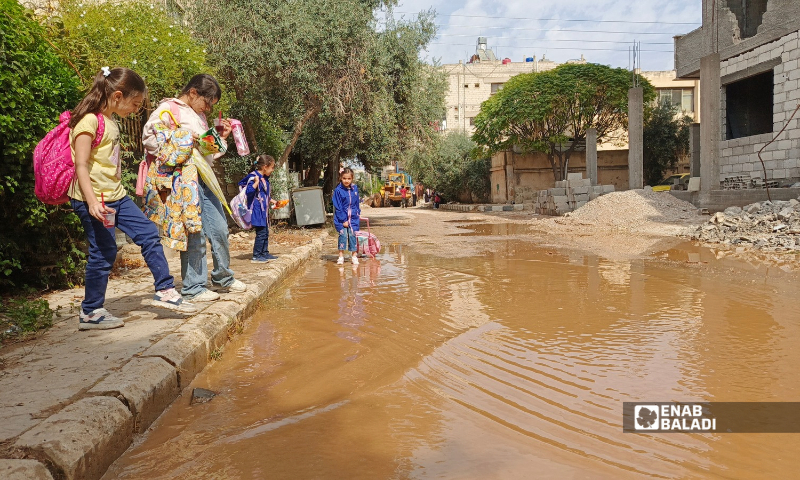
Students make their way through pools of water left by heavy rainfall on a street in Daraa (southern Syria), October 28, 2026. (Enab Baladi/Mahjoub al-Hashish)
Smart Solutions for Flood Hotspots
Al-Dalati outlined an integrated approach using remote sensing technologies and geographic information systems (GIS) to predict flood-prone locations and redesign their infrastructure.
The approach involves three stages: collecting and analyzing meteorological and land-cover data, using GIS modeling and simulations to identify drainage bottlenecks, and simulating alternative engineering solutions through sustainable drainage planning and the redirection of water flows.
According to al-Dalati, Syria’s worsening drought is a major challenge that grows more severe each year. He stressed the need to make effective use of all water sources, including rainfall, through scientifically designed collection channels and dedicated storage areas.
He also proposed developing engineering systems that would allow collected rainwater to replenish groundwater reserves, turning the flooding crisis into an opportunity to strengthen water security.
Regarding potential solutions, al-Dalati recommended focusing on sustainable, low-cost engineering approaches. He called for a thorough assessment of the crisis to develop smart, rapidly implementable solutions in flood hotspots and areas most vulnerable to water accumulation, without necessarily rebuilding entire large-scale drainage networks.
He outlined two main measures:
- Permeable surfaces: Replacing asphalt layers and sidewalks in critical areas with porous concrete or permeable asphalt that allows rainwater to infiltrate directly into the soil.
- Green drainage channels: Converting road medians and roadsides into low-lying vegetated channels with deep-rooted plants and porous soil to absorb rainwater runoff effectively.
A Vision for Introducing Sponge Cities in Syria
Dr. Safwan al-Halabi, a water resources researcher, said the concept of “sponge cities” could be introduced gradually in Syria at relatively low cost, without requiring large-scale projects beyond the country’s current economic capacity.
Al-Halabi told Enab Baladi that the concept involves absorbing or temporarily retaining rainwater to slow its flow and allow it to be used later. Measures could include rain gardens, small collection basins, permeable surfaces and tanks that collect rooftop rainwater from schools and public buildings.
He stressed that the success of these solutions depends on soil characteristics, groundwater levels, rainfall intensity and the availability of maintenance. He proposed beginning with a pilot neighborhood experiencing water accumulation, measuring the results and then expanding the approach if it proves effective and economically viable.
Al-Halabi added that constructing enormous underground reservoirs beneath cities is not automatically the best option for managing flash floods, although such systems can be effective in densely populated areas with limited surface space.
He explained that these reservoirs involve high excavation, waterproofing and maintenance costs. Construction becomes even more difficult in areas with high groundwater levels or extensive buried utility networks.
Al-Halabi proposed evaluating three alternatives before making a decision: distributed small and medium-sized tanks, surface detention basins, and centralized underground reservoirs in locations where studies justify their construction.
He explained that storage capacity should be determined using actual calculations of runoff volumes, peak flows and drainage network capacity, rather than assuming that a larger reservoir is always better.
He also called for linking these projects to rainwater harvesting so collected water can be reused for irrigation and cleaning after confirming that its quality is suitable for the intended purpose.
Al-Halabi discussed the possibility of turning Syria’s rainfall from a hazard into a resource through water harvesting basins around cities and agricultural areas, or through artificial groundwater recharge where geological conditions permit.
He stressed the importance of separating relatively clean rooftop rainwater from contaminated runoff from roads and industrial areas, which requires special treatment.
According to al-Halabi, the success of such projects depends on planning, clearly identifying how the water will be used, ensuring its quality, and providing storage and maintenance facilities suited to local conditions.
He also called for integrating hydrological studies into urban master plans and infrastructure rehabilitation projects, as well as developing a digital platform for data sharing and coordination among institutions, with results measured against clear, publicly announced indicators.
Syria needs engineering that anticipates problems, protects people, safeguards infrastructure and maximizes the benefits of available resources. This is the essence of sustainable engineering, which I advocate adopting in the construction and rehabilitation of cities during the reconstruction phase.
Dr. Safwan al-Halabi
Water Resources Researcher
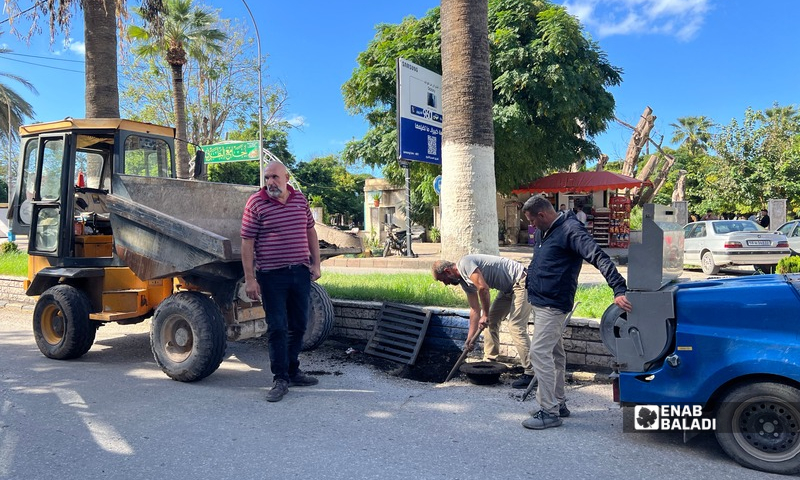
Municipal crews clean drainage openings along the Western Corniche in Latakia (western Syria), October 18, 2026. (Enab Baladi/Doha Saqqa)
if you think the article contain wrong information or you have additional details Send Correction
النسخة العربية من المقال
-
Follow us :





 More In-Depth